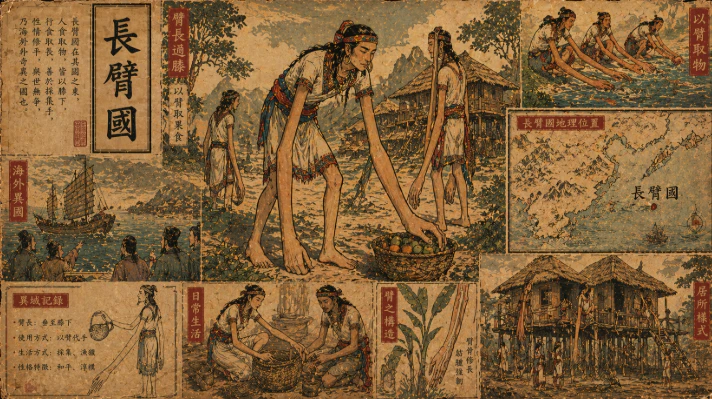
長臂國記載於《山海經》,其民手臂修長異常,行動與生活方式皆異於常人。這個傳說不僅展現古人對異族的想像,也反映人類對身體極限與多樣性的思考。
The Long-Armed People appear in ancient Chinese myth as a tribe with unusually extended limbs. Their story reflects early imagination about human diversity and the boundaries of physical form.
中文
在遙遠而人跡罕至的海域之外,有一片少有人知的土地,被稱為長臂國。此地常年風勢強勁,海浪拍擊岸邊岩石,發出低沉回響,天地之間帶著一種難以言喻的荒遠氣息。長臂國的居民外貌與常人無異,唯有雙臂異常修長,垂下時幾乎觸及膝下,甚至可延伸至地面。他們的手指靈活而有力,能輕易攀附岩壁,亦能從遠處取物,彷彿天生具備超越常人的能力。在這片土地上,長臂並非異常,而是生存的基礎。高聳的樹木與陡峭的山壁構成了他們的生活環境,普通人難以通行的地形,對他們而言卻如履平地。他們能懸於峭壁之間,單憑雙臂移動,猶如在空中行走;亦能從高處垂下身體,輕鬆摘取果實或捕捉獵物。孩童自幼便學習如何運用雙臂,這不只是技巧,更是一種與身體共存的本能。當風暴來臨時,他們會牢牢抓住岩石與樹幹,以強大的握力抵禦狂風,彷彿與大地緊密相連。外來者若偶然踏入此地,往往會對他們的動作感到震驚與不安,因為那種姿態既熟悉又陌生,像人卻又超越了人類的習慣。有人曾試圖與長臂國交流,卻發現他們的語言與行為方式與外界大相逕庭。他們不以速度為傲,也不追求力量的炫耀,而是以靈活與適應為生。他們的建築多依附於自然,房屋懸於半空,以繩索與木架連結,方便以雙臂移動。夜晚降臨時,他們會聚集於高處的平台,彼此交流,聲音在風中傳遞,與自然融為一體。關於長臂國的起源,流傳著不同說法。有傳說認為他們是遠古人類在特殊環境中逐漸演變而來,也有人說他們是天地造化的產物,是自然意志的延伸。無論真相如何,他們的存在挑戰了人類對「正常」的定義。在這片土地上,異常即是常態,限制被重新書寫。當夕陽落下,光影拉長,他們的身影在岩壁與樹影間延展,如同與天地相呼應的線條。他們並不覺得自己奇異,因為對他們而言,這正是最自然的形態。長臂國的傳說不僅描繪了一種奇特的民族,也提醒人們,世界遠比想像更為多樣,而所謂的界限,或許只是視角的不同。
English Version
Beyond the familiar edges of the known world, across windswept seas and rugged coastlines, there are stories of a distant land inhabited by people unlike any others—the Long-Armed People. At first glance, they appear human, sharing the same posture, the same faces, the same presence. Yet one detail sets them apart in a way that reshapes everything: their arms extend far beyond ordinary proportions, long enough to redefine how they move, live, and interact with their environment. In their homeland, the terrain is harsh and vertical. Cliffs rise sharply from the ground, forests grow tall and dense, and the landscape offers few easy paths. For most, such a place would be nearly impossible to navigate. But for the Long-Armed People, it is perfectly suited to their form. Their extended limbs allow them to reach, grasp, and climb with remarkable ease. Movement is no longer confined to walking; instead, they traverse their world through suspension, swinging, and controlled descent. A cliff face becomes a pathway, a towering tree becomes a network of routes. From a young age, children learn to rely on their arms not as tools, but as primary means of movement. Balance, grip, and coordination are second nature to them, forming a rhythm that outsiders would struggle to understand. Their homes reflect this adaptation. Structures are built above ground, connected by ropes, wooden beams, and natural formations. Living spaces are suspended, designed for access by reach rather than steps. Even daily tasks are shaped by their unique anatomy—gathering food, constructing shelters, and interacting with one another all revolve around the flexibility and strength of their arms. When storms sweep across the land, bringing fierce winds and heavy rain, they anchor themselves securely, holding onto the environment with a stability that seems almost effortless. To those who encounter them for the first time, their movements can feel unsettling, as if witnessing a familiar form behaving in unfamiliar ways. Attempts to imitate them inevitably fall short, as their abilities are not learned in isolation but embedded in their entire way of being. The origins of the Long-Armed People remain uncertain. Some believe they are descendants of early humans who adapted over generations to a demanding environment. Others suggest they were shaped by forces beyond natural explanation, an embodiment of nature’s creativity rather than its rules. Regardless of the truth, their existence challenges the idea that there is a single way to be human. What is considered unusual in one place becomes entirely natural in another. As the sun sets and shadows stretch across the cliffs, their silhouettes lengthen along with the land itself, blending into the contours of their world. They do not see themselves as different, because difference is only defined by comparison. In their own realm, they are simply what they have always been. Their story remains as a reflection of possibility—a reminder that the boundaries we accept may not be as fixed as we believe, and that human form, like human experience, can take on many shapes beyond expectation.