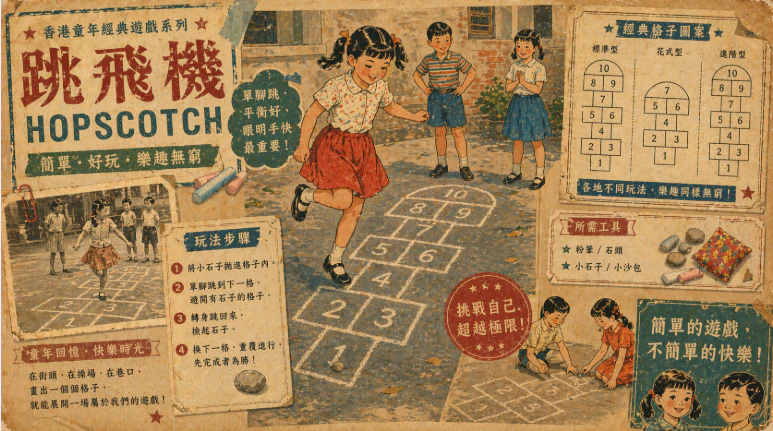
跳飛機是一種簡單卻充滿節奏的地面遊戲,孩子透過單腳跳躍與平衡,在畫好的格子之間來回穿梭,不只是遊戲,更是一種身體與節奏的練習
Hopscotch is a simple yet rhythmic ground game where children hop through drawn squares on one foot, combining balance, coordination, and playful movement into a timeless form of outdoor fun
中文
跳飛機,是一種歷史悠久且廣泛流傳的戶外遊戲,在香港以及世界各地的童年記憶中都佔有重要位置,它的玩法看似簡單,只需在地面畫出一組由單格與雙格組成的圖案,再配上一顆小石子或物件,便可以開始遊戲,玩家首先將石子投擲到指定格子中,然後以單腳跳入格子之間,避開石子所在位置,依序前進並返回,過程中需要保持平衡與節奏,一旦失去平衡或踩線便需重新開始,這種看似簡單的規則,實際上結合了精準投擲、身體控制與空間判斷,使遊戲充滿挑戰與趣味,在過去的年代,孩子會在街道、操場或空地上用粉筆或石頭畫出跳飛機的格子,不同地區甚至會發展出各自獨特的圖案與玩法,形成一種地方性的文化特色,跳飛機不僅是一種個人技巧的展現,也是一種社交活動,孩子會輪流遊玩,互相觀察與比較技巧,甚至在遊戲中建立默契與友誼,這種簡單而直接的互動,構成了童年中重要的人際經驗,與其他傳統遊戲一樣,跳飛機不需要昂貴的器材,只需一塊空地與一點創意,就能展開長時間的遊戲,這種低門檻與高自由度,使它能夠跨越時代與地域而持續存在,隨著城市發展與電子娛樂的普及,孩子戶外活動的時間逐漸減少,像跳飛機這樣的遊戲不再如以往常見,但它所代表的價值仍然存在,它不只是運動,更是一種關於身體感知與節奏的學習,孩子在跳躍中學會控制身體,在失誤中學會重新嘗試,在成功中建立自信,這些經驗雖然來自簡單的遊戲,卻對成長具有深遠影響,當我們重新回望跳飛機,會發現它不只是地上的幾個格子,而是一段關於童年、空間與自由的記憶,它提醒我們,遊戲的本質不在於複雜的設計,而在於身體與環境之間的互動,以及在過程中所產生的快樂與連結.
English Version
Hopscotch is a timeless outdoor game that has been played across generations and cultures, holding a special place in childhood memories around the world, its setup is simple, requiring only a series of squares drawn on the ground and a small object such as a stone or marker, yet within this simplicity lies a dynamic and engaging experience, the player begins by tossing the object into a designated square and then proceeds to hop through the pattern on one foot, carefully avoiding the square occupied by the object, maintaining balance while moving forward and returning along the same path, the rules are straightforward, but the execution demands precision, coordination, and rhythm, making each round both challenging and rewarding, in earlier times, children would draw hopscotch grids on streets, playgrounds, or open spaces using chalk or stones, and over time, different regions developed their own variations in layout and gameplay, giving the game a unique cultural flavor in each setting, beyond individual performance, hopscotch also serves as a social activity, with players taking turns, observing one another, and sharing moments of success and failure, building friendships and a sense of community through play, its accessibility is one of its greatest strengths, requiring minimal resources and allowing spontaneous participation, which helped it thrive across different environments and economic backgrounds, as modern lifestyles shifted toward digital entertainment and indoor activities, traditional games like hopscotch became less common in daily life, yet their significance has not diminished, the game offers more than physical movement, it teaches balance, timing, and resilience, encouraging children to adapt, retry, and improve with each attempt, these lessons, embedded in simple play, contribute to personal growth in subtle but meaningful ways, revisiting hopscotch today reveals it as more than a childhood pastime, it is a reflection of how play connects the body, space, and imagination, reminding us that meaningful experiences can arise from the simplest interactions between movement and environment.