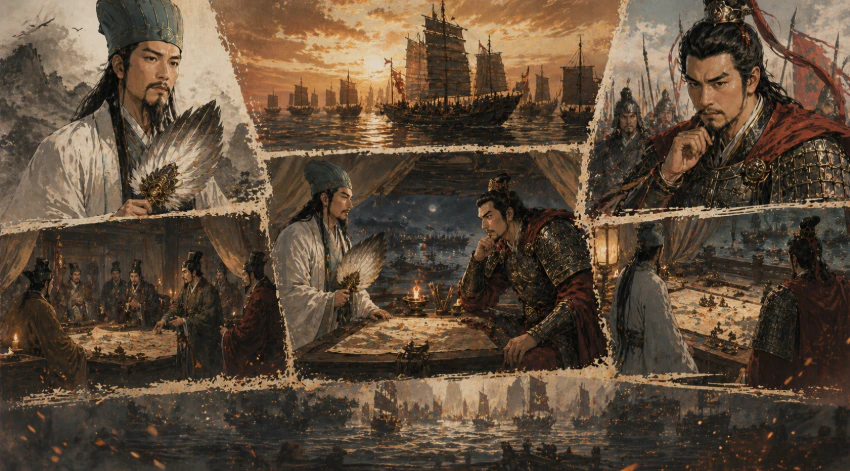
聯盟已成,卻未穩固。周瑜與諸葛亮之間,既是合作,也是較量。一場無形的心理戰,決定赤壁之前的真正主導權。
The alliance is formed—but far from secure. Between Zhou Yu and Zhuge Liang lies both cooperation and rivalry. Before Red Cliffs, the real battle is one of minds.
中文小說寫法
江東水軍列陣,旌旗蔽日。
表面上,聯劉抗曹之策已定,氣勢正盛;然而在這看似一致的背後,卻隱藏著另一層不為人言的緊張。
那不是敵我之爭,而是盟友之間的試探。
周瑜,江東大都督,年少成名,氣度非凡。他深知軍事之道,更明白權力之重。
而另一邊,則是初入江東的諸葛亮。
兩人未曾交鋒,卻早已彼此知名。
這樣的相遇,不可能只是合作。
初見之時,周瑜禮數周全,言辭溫和。
但在這層溫和之下,是審視。
他要確定,這位來自劉備陣營的軍師,究竟是助力,還是隱患。
諸葛亮亦不急於表現。
他觀察環境,觀察人心,更觀察周瑜。
這不是戰場,但每一句話,都可能成為勝負的關鍵。
周瑜首先試探。
他以曹操之勢為題,探問諸葛亮的看法。
諸葛亮從容應對,不僅不誇大敵情,反而指出曹軍之短:不習水戰,遠征疲憊。
這番話,既合理,又精準。
但周瑜並未完全信服。
他轉而以情試之。
傳言曹操欲得江東美女,甚至提及小喬之名,試圖激起周瑜情緒。
然而,這一次,主動出手的,卻是諸葛亮。
他將話題推向極端,描繪若江東不戰,將面臨的屈辱與失去。
語言不再溫和,而是直指人心。
周瑜沉默。
那不是被說服,而是被點燃。
他本就不願屈於人下,此刻更無退路。
「此戰,非戰不可。」
這句話,不只是對曹操,也是對自身的確認。
從這一刻起,聯盟不再只是策略,而成為共同意志。
然而,兩人之間的微妙關係,並未消失。
周瑜開始真正重視諸葛亮。
不是作為盟友,而是作為對手。
而諸葛亮亦清楚,真正的難題,不只在曹操,也在這位江東都督。
夜色降臨,江水靜流。
營帳之中,燈火微明。
兩位天才,各自沉思。
同一個戰場,不同的心思。
赤壁之戰尚未開始,
但真正的博弈,已悄然展開。
English Version
The alliance between Liu Bei and Sun Quan had been established—but it was not yet stable.
On the surface, everything aligned. Both sides agreed to resist Cao Cao. Both understood the stakes. Both prepared for war.
But beneath that agreement lay something more complicated.
Trust had not yet formed.
And in its place, something sharper emerged.
Zhou Yu stood at the center of Wu’s military command. Young, brilliant, and confident, he was not a man easily overshadowed. His authority was not just formal—it was earned.
Then came Zhuge Liang.
An outsider.
A strategist with a growing reputation, representing an ally that was, in many ways, weaker than Wu.
From Zhou Yu’s perspective, this created a paradox.
Why did this man speak with such certainty?
Why did he seem so composed in a situation that should have been uncertain?
Zhou Yu did not confront these questions directly.
Instead, he tested.
Their conversations began with strategy. Cao Cao’s strength, his weaknesses, the logistics of an upcoming confrontation. Zhuge Liang’s responses were measured, precise, and difficult to challenge.
So Zhou Yu changed his approach.
If logic could not expose weakness, perhaps emotion could.
He introduced the idea—whether as rumor or tactic—that Cao Cao’s ambitions extended beyond conquest. That he desired the beauty of Wu, even naming Xiao Qiao.
It was a calculated move.
But Zhuge Liang saw through it.
Rather than deflecting, he amplified.
He painted a future in which submission meant humiliation, not just for the state, but for its people, its leaders, its identity.
This was no longer about analysis.
It was about consequence.
Zhou Yu did not react immediately.
But the effect was clear.
His hesitation—if any remained—disappeared.
War was no longer one option among many.
It was the only one left.
From that moment, the alliance gained something it had previously lacked.
Conviction.
Yet something else formed alongside it.
Awareness.
Zhou Yu began to see Zhuge Liang not just as an ally, but as an equal. Perhaps even as a rival.
And Zhuge Liang, for his part, understood that the coming conflict would not be defined solely by external enemies.
Sometimes, the most delicate balance exists within cooperation itself.
As night fell over the river, both men prepared in their own ways.
The battlefield had not yet taken shape.
But the outcome was already being shaped—
Not by armies.
But by minds.