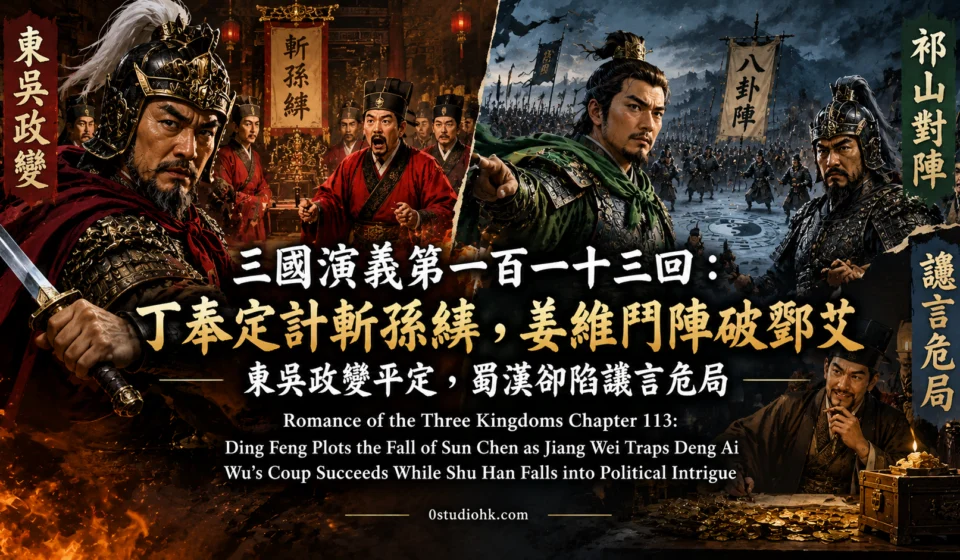
三國演義第一百一十三回:丁奉定計斬孫綝,姜維鬥陣破鄧艾|東吳政變平定,蜀漢卻陷讒言危局 | Romance of the Three Kingdoms Chapter 113: Ding Feng Plots the Fall of Sun Chen as Jiang Wei Traps Deng Ai|Wu’s Coup Succeeds While Shu Han Falls into Political Intrigue
東吳權臣孫綝專權,丁奉與孫休設計將其誅除,吳國重新收回朝政。與此同時,姜維再出祁山,以八卦陣困住鄧艾,眼看便能取勝,卻因黃皓受賄、散布謠言而被劉禪召回。前線的勝機,最終敗在後方的腐朽之中。
While Ding Feng and Sun Xiu devise a successful plan to eliminate the powerful regent Sun Chen in Wu, Jiang Wei launches another campaign against Wei. His Eight Trigrams Formation traps Deng Ai and nearly secures victory, but corruption in Chengdu changes everything. After Huang Hao accepts a bribe and spreads false accusations against Jiang Wei, Liu Shan recalls his commander, allowing Deng Ai to escape.
中文版本
東吳與蜀漢雖然都面對來自魏國的巨大壓力,但兩國內部同樣暗藏著不同的危機。此時的東吳,權臣孫綝長期掌握朝政,行事專橫,甚至連吳帝孫亮也感到難以忍受。孫亮不願繼續受制於權臣,暗中策劃誅殺孫綝,希望重新奪回皇帝應有的權力。然而計畫最終失敗,孫亮不但未能除掉孫綝,反而被迫退位。孫休即位後,東吳的局勢仍然沒有立即恢復平靜。孫綝依舊掌握大權,朝廷之中人人自危,孫休也明白,如果不能除掉這名權臣,自己便始終只是一個受制於人的皇帝。就在這個關鍵時刻,老將丁奉成為孫休最重要的支持者。丁奉久經戰陣,知道對付孫綝不能只靠正面衝突,更不能讓對方提前察覺。於是兩人暗中商議,利用臘祭之時設宴,表面上是宮廷宴會,實際上卻早已安排伏兵。孫綝沒有想到自己已經落入圈套,當丁奉等人突然發動行動時,孫綝再也無法調動自己的力量。最終,這名長期控制東吳朝政的權臣被成功斬殺。孫休終於重新掌握朝廷,東吳的這場政治風暴暫時平息。可是就在東吳完成權力重新分配的同時,蜀漢前線也迎來了新的戰機。姜維一直沒有放棄北伐,當他得知魏國局勢出現變化後,再次率軍出祁山,希望趁機突破魏軍防線。這一次,姜維的目標不只是普通的軍事勝利,而是希望在戰場上真正擊敗鄧艾,打開蜀軍北上的道路。鄧艾同樣不是容易對付的敵人。他多年研究蜀軍作戰方式,熟悉山川地勢,也逐漸成為魏國重要將領。兩軍在祁山一帶相遇後,姜維沒有急於正面決戰,而是開始布置自己精心設計的陣法。隨著蜀軍旗幟移動,士兵按照預定位置迅速排列,一座氣勢森嚴的八卦陣逐漸形成。鄧艾很快看出了姜維的意圖。他知道這種陣勢一旦被敵軍完全控制,貿然進入便可能陷入重重包圍。因此,他仔細觀察陣形,希望找出其中的破綻。然而姜維早已料到鄧艾會研究陣法,八卦陣並不是單純依靠兵力,而是利用變化、地形與軍隊調動形成層層包圍。鄧艾雖然看破其中部分奧妙,卻始終找不到安全的突破方向。魏軍一旦深入,便被蜀軍從四面牽制。姜維抓住機會,命令各部迅速合圍。鄧艾的軍隊一度陷入危險之中,魏軍陣形開始混亂。這一刻,姜維似乎終於看見多年北伐以來難得的勝機。如果能夠在此戰消滅鄧艾主力,蜀漢北伐或許可以重新打開局面。然而戰場上的勝負,有時並不只由前線將領決定。鄧艾陷入重圍之後,司馬望及時率軍救援,魏軍趁機打開缺口,鄧艾終於得以脫離險境。姜維雖然成功以八卦陣壓制鄧艾,卻沒有取得最後的決定性勝利。鄧艾逃出生天,也意味著這場較量遠遠沒有結束。姜維原本準備乘勝追擊,卻沒有想到另一場危機正在成都悄悄形成。鄧艾知道,單靠正面戰場未必能夠迅速擊敗姜維,於是開始思考如何利用蜀漢內部的弱點。這時,黨均奉鄧艾之命,攜帶重金前往成都,試圖收買黃皓。黃皓長期干預朝政,在後主劉禪身邊具有相當影響力。黨均利用金錢與讒言,開始散布姜維有意謀反的消息。對前線將士而言,這種消息極其危險,因為真正的戰場在千里之外,而朝廷卻未必能夠看清前線的實況。黃皓收受賄賂後,進一步在劉禪面前說姜維的壞話,使原本正在前線作戰的姜維突然陷入政治危機。劉禪本就難以完全掌握前線軍情,在讒言影響之下,開始懷疑姜維的忠誠。最終,一道召回姜維的詔令送往前線。姜維收到詔令時,正是戰局最關鍵的時刻。鄧艾剛剛從八卦陣中脫險,魏軍仍然處於需要重新整頓的狀態,而蜀軍仍有可能乘勢追擊。如果姜維繼續進攻,也許可以取得更大的戰果;但皇帝的詔令卻不能不遵從。姜維心中充滿無奈。他知道,自己多年來忠心北伐,如今竟然不是敗給魏軍,而是敗給後方的猜疑。最終,他只能放棄眼前的戰機,率軍班師。這一次北伐本來可能成為姜維擊敗鄧艾的重要一戰,卻因成都內部的政治干預而功敗垂成。更令人擔憂的是,黃皓受賄並干預軍政的情況,揭示了蜀漢真正的危機已經不只在魏國。前線有強敵,後方卻有腐朽的政治環境;姜維即使能夠在戰場上取得優勢,也可能因朝廷一句疑心而失去成果。姜維回望祁山,心中明白,鄧艾雖然逃脫,兩人的較量卻才剛剛開始。鄧艾在八卦陣中看到了姜維的軍事才能,也更加清楚蜀漢前線的弱點;姜維則逐漸意識到,真正難以對付的敵人,不只是魏軍將領,還有來自自己國家的內部問題。東吳剛剛經歷政變,孫休與丁奉成功除掉孫綝;魏國則在司馬氏勢力下逐步整合;蜀漢卻在姜維與黃皓之間形成越來越深的矛盾。三國局勢再次發生變化,而蜀漢的命運,也因這場看似普通的讒言而埋下更深的危機。姜維帶著未竟的戰果返回成都,北伐大業仍然沒有停止,但他心中已經明白,若後方不能穩定,再強大的軍隊也難以長久支撐。祁山的戰火逐漸遠去,然而鄧艾與姜維之間的宿敵之局,已經正式展開,而蜀漢內部的裂痕,也正在一步一步擴大。
English Version
The Three Kingdoms were entering another period of political transformation, and the dangers facing Shu Han were no longer limited to the battlefield. In Eastern Wu, Sun Chen had accumulated enormous power and ruled with increasing arrogance. Emperor Sun Liang had grown deeply dissatisfied with being controlled by a powerful minister and secretly planned to eliminate Sun Chen. The attempt failed, however, and Sun Liang was removed from the throne. Sun Xiu succeeded him, but the political problem remained. Sun Chen still controlled the government, and the new emperor understood that simply taking the throne would not give him real authority. If Sun Chen remained in power, Sun Xiu would continue to be little more than a figurehead. At this critical moment, the veteran general Ding Feng became one of Sun Xiu’s most important allies. Ding Feng understood that Sun Chen could not easily be defeated through an open confrontation. The powerful minister had influence, soldiers, and supporters within the government. A direct challenge might fail before it even began. Ding Feng therefore proposed a carefully concealed plan. During the Laji ceremonial gathering, a banquet would be arranged that appeared to be a normal court occasion. Behind the scenes, however, soldiers would be positioned to strike when Sun Chen was least prepared. Sun Chen attended without realizing that the political balance had already shifted against him. When the hidden forces moved, he was unable to respond effectively. The powerful regent who had dominated Wu’s government was finally killed, and Sun Xiu was able to reclaim political authority. The crisis in Wu temporarily came to an end, but another opportunity was emerging elsewhere. In Shu Han, Jiang Wei had never abandoned the Northern Expeditions. When reports indicated that Wei was distracted by political and military developments, he once again marched toward Mount Qi. Jiang Wei believed that the opportunity could be used to put pressure on Wei’s western defenses and, if possible, defeat Deng Ai. This campaign was more than another routine border conflict. Jiang Wei wanted to prove that Shu could still achieve a major victory despite its weakening resources. Deng Ai, however, had become an increasingly formidable opponent. He had studied the Shu army carefully, understood the mountainous terrain, and developed a reputation for recognizing the intentions of his enemies. When the two forces confronted one another near Mount Qi, Jiang Wei did not immediately launch a conventional attack. Instead, he prepared a carefully designed Eight Trigrams Formation. Shu soldiers moved into their assigned positions, and the battlefield gradually transformed into an intricate pattern of shifting formations. Deng Ai quickly recognized that the formation was not merely a display of military discipline. He understood that entering it without sufficient caution could allow the Shu army to surround his forces from several directions. He therefore studied the arrangement carefully, searching for weaknesses. But Jiang Wei had anticipated that reaction. The Eight Trigrams Formation depended not simply on the number of soldiers, but on movement, coordination, changing positions, and the use of terrain. Every apparent opening could become another trap. Deng Ai understood parts of the design, yet he could not find a reliable path through it. As Wei troops moved deeper into the formation, Shu forces began closing around them. Jiang Wei seized the opportunity and ordered his commanders to tighten the encirclement. For a moment, Deng Ai’s army appeared to be in serious danger. Wei formations began to lose cohesion, and Shu soldiers pressed from multiple directions. Jiang Wei finally seemed close to achieving the kind of battlefield victory he had been seeking for years. If Deng Ai’s main force could be destroyed, the balance along the frontier might shift and Shu could regain the initiative. Yet a battlefield victory is rarely determined by one commander alone. As Deng Ai became trapped, Sima Wang arrived with reinforcements. His troops attacked the Shu positions and created an opening through which Deng Ai could escape. The carefully constructed formation had succeeded in trapping Deng Ai, but Jiang Wei was unable to destroy the enemy commander or turn the advantage into a decisive strategic victory. Deng Ai survived, and the rivalry between the two commanders became even more significant. Jiang Wei was prepared to pursue the retreating Wei forces, but a new danger was already developing far away in Chengdu. Deng Ai understood that defeating Jiang Wei directly would not necessarily be easy. If the Shu commander could be drawn into another battle, the same military problem would return. But Shu Han had a weakness that could not be solved on the battlefield: political division within the court. Deng Ai therefore sought another method. He sent Dang Jun to Chengdu carrying a large amount of money. The target was Huang Hao, a court eunuch who had gained considerable influence around Liu Shan and increasingly interfered in government affairs. Dang Jun used bribery and rumor to create suspicion around Jiang Wei. The accusation was especially dangerous because Jiang Wei was far from the capital. The court could not directly observe his actions, and reports from the frontier took time to arrive. A carefully planted rumor could therefore become more powerful than the truth. After accepting the bribe, Huang Hao began speaking against Jiang Wei and suggesting that the general might be planning a rebellion. Liu Shan, already dependent upon court officials for information about the distant battlefield, became suspicious. The accusation reached him at a moment when Jiang Wei was enjoying a rare military opportunity. Deng Ai had only just escaped the Eight Trigrams Formation, and the Wei forces still needed time to reorganize. Jiang Wei could potentially have pressed the attack and achieved a greater victory. Instead, an imperial order arrived commanding him to return. Jiang Wei faced an impossible choice. He could not ignore an order from the emperor, even though he believed the military situation still offered an opportunity. He understood that the danger did not come from Wei soldiers alone. He was now being undermined by suspicion within his own government. Reluctantly, Jiang Wei abandoned the battlefield and ordered his army to withdraw. The campaign that might have become one of his greatest victories ended without a decisive result. Deng Ai survived, while Jiang Wei returned to Chengdu frustrated and disappointed. More importantly, the episode revealed a deeper problem within Shu Han. The kingdom was not only fighting a powerful external enemy. Its own political system was beginning to interfere directly with military command. Huang Hao’s acceptance of money and his ability to influence Liu Shan demonstrated how vulnerable the Shu government had become. Jiang Wei could outmaneuver an enemy commander on the battlefield, but he could not easily defend himself against accusations whispered inside the palace. The contrast was striking. In Wu, Ding Feng and Sun Xiu had successfully removed Sun Chen and restored imperial authority. In Wei, the Sima clan continued consolidating political power and strengthening its military position. In Shu, however, the commander responsible for defending the kingdom was being recalled because of rumors planted by an enemy and amplified by a corrupt court official. Jiang Wei looked back toward Mount Qi as his army withdrew. He knew that Deng Ai had escaped, but the confrontation between them was far from over. Deng Ai had witnessed Jiang Wei’s ability to construct and control a sophisticated formation. More importantly, he had discovered that Shu Han possessed a vulnerability that could be exploited beyond the battlefield. Jiang Wei, meanwhile, was beginning to understand that his most dangerous opponents were not only Wei commanders. The weakness of his own government could be equally destructive. The battle at Mount Qi therefore ended without the decisive victory Jiang Wei had hoped for, but it marked the beginning of a much larger struggle. Deng Ai and Jiang Wei were becoming long-term rivals, each studying the other and searching for the next opportunity. At the same time, Huang Hao’s growing influence revealed a political weakness that would become increasingly important to Shu Han’s future. Jiang Wei returned to Chengdu with his military objective unfinished. The Northern Expeditions had not ended, but their future had become even more uncertain. The kingdom could still fight bravely on the frontier, yet victory would remain difficult if the government behind the army continued to suffer from corruption, suspicion, and internal interference. The fighting around Mount Qi gradually faded, but the consequences remained. Deng Ai had escaped. Jiang Wei had lost a valuable opportunity. Huang Hao had demonstrated the dangerous power of political influence. And the final struggle over the fate of Shu Han was quietly moving closer.