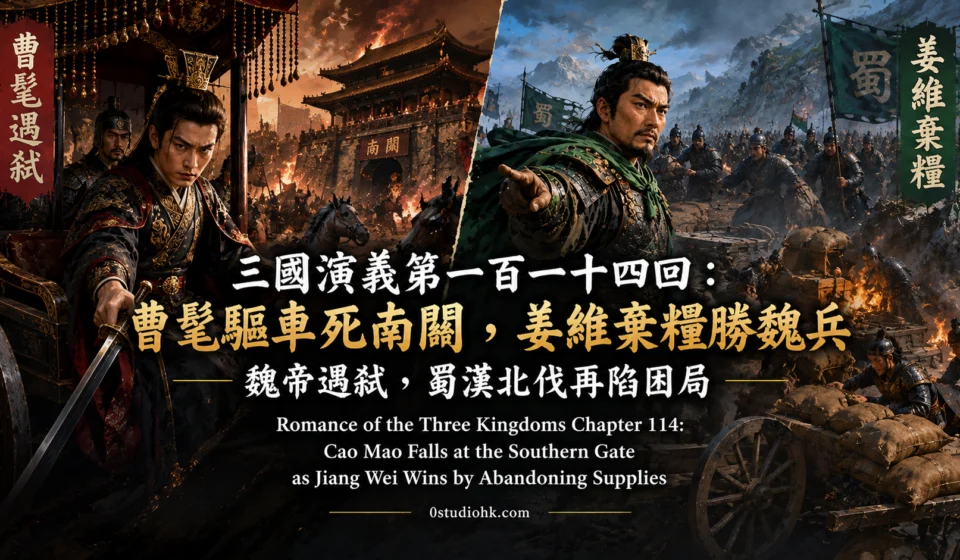
三國演義第一百一十四回:曹髦驅車死南闕,姜維棄糧勝魏兵|魏帝遇弒,蜀漢北伐再陷困局 | Romance of the Three Kingdoms Chapter 114: Cao Mao Falls at the Southern Gate as Jiang Wei Wins by Abandoning Supplies

魏帝曹髦不甘受司馬昭控制,親率宮人出宮討伐權臣,最終死於南闕,曹魏皇權徹底崩潰。與此同時,姜維趁魏國政局震盪再次北伐,以棄糧誘敵之計在洮陽取勝,卻又在侯和敗於鄧艾。連番勝負之間,姜維開始思考自己的退路。
Emperor Cao Mao refuses to remain a powerless ruler and makes a desperate attempt to confront Sima Zhao, but the confrontation ends with his death at the Southern Gate. Meanwhile, Jiang Wei launches another Northern Expedition, defeats Yang Xin at Taoyang through a clever feigned retreat involving abandoned supplies, but is later defeated by Deng Ai at Houhe. As political danger and military setbacks mount, Jiang Wei begins to consider how he might protect himself.
中文版本
魏國的局勢,在這個時候已經走到一個極其危險的關口。司馬氏掌握朝政多年,魏帝曹髦雖然名義上是天下之主,實際上卻逐漸感受到自己手中的皇權正在被一步一步架空。曹髦年輕而不甘受制於人,他不願意成為一個只能坐在宮中聽命的傀儡皇帝,更不願眼睜睜看著司馬昭將曹魏江山掌握在自己手中。朝廷之中,司馬昭的勢力越來越強,曹髦心中的不滿也越積越深。終於有一天,曹髦決定不再等待。他召集身邊數百名宮人與侍從,帶著兵器出宮,準備親自前往誅殺司馬昭。這是一場幾乎沒有勝算的冒險,但曹髦已經沒有太多選擇。他知道,如果繼續沉默,皇帝這個名號最終只會剩下一個空殼。宮門打開,曹髦驅車而出,身邊的人雖然人數不多,卻都帶著一股決死的氣勢。消息很快傳到司馬昭耳中。司馬昭知道事情非同小可,立即命人阻止曹髦。雙方在宮門附近形成緊張局面,曹髦仍然希望以皇帝的身份命令司馬氏勢力退讓,可是到了這個時候,魏國的權力早已不是皇帝一句話便能重新掌握。曹髦的隊伍很快被攔截,在混亂之中,司馬昭部將成濟持槍上前,在太子舍人充 calculate 指揮之下,向曹髦發起攻擊。曹髦最終倒在南闕之前,一代魏帝就這樣死在自己臣子的兵刃之下。這一幕對曹魏皇室而言,是極其沉重的打擊。皇帝不是死於外敵,而是死於掌握朝政的權臣勢力之手,代表曹魏皇權已經幾乎失去實際力量。司馬昭隨後立曹奐為帝,試圖重新建立表面的政治秩序。為了堵住天下悠悠之口,成濟最終亦被處死,但所有人都明白,真正掌握魏國權力的人依然是司馬昭。曹髦之死,也成為司馬氏走向最後篡位的重要伏筆。就在魏國發生如此巨大的政治震盪之時,姜維得知魏帝被弒,立即看到了一個北伐的機會。對蜀漢而言,魏國內部發生重大變故,正是可以趁機施加軍事壓力的時刻。姜維於是再次整軍北上,希望利用魏國政局不穩,在邊境取得更大的戰果。他知道蜀漢的國力已經逐漸衰弱,因此每一次北伐都必須更加講究策略,不能只靠兵力硬拼。這一次,姜維率軍來到洮陽一帶,與魏將楊欣交鋒。姜維觀察戰場形勢後,想到了一個大膽的計策。他故意留下大量糧草與物資,製造蜀軍因形勢不利而倉皇撤退的假象。楊欣看到蜀軍留下糧食,以為姜維已經敗退,便率兵追擊,希望趁機取得更大的戰果。然而這正是姜維等待的機會。當魏軍進入預定位置後,姜維突然回軍反擊。原本以為自己正在追擊敗軍的魏軍,突然發現形勢完全逆轉。蜀軍從不同方向殺出,令楊欣措手不及。姜維利用「棄糧誘敵」之計成功擊敗魏軍,取得一場漂亮的勝利。這一戰證明姜維依然擁有出色的戰場判斷力,也說明他在多年北伐之後,已經形成自己獨特的用兵方式。可是姜維很快便發現,一場勝利並不能改變整個戰局。魏國雖然內部出現政治危機,但軍隊並沒有因此完全失去戰鬥能力。鄧艾仍然在前線保持高度警覺。他知道姜維善於利用假象與誘敵之計,因此沒有輕易被表面的勝負迷惑。姜維在洮陽取得勝利後,繼續尋找突破魏軍防線的機會,但在侯和一帶,雙方再次交鋒。這一次,鄧艾早已有所準備。姜維原本希望延續先前的優勢,卻遇上更加謹慎的魏軍。鄧艾利用地形與軍隊部署,逐步限制蜀軍行動,最終令姜維遭受挫敗。蜀軍只得重新整理部隊,避免更大的損失。姜維心中十分清楚,自己又一次陷入熟悉的困境:戰場上可以取勝,但無法取得足以改變國運的決定性成果。更令他感到疲憊的是,前線的努力往往還要受到後方政治環境的影響。黃皓在成都的勢力日益增加,朝廷內部的猜疑也越來越嚴重。姜維知道,自己長年率軍在外,遠離成都,很難控制朝廷之中的流言與權力鬥爭。這一次,他更清楚地感受到自身處境的危險。魏國可以利用軍事力量對付他,蜀漢內部也可能因政治鬥爭而懷疑他。無論北伐成功或失敗,他都可能成為別人眼中的威脅。夜深之時,姜維獨自看著軍營中的燈火,回想自己多年來所走過的道路。諸葛亮臨終時將北伐遺志交給他,他一直相信自己只要繼續努力,終有一天可以完成復興漢室的理想。然而如今,他不得不面對另一個現實:蜀漢的國力越來越弱,而自己在朝中的處境也越來越危險。曹髦之死讓他看見魏國皇權已經名存實亡,卻也讓他更加明白司馬氏的力量有多麼可怕。鄧艾在戰場上的崛起,同樣令他不能掉以輕心。洮陽的一勝證明他仍有能力擊敗魏軍,侯和的一敗卻提醒他,魏國已經擁有足以與自己長期周旋的名將。姜維開始思考,自己究竟還能走多遠。北伐不能完全停止,因為停止便等於將主動權交給魏國;可是繼續無休止地出兵,也可能令蜀漢國力更快耗盡。更重要的是,他已經不能只思考如何打敗敵人,也必須思考如何保全自己。這個念頭一旦出現,便成為他心中新的陰影。魏國的皇帝已經死在臣子的兵刃之下,司馬昭距離真正取代曹魏只剩最後一步;蜀漢則仍在姜維的北伐與黃皓的內政鬥爭之間苦苦支撐。天下看似仍然維持三國鼎立,實際上舊有的秩序正在迅速崩解。姜維收拾兵馬,準備返回蜀地。他知道這一次又沒有完成自己的目標,但他也明白,真正的危機已經越來越近。曹魏皇權崩潰、司馬氏權勢日盛、鄧艾逐漸成為強敵,而蜀漢後方又充滿不安。北伐的道路仍然在前方,可是對姜維而言,下一步已經不只是如何進攻魏國,而是如何在即將到來的亂局之中繼續守住自己的信念與性命。
English Version
Wei had reached a dangerous turning point. For years, the Sima clan had steadily increased its control over the imperial government, while Emperor Cao Mao found himself with less and less real authority. Although Cao Mao was formally the ruler of Wei, he could see that important decisions were increasingly controlled by Sima Zhao and his supporters. The young emperor refused to accept this situation quietly. He did not want to become a powerless figurehead who could do nothing while another family controlled the state. His frustration gradually became determination, and eventually he decided that waiting was no longer possible. Cao Mao gathered several hundred palace attendants and guards, armed them, and personally left the palace in an attempt to confront Sima Zhao. It was an extraordinarily dangerous decision, but Cao Mao believed that remaining silent would mean accepting the complete destruction of imperial authority. His small force moved through the palace grounds toward the southern gate. The news quickly reached Sima Zhao, who understood that the emperor’s action could not be ignored. His supporters moved to block Cao Mao’s advance. The confrontation soon became tense, with the emperor attempting to use his position and authority to force the Sima faction to stand down. But by this stage, Wei’s political reality had changed. Imperial commands alone could no longer restore the authority of the Cao family. During the confrontation, Sima Zhao’s commander Cheng Ji advanced with a spear. Under the direction of the palace official described in the campaign as being associated with the Crown Prince’s staff, Cheng Ji attacked Cao Mao. The emperor was struck down at the Southern Gate, dying not at the hands of a foreign enemy, but during a confrontation with forces belonging to his own government. His death represented a devastating blow to the Wei imperial house. The emperor’s position had effectively become powerless, while the Sima clan possessed the military strength needed to determine political outcomes. Sima Zhao subsequently placed Cao Huan upon the throne, attempting to restore the appearance of political stability. Cheng Ji was later executed in an effort to silence public outrage and distance the Sima leadership from the killing. Yet everyone understood the deeper reality. Sima Zhao remained the dominant power within Wei. Cao Mao’s death therefore became one of the clearest signs that the Cao family’s control of the empire was nearing its end. While Wei was struggling with this political earthquake, Jiang Wei saw an opportunity. News of the emperor’s death suggested that Wei was vulnerable, and Jiang Wei believed Shu Han should take advantage of the disruption. He once again gathered his troops and marched north. He understood, however, that Shu’s resources were becoming increasingly limited. A campaign could no longer depend simply on superior courage or numbers. Strategy had become essential. Jiang Wei therefore sought opportunities to defeat Wei through deception and maneuver rather than a costly frontal assault. At Taoyang, he confronted the Wei commander Yang Xin. After studying the situation, Jiang Wei devised a risky plan. He deliberately abandoned supplies and food, creating the appearance that the Shu army had been forced into a hurried retreat. Yang Xin saw the abandoned provisions and believed that Jiang Wei’s army had been defeated. Confident that the Shu forces were fleeing, he ordered his soldiers to pursue them. But the abandoned supplies were part of Jiang Wei’s trap. Once the Wei troops entered the position Jiang Wei had anticipated, the Shu army suddenly turned and attacked. The force that had believed it was chasing a defeated enemy now found itself surrounded by a counterattack. Jiang Wei’s soldiers struck from several directions, disrupting the Wei formation and forcing Yang Xin’s troops into retreat. The strategy of abandoning supplies to lure the enemy into pursuit succeeded, giving Jiang Wei an important battlefield victory. The battle demonstrated that Jiang Wei remained a highly capable commander. After years of warfare, he had developed a distinct style based on deception, mobility, and careful observation of the enemy. Yet the victory at Taoyang could not change the wider balance of power. Wei might be suffering from political conflict at the highest level, but its military commanders remained capable and alert. Deng Ai in particular had become increasingly difficult to deceive. He understood Jiang Wei’s methods and knew that an apparent victory might conceal a larger trap. After Taoyang, Jiang Wei continued looking for another opportunity to penetrate the Wei defenses. The armies eventually clashed again around Houhe. This time, however, Deng Ai was prepared. Jiang Wei hoped to continue the momentum of his earlier success, but Wei forces responded more cautiously. Deng Ai used terrain, troop positioning, and careful timing to restrict the movement of the Shu army. The situation gradually turned against Jiang Wei, and Shu suffered another setback. Jiang Wei was forced to reorganize his troops and withdraw before the losses became even greater. Once again, he faced the same painful reality. He could win individual battles, but he could not easily transform those victories into a strategic breakthrough capable of changing the fate of Shu Han. Even more frustrating was the fact that his military efforts were increasingly affected by politics behind the front. Huang Hao’s influence in Chengdu was growing, and suspicion within the Shu court was becoming more dangerous. Jiang Wei spent much of his time far from the capital, and that distance made it difficult for him to control rumors or political struggles. He began to understand that his position was becoming vulnerable. Wei could attack him with armies, but political opponents inside Shu could also weaken him through suspicion and intrigue. Whether his campaigns succeeded or failed, he could become a target for those who feared his influence. Late at night, Jiang Wei sat alone among the campfires and thought about the road he had travelled. Zhuge Liang had entrusted him with the unfinished Northern Expedition, and Jiang Wei had spent years believing that persistence might eventually restore the Han dynasty. But the political reality was becoming harder to ignore. Shu Han was losing strength, while his own position within the government was becoming increasingly uncertain. Cao Mao’s death had shown Jiang Wei how completely the Wei imperial authority had been undermined. It also demonstrated the extraordinary power accumulated by the Sima clan. At the same time, Deng Ai’s growing ability on the battlefield meant that Jiang Wei now faced an opponent capable of matching his own experience and tactical skill. The victory at Taoyang proved that Jiang Wei could still defeat Wei commanders. The defeat at Houhe reminded him that Wei could also adapt and counterattack. Jiang Wei began asking himself how much longer he could continue along the same path. The Northern Expeditions could not simply stop, because abandoning the initiative would allow Wei to concentrate its strength against Shu. Yet endless campaigns would consume the resources that Shu needed to survive. More importantly, Jiang Wei could no longer think only about defeating his enemies. He also had to think about protecting himself from the political dangers within his own kingdom. Once that thought entered his mind, it became impossible to ignore. The emperor of Wei had been killed by forces belonging to his own government, Sima Zhao was now closer than ever to replacing the Cao family, and Shu Han continued struggling between Jiang Wei’s military campaigns and the growing influence of Huang Hao. The Three Kingdoms still appeared to exist, but the political order that had defined the era was rapidly breaking apart. Jiang Wei gathered his remaining forces and prepared to return. He had once again failed to achieve his larger objective, but he understood that the real danger was becoming much greater. Wei’s imperial authority had collapsed, the Sima clan was approaching complete control, Deng Ai was emerging as a formidable rival, and Shu Han’s own political foundations were becoming increasingly unstable. The road of the Northern Expedition remained ahead of him. But for Jiang Wei, the next challenge was no longer simply how to defeat Wei. It was how to preserve his loyalty, his purpose, and perhaps even his own life as the coming storm gathered over the Three Kingdoms.