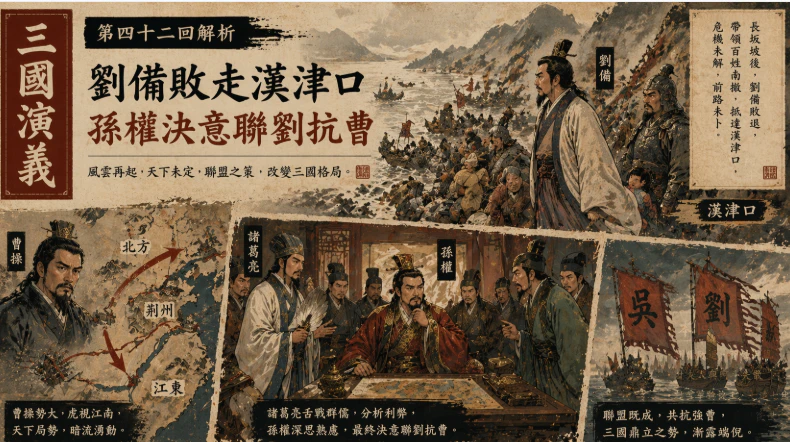
長坂坡後,局勢急轉。劉備敗而不亡,曹操乘勝追擊,而江東的選擇,將決定天下走向。聯盟,從來不是信任,而是必要。
After Changban, everything shifts. Liu Bei survives but falters, Cao Cao advances, and in Jiangdong a decision must be made. Alliances are not built on trust—but on necessity.
中文
長坂坡的煙塵尚未散去,命運已推動眾人走向下一個交會點。
劉備帶著殘軍與百姓南行,終於抵達漢津口。江水滔滔,彷彿一道天然屏障,將追兵暫時隔開,也將未來懸置於未知之中。
敗,不可怕。
可怕的是,無路可走。
此時的劉備,正站在這樣的邊緣。
北有曹操大軍壓境,西未及益州,東則是尚未確定態度的江東。
唯一的生機,在於「選擇」。
另一邊,江東之主孫權亦在權衡。
曹操勢大,號稱百萬之眾,聲勢如日中天。若順勢歸附,可保一時安穩;若選擇對抗,則是一場難以預測的豪賭。
朝堂之上,意見分歧。
有人主降,認為曹操挾天子之名,不可違抗;有人主戰,認為江東基業,不可輕棄。
爭論之中,一個名字逐漸被提起——
劉備。
他雖敗於長坂,卻未失人心;雖勢弱,卻仍具潛力。
若與之聯手,或可形成抗衡之勢。
就在此時,諸葛亮奉命前往江東。
這不是一次普通的出使,而是一場以言語為兵器的戰役。
諸葛亮踏入江東,面對的不只是孫權,還有整個權力結構。
群臣環伺,言辭如鋒。
有人質疑劉備之敗,有人輕視其力,有人直言不可與曹操為敵。
諸葛亮不急。
他並未急於辯解,而是逐步拆解對方的恐懼。
「曹操之強,在於聲勢;其弱,在於遠征。」
「江東之利,在於地勢;其危,在於猶豫。」
他將局勢重新排列,使「恐懼」轉為「機會」。
他指出,若江東投降,終將失去自主;若選擇聯劉抗曹,則仍有一線主導未來的可能。
這番話,不只是說服,更是一種喚醒。
孫權沉默良久。
他不是聽不懂,而是在衡量代價。
戰,意味著風險;降,意味著終局。
最終,他做出了選擇。
「不可降。」
這三字,簡短,卻沉重。
歷史,在此刻再次轉動。
聯盟,就此形成。
劉備在漢津口得知消息,神情未變,卻長長吐出一口氣。
這不是勝利,但卻是活下去的機會。
曹操或許仍強,但天下已不再單線前進。
三分之勢,開始真正成形。
江水依舊東流,戰火尚未燃起。
但所有人都知道——
下一場風暴,將比長坂坡更加猛烈。
English Version
The aftermath of Changban did not bring clarity—it brought urgency.
Liu Bei had survived, but survival alone was not enough. His forces were scattered, his position weakened, and his future uncertain. Reaching Hanjin Crossing offered temporary safety, but no solution.
Behind him, Cao Cao advanced with unstoppable momentum.
Ahead of him, only one possibility remained.
The east.
Jiangdong.
Sun Quan stood at the center of a decision that would shape the course of the era.
He commanded a strong and stable region, protected by geography and built through careful leadership. But now, that stability was under threat. Cao Cao’s expansion was not just military—it was systemic. If left unchecked, it would consume everything in its path.
The question was simple.
Submit—or resist.
The answers, however, were anything but.
Within Sun Quan’s court, division ran deep. Some argued for surrender, pointing to Cao Cao’s overwhelming strength and imperial legitimacy. Others pushed for resistance, insisting that Jiangdong’s independence was worth defending at any cost.
Both sides were right.
And that was the problem.
Into this tension stepped Zhuge Liang.
He did not arrive as a conqueror, nor as a supplicant. He came as something far more dangerous—a thinker.
His task was not to demand alliance, but to redefine the situation entirely.
He engaged with the court directly, confronting doubt with logic, and fear with clarity. He did not deny Cao Cao’s strength. Instead, he reframed it.
A powerful army, he argued, is not invincible—especially when operating far from its base.
A strong position, like Jiangdong’s, is not secure—especially when paralyzed by indecision.
What he offered was not reassurance, but perspective.
Surrender, he suggested, would not guarantee survival—only submission. Resistance, though risky, preserved agency.
And in that distinction, everything changed.
Sun Quan listened.
He weighed not just the immediate consequences, but the long-term implications. Power, once surrendered, is rarely regained.
The decision came quietly.
No grand declaration. No dramatic gesture.
Just resolve.
He would not submit.
With that, the foundation of an alliance was laid.
It was not built on trust, nor on shared ideals. It was built on necessity—a mutual recognition that survival required cooperation.
Back at Hanjin, Liu Bei received the news.
Relief was not visible, but it was there.
For the first time since Changban, the future opened slightly. Not wide enough to see clearly—but enough to move forward.
Cao Cao’s advance would not stop.
But now, it would meet resistance.
And from that resistance, a new balance would emerge.
Not immediately.
But inevitably.