
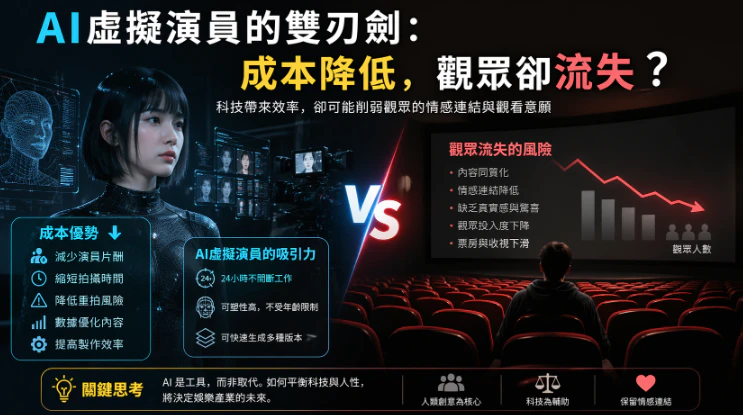

當AI虛擬演員成為製作常態,片商或許能大幅降低成本,但觀眾是否仍然願意買單?當效率取代人味,娛樂產業可能正面臨一個更隱性的危機。
As AI virtual actors reduce production costs, a critical question arises: will audiences still care? When efficiency replaces human presence, the industry may face a subtle but serious decline in engagement.
中文
AI虛擬演員的普及,對影視產業而言看似是一場理想的效率革命,片商可以減少演員片酬、縮短拍攝時間、降低重拍風險,甚至透過數據分析直接生成「最受歡迎」的角色與情節,整個製作流程變得更可控、更可預測,從商業角度來看,這無疑是一種極具吸引力的模式。然而問題在於,當內容逐漸由演算法主導,作品可能開始失去某種難以量化的「人性溫度」,觀眾或許一開始會對AI演員感到新鮮,但當這種表演變得普遍甚至公式化時,觀看體驗可能轉為疲乏,因為真正吸引人的,往往不是完美,而是帶有瑕疵與不確定性的真實情感。這種情況與過去大量使用特效電影的階段相似,當視覺震撼成為標準配置,觀眾的感官門檻也隨之提高,最終反而削弱了作品的吸引力。若片商過度依賴AI虛擬演員,長遠可能導致內容同質化,角色表現趨向一致,故事節奏被數據優化成「安全公式」,結果反而令觀眾失去期待與驚喜,觀看人數逐漸下降。更重要的是,觀眾與演員之間其實存在一種情感連結,人們會因為喜愛某位演員而觀看作品,甚至追隨其職業生涯,這種「明星效應」是娛樂產業的重要動力,而AI虛擬演員難以建立同樣深層的情感投射,因為觀眾清楚知道其背後並非一個真正經歷人生的人。當這種連結減弱,觀眾對作品的投入程度也可能下降,最終影響票房與收視。另一方面,過度追求降低成本亦可能形成一種惡性循環,片商因為觀眾減少而進一步削減預算,導致作品質素下降,再次流失觀眾,最終陷入「越省越少人看」的困局。這並不代表AI虛擬演員沒有價值,而是其使用方式需要平衡,當科技成為輔助而非取代,當人類創作仍然保有核心地位,AI才能真正提升而非削弱內容吸引力。未來的關鍵,或許不是用不用AI,而是如何用,當片商只看到成本而忽略觀眾感受,短期的節省可能會換來長期的流失,娛樂產業最終仍然要回到一個基本問題:觀眾究竟是為了什麼而觀看。
English Version
The widespread adoption of AI virtual actors promises a new era of efficiency for the entertainment industry. Studios can significantly cut costs by reducing actor salaries, minimizing production delays, and eliminating the need for reshoots. With the help of data analytics, content can even be optimized to match audience preferences, creating characters and narratives designed for maximum appeal. From a business standpoint, this model appears almost ideal—predictable, scalable, and cost-effective. However, this efficiency comes with an underlying risk. As algorithms begin to shape performances and storytelling, something less tangible may be lost: the human element. Audiences may initially be intrigued by AI-generated performances, but over time, novelty fades. When performances become too polished or formulaic, they risk feeling hollow. Imperfection, spontaneity, and emotional unpredictability—qualities inherent to human actors—are often what make stories resonate deeply. Without them, content may struggle to sustain long-term engagement. This phenomenon echoes earlier trends in effects-driven cinema, where spectacle alone eventually failed to captivate audiences once it became commonplace. If studios rely too heavily on AI actors, content could become increasingly homogenized, with similar character behaviors and narrative structures shaped by algorithmic optimization. As a result, viewers may lose interest, leading to declining audience numbers. Another critical factor is the emotional bond between audiences and performers. Fans often follow actors across projects, forming connections that extend beyond individual films. This star-driven engagement is difficult for AI actors to replicate, as audiences are aware that these entities lack genuine lived experience. Without this connection, emotional investment weakens, potentially reducing viewership and long-term loyalty. Furthermore, an excessive focus on cost-cutting can trigger a downward spiral. As audiences decline, studios may respond by reducing budgets even further, which can compromise quality and accelerate audience loss. This cycle risks undermining the very efficiency gains that AI initially provided. None of this suggests that AI actors lack value. On the contrary, when used thoughtfully, they can expand creative possibilities and enhance storytelling. The challenge lies in balance. AI should serve as a tool that supports human creativity rather than replaces it. The future of entertainment will depend not on whether AI is used, but on how it is integrated. If studios prioritize cost over audience experience, short-term savings may come at the expense of long-term relevance. Ultimately, the industry must confront a fundamental question: what truly draws people to watch, and can that essence survive in an increasingly automated creative landscape?