三國演義 第七十九回:兄弟反目釀悲劇,關羽首級震動三國 | Romance of the Three Kingdoms Chapter 79: Brothers Turn Against Each Other as Guan Yu’s Head Shakes the Three Kingdoms
關羽殞命後,孫權為平息蜀漢怒火,將關羽首級送往曹魏,企圖將責任轉嫁給曹操。然而,曹操識破東吳用意,以隆重禮儀厚葬關羽首級。另一邊,曹丕繼承魏王之位,兄弟之間因權力漸生嫌隙,三國局勢也在暗潮洶湧中迎向新的變局。
Following Guan Yu’s execution, Sun Quan attempted to shift responsibility by sending the fallen hero’s head to Cao Cao. Recognizing the political trap, Cao Cao honored Guan Yu with a dignified burial instead of claiming the victory. At the same time, Cao Pi consolidated power after succeeding his father, while tensions among the Cao brothers quietly deepened, preparing the stage for a new era of rivalry within Wei.
中文
麥城一戰結束後,天下並未恢復平靜。
關羽雖已身亡,但他的名字依舊震動四方。
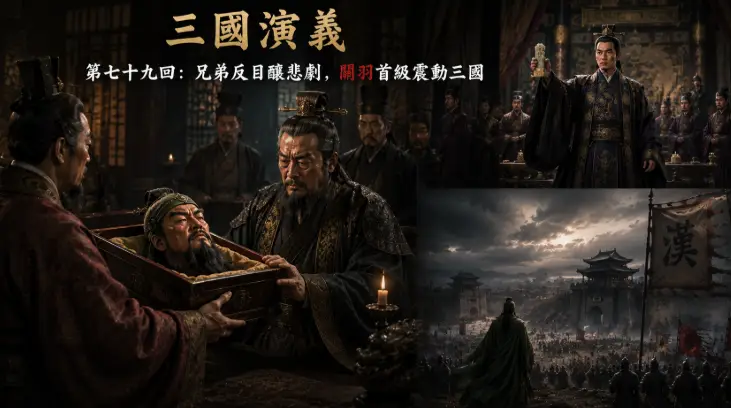
江東宮廷內,孫權望著案上的木匣,神情複雜。
木匣之中,正是關羽首級。
群臣議論紛紛。
有人認為應立即向天下宣告大勝,也有人擔心劉備必定興兵報仇。
沉默許久後,張昭緩緩說道:
「若將關羽首級送往魏國,便可使天下認為曹魏才是真正主使,蜀漢怒火自然轉向曹操。」
孫權沉思片刻,最終採納此策。
不久,使者攜帶木匣北上洛陽。
此時的曹操病勢沉重,曹丕已開始主持朝政。
當木匣送入殿中,眾臣無不屏息。
盒蓋緩緩打開。
那張熟悉而威嚴的面容,依然帶著不屈神色。
曹操凝視良久,久久未語。
昔日白馬坡前放走關羽,華容道上受其義氣,數十年英雄相惜,一幕幕往事浮現在眼前。
忽然,一陣風吹入大殿。
有人驚呼,彷彿看見關羽雙目怒睜。
殿中眾臣一時失色。
曹操卻神色平靜。
「雲長真英雄也。」
他當即下令,以諸侯之禮厚葬關羽首級,並雕刻沉香木身,合葬安置。
此舉既表敬重,也讓天下看見曹操並非趁人之危之人。
然而,孫權借刀嫁禍的計策,也因此落空。
就在魏國舉行葬禮之時,另一場權力更替正在悄然展開。
曹操病逝後,曹丕正式繼承魏王之位。
文武百官紛紛朝賀。
唯有曹植神情複雜。
自幼才華出眾的他,深受曹操喜愛,曾一度被視為世子熱門人選。
如今大局已定,兄弟之間過去隱藏的競爭,也逐漸浮上檯面。
有人暗中依附曹丕,也有人仍支持曹植。
朝廷之中,人心開始分裂。
曹彰率兵返京奔喪。
他性格豪爽,不善權謀,只希望兄弟和睦。
然而,流言四起。
有人誣陷曹彰擁兵自重,也有人懷疑曹植心存不服。
曹丕深知,若兄弟不能同心,魏國將永無寧日。
於是,他一方面厚待宗室,一方面逐步收回兵權。
曾經親密無間的兄弟情誼,也在權力與猜忌之中漸漸改變。
遠在成都。
劉備終於收到關羽首級已被厚葬的消息。
雖然曹操未曾羞辱故友,但關羽終究死於東吳之手。
劉備望著青龍偃月刀,久久沉默。
桃園結義時的誓言,再次浮現腦海。
「不求同年同月同日生,但求同年同月同日死。」
如今,二弟已去。
那份兄弟之情,也化作難以平息的悲痛。
劉備緩緩起身。
「此仇,不可不報。」
一句話,也為日後東征吳國埋下伏筆。
關羽雖然離世,但他的忠義精神卻沒有消失。
在民間,百姓開始自發祭拜這位忠勇無雙的英雄。
許多地方更流傳著關羽顯靈護民的故事。
一顆首級,震動的不只是三國政局,更讓忠義二字深深刻進後世人心。
English Version
The fall of Guan Yu did not bring peace to the empire.
Instead, his death created new political tensions among the three rival kingdoms.
Within the court of Eastern Wu, Sun Quan faced a difficult decision.
Before him rested a wooden box containing Guan Yu’s severed head.
Some ministers urged him to celebrate the victory openly.
Others warned that Liu Bei would certainly seek revenge.
Veteran adviser Zhang Zhao proposed another solution.
Send Guan Yu’s head to Wei.
If the gift reached Cao Cao, Shu might believe that Wei had played the central role in Guan Yu’s death, easing Wu’s immediate political pressure.
Sun Quan approved the plan.
The envoy soon arrived in Luoyang.
By then, Cao Cao’s health had already deteriorated, and Cao Pi had begun assuming greater responsibility for state affairs.
When the box was opened before the court, silence filled the hall.
Cao Cao stared at the familiar face for a long time.
Memories returned—the release of Guan Yu after the Battle of Boma, their mutual admiration despite serving different masters, and the extraordinary respect shared between two remarkable men.
According to legend, a sudden gust of wind swept through the palace, causing many officials to believe Guan Yu’s eyes had opened.
Fear spread across the hall.
Cao Cao remained composed.
“Guan Yu was truly a hero.”
Rather than claiming victory, he ordered that Guan Yu’s head receive full funeral honors before being respectfully buried.
The decision frustrated Sun Quan’s attempt to shift responsibility onto Wei.
Meanwhile, another struggle quietly emerged.
After Cao Cao’s death, Cao Pi formally inherited leadership of Wei.
Although the succession appeared peaceful, tensions among Cao Cao’s sons gradually surfaced.
Cao Zhi, celebrated for his literary brilliance, had once been considered a possible successor.
Now he watched his elder brother ascend to supreme authority.
Cao Zhang returned with his armies to attend their father’s funeral.
Though personally loyal to the family, rumors quickly spread that he possessed dangerous military ambitions.
Within the Wei court, officials began choosing sides.
Some supported Cao Pi completely.
Others continued to admire Cao Zhi’s remarkable talents.
Recognizing the potential danger, Cao Pi carefully strengthened his authority while limiting the independent power of his brothers.
The bonds of family slowly yielded to the realities of politics.
Far away in Chengdu, Liu Bei learned that Cao Cao had buried Guan Yu with honor.
Although grateful for the respect shown to his sworn brother, he never forgot who had ultimately caused Guan Yu’s death.
Standing before the Green Dragon Crescent Blade, Liu Bei recalled the oath sworn years earlier in the Peach Garden.
The brotherhood that had shaped his entire life had been forever broken.
Quietly, he spoke only a few words.
“This debt must be repaid.”
Those words would soon lead Shu toward another great war.
Guan Yu’s life had ended, but his reputation continued to grow.
Across China, ordinary people began honoring him as the perfect symbol of loyalty, courage, and righteousness.
The hero had fallen.
The legend had only just begun.