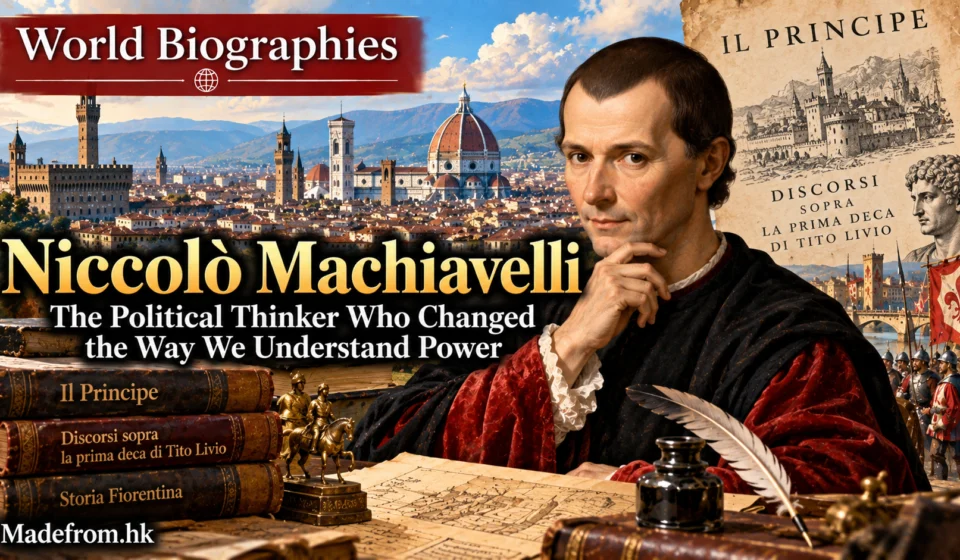
Niccolò Machiavelli: The Political Thinker Who Changed the Way We Understand Power
Niccolò Machiavelli was an Italian political philosopher, diplomat, historian and writer of the Renaissance. Born in Florence in 1469, he lived through a period of political instability, foreign invasions and changing alliances. His experiences in diplomacy and government shaped his realistic approach to politics and made him one of the most influential thinkers in political history.
Niccolò Machiavelli was born in Florence on May 3, 1469, into a family with a long history in the city. His father, Bernardo Machiavelli, was a lawyer, and his family provided him with a relatively strong education in Latin and Italian literature. Little is known about Machiavelli’s childhood, but his father’s library exposed him to important works of Roman history, philosophy and political thought. He grew up during one of the most turbulent periods in Italian history. Florence, Rome, Venice and other Italian states competed for influence while France, Spain and the Holy Roman Empire repeatedly intervened in Italian affairs. Political alliances could change rapidly, military forces were often made up of mercenaries, and governments could rise or collapse within a short period of time. These conditions became an important background to Machiavelli’s later political thinking. In 1494, the Medici family was expelled from Florence after ruling the city for decades, and Florence became a republic. Girolamo Savonarola subsequently became a powerful political and religious figure, but his strict rule eventually collapsed and he was executed. In 1498, Machiavelli entered government service in the Florentine Republic. He became secretary of the Second Chancery and also served as secretary of the Ten of Liberty and Peace, responsibilities that involved diplomacy, military affairs and foreign relations. His official position allowed him to travel extensively and meet powerful political leaders throughout Europe and Italy. These experiences gave him an unusual opportunity to observe political power at close range. He encountered kings, popes, military commanders and rulers, and carefully studied how they gained authority, maintained control and responded to threats. Machiavelli became particularly interested in the weakness of mercenary armies. He believed that Florence needed its own citizen army rather than relying on soldiers whose loyalty could change according to money or political circumstances. His efforts contributed to the establishment of a Florentine militia, and he became involved in military organisation and campaigns. In 1509, Florence successfully captured Pisa, an achievement in which Machiavelli’s military work played an important role. During his diplomatic missions, he also met Cesare Borgia, the powerful Italian military and political figure. Machiavelli closely observed Borgia’s methods of gaining territory and maintaining political control. Borgia became one of the most important examples in Machiavelli’s later political analysis because he represented the kind of ambitious ruler who relied on strategy, force, calculation and political adaptability. Machiavelli also travelled on diplomatic missions involving France, the Papal States and the Holy Roman Empire. His experiences convinced him that political decisions could not always be understood through ideal principles alone. Governments operated in a world of competing interests, military threats, ambition, fear and uncertainty. In 1512, the political situation in Florence changed dramatically. The Medici family returned to power with military support, and the Florentine Republic collapsed. Machiavelli lost his government positions and was excluded from political life. In 1513, he was accused of conspiracy, imprisoned and tortured, although he was eventually released. Having lost his position and much of his livelihood, he withdrew to his property near Florence and began concentrating on writing. During this period, he produced the works that would later make his name famous throughout the world. His most famous book, The Prince, was written in 1513 and dedicated to Lorenzo II de’ Medici. The work examined how rulers could acquire, maintain and strengthen political power. Rather than presenting an idealised image of a perfect ruler, Machiavelli examined political behaviour as it appeared in the real world. He considered situations in which rulers might need to use force, deception, fear or other harsh methods when necessary to protect their state. This approach was highly controversial because it separated political effectiveness from conventional moral expectations. The term “Machiavellian” later developed from these ideas and came to describe political behaviour associated with manipulation, calculation and the pursuit of power. Yet The Prince represented only one part of Machiavelli’s political thought. In Discourses on Livy, he examined the structure and advantages of republican government. He discussed political institutions, the balance of power, the importance of civic participation and the historical conditions that could help a republic survive. His writings therefore cannot simply be reduced to support for absolute rulers. Machiavelli was deeply interested in republican government and believed that political institutions and citizen participation could play an important role in preserving a state. His study of Roman history also influenced his understanding of political power. He examined historical examples to identify patterns that could help explain why states succeeded or failed. For Machiavelli, history was not simply a record of the past; it was a source of political lessons. He believed that rulers and citizens could study earlier societies to understand ambition, conflict, military organisation, institutions and political change. Machiavelli also wrote The Art of War, a work examining military organisation and the relationship between warfare and political power. His interest in military affairs was closely connected to his belief that a stable state required reliable military forces. He later received support from members of the Medici family and was commissioned to write a history of Florence. His Florentine Histories described the development and political conflicts of the city from its early history through the period of Lorenzo de’ Medici. He completed the work in 1525 and dedicated it to Pope Clement VII. This period marked a limited return to public activity, although Machiavelli never fully recovered his earlier political position. His literary work also extended beyond political philosophy. He wrote plays, including the comedy Mandragola, and produced other political and historical writings. Through these different forms, he explored human ambition, deception, desire, social conflict and the complicated relationship between individuals and institutions. Machiavelli’s political philosophy was grounded in realism. Instead of beginning with the question of how people should behave in an ideal society, he often asked how people actually behaved when faced with power, fear, opportunity and danger. He paid close attention to the difference between appearance and reality in politics. A successful ruler, in his view, might need to appear virtuous while making difficult decisions that could not always conform to conventional morality. This did not mean that he simply celebrated cruelty or dishonesty. His central concern was political necessity and the survival of the state. He examined the difficult choices that leaders might face when political stability, national security and moral principles came into conflict. His work therefore became an important foundation for political realism and later studies of international relations. Machiavelli’s reputation changed significantly after his death. Some readers regarded him as a defender of ruthless political power, while others saw him as a sharp observer who exposed the realities of political life. His works influenced later political philosophers and writers, including Jean-Jacques Rousseau, and his ideas continued to be debated across Europe. The word “Machiavellian” eventually became part of everyday language, although its negative meaning represents only one interpretation of his much broader body of work. In 1527, Florence restored its republican government. Machiavelli hoped to return to public service, but his previous association with the Medici government prevented him from receiving a position. He became ill and died in Florence on June 21, 1527, at the age of 58. He was buried at the Basilica of Santa Croce. After his death, The Prince and other major works were published and gradually became central texts in the history of political thought. Machiavelli’s lasting importance comes from the way he examined politics as a practical human activity rather than simply as an ideal system. His diplomatic experience, military observations and study of history allowed him to develop a distinctive understanding of power, leadership, conflict and political institutions. More than five centuries later, his name remains closely associated with political realism, strategic thinking and the difficult relationship between morality and power.
Machiavelli remains one of history’s most debated political thinkers. His works challenged idealised views of leadership and examined power through history, diplomacy, military affairs and human behaviour. His ideas continue to influence political philosophy, strategy and modern discussions of power.