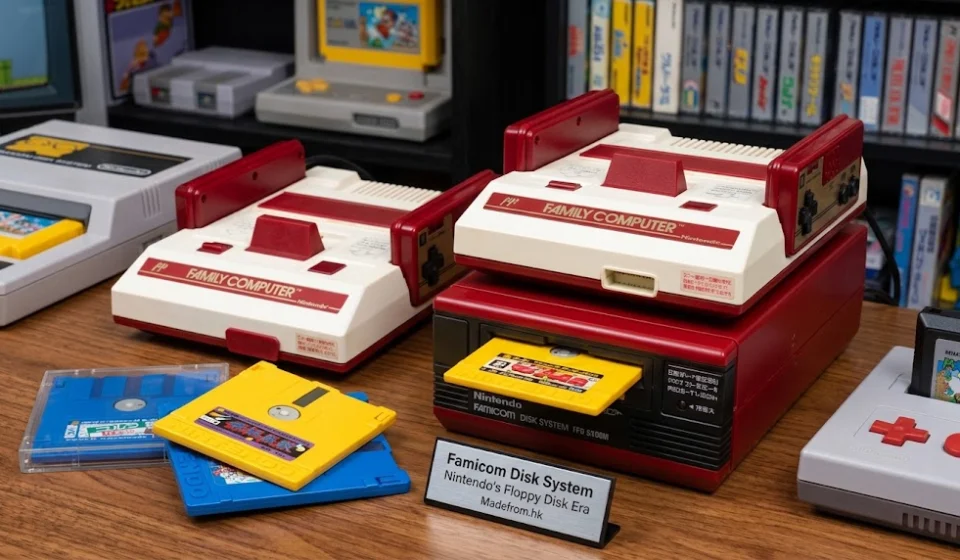
Famicom Disk System: Nintendo’s Floppy Disk Era
In 1986, Nintendo introduced the Famicom Disk System, bringing rewritable floppy disks to the Famicom and opening a new chapter in game storage, distribution, and interactive entertainment.
The Famicom Disk System was one of Nintendo’s most interesting experiments during the early development of home video games. When it appeared in Japan in 1986, cartridges were still the standard way of distributing games for home consoles. Cartridges offered fast loading and simple operation, but they were also relatively expensive to manufacture and had limited storage capacity. Nintendo was therefore looking for another solution that could provide more flexibility without abandoning the enormous installed base of the Famicom. Floppy disks offered an intriguing alternative. Compared with contemporary cartridges, disks could provide more storage at a lower manufacturing cost, and their rewritable nature created the possibility of distributing different games without requiring a completely new physical cartridge each time. Nintendo based its system on a customized three-inch Quick Disk format and developed the Famicom Disk System as an add-on for the original Famicom. Released in Japan on February 21, 1986, the system cost 15,000 yen and connected to the Famicom rather than replacing it. The launch lineup demonstrated both familiar and experimental directions. Existing games such as Baseball, Golf, Mahjong, Soccer, Tennis and Super Mario Bros. were represented, while The Legend of Zelda was designed to take advantage of the new disk-based format. What made the system particularly unusual was not simply the disk itself, but the business model built around it. Nintendo installed dedicated disk-writing machines at video game retailers throughout Japan. Instead of purchasing another expensive cartridge, players could pay a relatively small fee to have another game written onto their disk. At the time, this created a very different relationship between players, retailers and game software. Some machines also supported data transmission. Players could bring compatible disks to participating locations, have their scores processed and transmitted to Nintendo, and compete with other players across Japan. Looking at the concept from a modern perspective, the system contained early ideas that would later become familiar in digital gaming: downloadable content, reusable storage, score transmission, competitive rankings and software distribution through a network of dedicated services. The Famicom Disk System initially performed strongly, selling around two million units in Japan during 1986 alone. However, the advantages that had made the system attractive were gradually weakened by developments in cartridge technology. By the middle of the same year, larger-capacity cartridges were becoming possible, reducing one of the disk system’s biggest advantages. Battery-backed cartridges also introduced convenient save functionality, meaning that saving progress was no longer something unique to disk-based games. At the same time, cartridge manufacturing became less expensive, making the economic argument for disks increasingly difficult to maintain. The wider console market was also changing. By 1990, the industry had entered the 16-bit generation, with systems such as the Super Famicom and Mega Drive offering more advanced graphics, sound and increasingly sophisticated software. Against this new generation, the Famicom Disk System gradually became a product of an earlier era. Nintendo stopped producing the hardware in 1990. The final officially licensed game appeared in 1992, while retail disk-writing services disappeared afterward. Nintendo’s official disk rewriting service continued for several more years, finally ending in September 2003. Hardware repair support continued even longer, until October 2007. The complete lifespan of the system therefore stretched across several different stages of the Japanese video game industry. In total, approximately 4.44 million units were sold. By the standards of Nintendo’s most successful hardware platforms, that figure was modest, and the Disk System did not replace cartridges as the dominant format. Yet its historical importance lies in what Nintendo attempted rather than simply in its sales numbers. The Famicom Disk System treated games as something that could be rewritten, redistributed and updated instead of being permanently fixed inside a single cartridge. Its retailer-based writing stations also created a physical distribution network that anticipated some ideas later associated with digital distribution. The system was eventually overtaken by better cartridge technology and newer generations of consoles, but the experiment remains an important part of gaming history. It represents a moment when Nintendo was already exploring a question that would become increasingly important decades later: should a video game be treated as a physical product that is bought once, or as software that can continue to change after the player has taken it home?
The Famicom Disk System did not replace cartridges, but it explored rewritable games, alternative distribution and player data transmission years before these ideas became commonplace. Its legacy lies in experimentation as much as success.