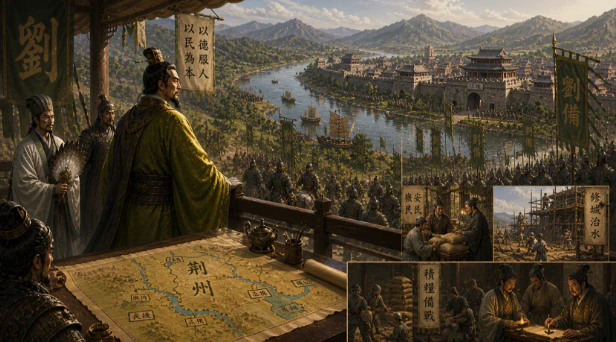
赤壁餘波未息,各方勢力迅速調整。有人重整旗鼓,有人趁勢崛起,天下的平衡,正在悄然改寫。
After Red Cliffs, power shifts rapidly. While some rebuild, others rise. The balance of the realm begins to take a new shape.
中文
戰火遠去,江水依舊。
赤壁之戰的勝負,已不再是焦點。
真正的關鍵,在於戰後的每一步。
曹操退回北方,面對的是殘破的軍隊與動搖的軍心。
他沒有停下。
反而更快地行動。
整頓軍紀,修復補給,重新部署。
對他而言,敗並不可恥,停滯才是。
北方逐漸恢復秩序。
而在南方,另一股力量開始成形。
劉備在諸葛亮輔佐下,迅速行動。
荊州,成為首要目標。
這片土地,不只是戰略要地,更是立足之本。
他不再是流亡之主,而是開始擁有根據地的勢力。
城池一一歸附,百姓逐漸安定。
這種穩定,比任何戰功更重要。
諸葛亮深知,戰後最重要的不是勝利,而是延續。
於是,他主張安民、修政、積糧。
一步一步,將混亂轉為秩序。
而江東的孫權,也未閒著。
他鞏固內政,加強水軍,穩定江東。
赤壁之戰給了他信心,但也讓他更加謹慎。
因為他明白,真正的對手,不只在北方。
還在身邊。
聯盟,開始變得複雜。
合作之中,已帶試探。
劉備的擴張,使孫權警覺。
曹操的恢復,使局勢再度緊張。
三方之間,形成微妙平衡。
沒有誰佔據絕對優勢。
也沒有誰可以輕易退場。
天下,進入另一種對峙。
這不是戰爭的結束,而是新的開始。
赤壁之火,點燃的不只是勝利。
更是一個長期競逐的時代。
English Version
The battle had ended, but the struggle had not.
Red Cliffs reshaped the map—but not the outcome of the war.
In the north, Cao Cao faced the aftermath of defeat.
His army was weakened, his confidence shaken—but not broken.
He responded with urgency.
Rebuilding discipline. Restoring logistics. Reorganizing command.
For him, defeat was a setback—not a conclusion.
Stability returned to the north, slowly but steadily.
In the south, Liu Bei moved with purpose.
Guided by Zhuge Liang, he shifted from survival to establishment.
Jing Province became his focus.
It was not just territory—it was identity.
A place to anchor his vision.
His forces expanded, but more importantly, his influence deepened.
Cities aligned. People settled. Order replaced uncertainty.
This transformation marked a turning point.
Liu Bei was no longer a wandering leader.
He was becoming a ruler.
Zhuge Liang ensured that growth was sustainable.
Military success alone was not enough.
Governance, stability, and trust were essential.
Meanwhile, Sun Quan strengthened his hold over Wu.
His navy remained powerful, his territory secure.
But he was not complacent.
He watched closely—both north and west.
Because alliances, once formed out of necessity, do not remain simple.
They evolve.
Liu Bei’s rise introduced new variables.
Cao Cao’s recovery restored pressure.
And Wu stood between them.
The result was not peace.
It was equilibrium.
A fragile balance, maintained not by trust, but by necessity.
The era that followed Red Cliffs was not defined by a single battle.
It was defined by positioning.
Each move mattered.
Each decision carried weight.
And from these movements, the shape of the Three Kingdoms continued to emerge.