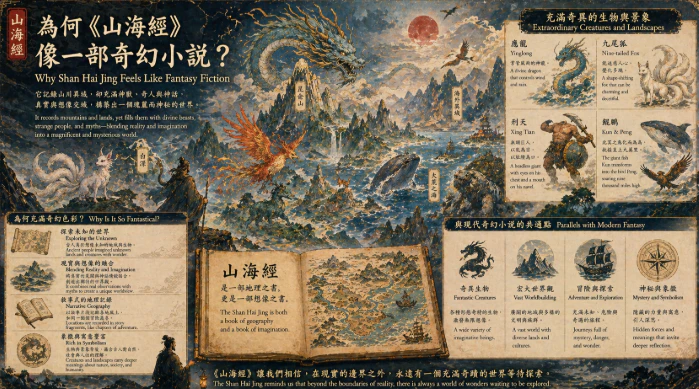
《山海經 049(現代視角)》為何《山海經》像一部奇幻小說?想像與現實的交錯 Why Shan Hai Jing Feels Like Fantasy Fiction: Where Imagination Meets Reality
《山海經》充滿奇異生物與神秘世界,讀來如同奇幻小說。這種風格源於古人將現實觀察與想像融合,形成獨特敘事。
The Shan Hai Jing reads like fantasy, filled with strange creatures and surreal lands, shaped by a blend of observation, imagination, and storytelling.
中文
在遠古的時代,人類對世界的理解仍停留在探索與猜測之間。當人們踏出熟悉的土地,面對陌生的山川與未知的生物時,現實與想像開始交錯。《山海經》正是在這樣的背景下誕生,它不是單純的記錄,而是一種充滿故事感的世界描寫。翻開書頁,讀者會看到各種奇異的存在:有的獸長著人的臉,有的鳥能發出人語,有的山會生出奇石,有的水中潛藏怪物。這些描寫讓整個世界充滿神秘與張力,宛如一部古代的奇幻小說。然而,這種奇幻感並非純粹虛構,而是源於現實的延伸。古人面對未知時,會以熟悉的元素去理解陌生的事物。例如,看到從未見過的動物,便以已知的形象加以組合與誇張,於是產生了人獸混合的神獸形象。這種創造既是誤解,也是想像的力量。同時,《山海經》的敘事方式也加強了其奇幻色彩。它並不按照現代邏輯排列,而是以片段式記錄不同地點與事件,使整體呈現出一種跳躍與拼貼的感覺。讀者在閱讀時,如同在不同世界之間穿梭,每一段描述都是一個獨立卻又相互連結的故事。這種結構與現代奇幻小說的世界建構不謀而合。此外,《山海經》中的世界並非完全穩定。它充滿變化與不確定性,某些地方危險重重,某些存在難以理解。這種不確定性正是奇幻作品的重要特徵,它讓讀者感受到探索的緊張與未知的魅力。同時,書中的生物與地景往往帶有象徵意義,它們不只是存在於故事中,更反映了古人對自然與人性的理解。於是,《山海經》既像地理志,也像寓言集,更像一部關於世界的奇幻敘事。當我們以現代視角閱讀它,會自然地將其歸類為奇幻作品,但對古人而言,它可能是對現實最真實的描述。這種差異使《山海經》具有獨特魅力,它跨越了時間與文化,讓不同時代的讀者都能在其中找到共鳴。它提醒我們,奇幻並非完全脫離現實,而是從現實中生長出來的另一種理解方式。當世界尚未被完全認識時,每一段未知都可能成為故事,而這些故事最終匯聚成我們今天所稱的奇幻。
English Version
In a time when the boundaries of the known world were still undefined, human understanding relied heavily on exploration, interpretation, and imagination. The Shan Hai Jing emerged from this environment, offering a depiction of the world that feels strikingly similar to modern fantasy literature. Its pages are filled with extraordinary beings—creatures that blend human and animal traits, landscapes that seem to defy natural laws, and regions that feel both vivid and unreal. To a contemporary reader, this naturally evokes the structure and tone of fantasy fiction. Yet this sense of fantasy does not arise from pure invention. Instead, it is rooted in the way early societies processed unfamiliar experiences. When confronted with unknown animals, distant lands, or unusual phenomena, people interpreted them through the lens of what they already understood. This often resulted in descriptions that combined recognizable features into new and exaggerated forms. In this way, imagination served as a bridge between the known and the unknown. The narrative style of the Shan Hai Jing further enhances its resemblance to fantasy. Rather than presenting a continuous or systematic account, it offers fragmented glimpses of different places and entities. Each section introduces a new setting or creature, creating a mosaic-like structure. Readers move from one scene to another, much like traveling through interconnected yet distinct worlds—a technique commonly found in modern speculative fiction. Another element that contributes to its fantastical quality is the instability of its universe. The world it portrays is dynamic and unpredictable, filled with dangers, wonders, and unexplained forces. This sense of uncertainty invites curiosity while also evoking a subtle tension, hallmarks of engaging fantasy narratives. At the same time, the creatures and environments described often carry symbolic meaning. They reflect deeper ideas about nature, morality, and human behavior, adding layers of interpretation beyond their surface appearance. As a result, the Shan Hai Jing occupies a unique position. It can be read as geography, mythology, or literature, depending on the perspective of the reader. What appears as fantasy today may have once been considered a genuine attempt to describe reality. This dual nature is precisely what gives the text its enduring appeal. It demonstrates that fantasy is not simply an escape from reality, but another way of understanding it. When the world is not fully known, imagination becomes a necessary tool, transforming uncertainty into narrative. The Shan Hai Jing stands as a testament to this process, showing how stories can emerge from the intersection of experience and wonder, and how those stories continue to resonate across time.