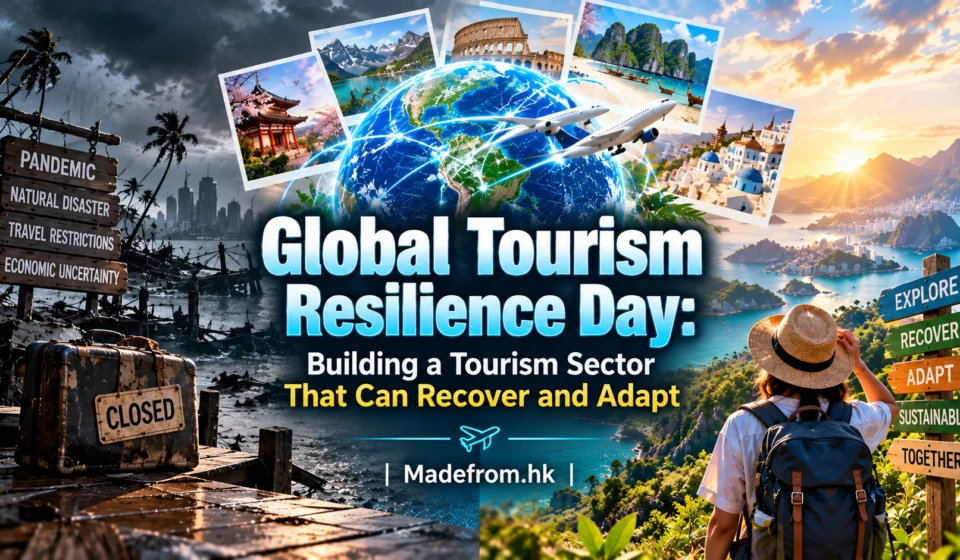
Global Tourism Resilience Day: Building a Tourism Sector That Can Recover and Adapt
Every February 17, Global Tourism Resilience Day highlights the need for tourism to prepare for disruption, recover from shocks and build a more sustainable future.
Global Tourism Resilience Day is observed every February 17 and was proclaimed by the United Nations General Assembly through resolution A/RES/77/269. The day was established in 2023 to draw attention to the vulnerability of tourism to emergencies and to encourage stronger, more adaptable tourism systems capable of recovering from major disruptions. Tourism is often associated with holidays, sightseeing and leisure, but its economic and social importance extends far beyond the experience of the traveller. In many developing countries, least developed countries, small island developing states, African countries and middle-income economies, tourism provides income, foreign exchange, tax revenue and employment. In some small island and developing economies, tourism can account for more than 20 percent of gross domestic product. This means that when tourism suffers a major shock, the consequences reach far beyond airlines, hotels and travel agencies. Restaurants, retailers, tour guides, transport providers, attractions, cultural workers, farmers, craftspeople and small businesses that depend on visitor spending can all be affected. In destinations heavily dependent on tourism, a sudden decline in visitors can quickly become a wider economic and social problem. The COVID-19 pandemic provided one of the clearest demonstrations of this vulnerability. International borders closed, flights were reduced and travel restrictions brought tourism activity to an extraordinary halt. According to the United Nations, tourism’s direct economic contribution fell from around $3.5 trillion before the pandemic to approximately $1.6 trillion in 2020. It recovered to about $1.9 trillion in 2021, but remained below the pre-pandemic level. The experience demonstrated an important distinction between recovery and resilience. Recovery means returning after a crisis. Resilience goes further: it means preparing before disruption, maintaining essential capacity during a crisis, adapting when circumstances change and emerging with stronger systems afterwards. The United Nations therefore describes Global Tourism Resilience Day as a call to foster resilient tourism development capable of dealing with shocks. Member States are encouraged to develop national strategies for rehabilitation after disruptions, including public-private cooperation and the diversification of tourism activities and products. The shocks facing tourism are not limited to pandemics. Natural disasters, climate change, biodiversity loss, food insecurity, political instability, armed conflict, the threat of terrorist attacks, cybercrime, cybersecurity problems and economic recessions can all influence tourism demand and the ability of businesses to operate. These risks were highlighted in discussions surrounding the establishment of Global Tourism Resilience Day, particularly because tourism is highly sensitive to changes in perceptions of safety, accessibility and destination attractiveness. Climate change presents a particularly important long-term challenge. Tourism depends heavily on natural environments, including beaches, forests, mountains, coral reefs, wildlife and landscapes. When these resources are degraded, the tourism economy can also lose part of the attraction on which it depends. Sustainable tourism is therefore not simply an environmental concept; it is also part of long-term tourism resilience. The United Nations notes that sustainable tourism, including ecotourism, can support economic growth, poverty reduction, employment, local culture and the conservation of biodiversity and natural resources. This changes the question from simply asking how many visitors a destination can attract to asking what remains after those visitors leave. A tourism model that generates revenue while creating excessive environmental pressure, waste, resource consumption or damage to cultural heritage may be difficult to sustain. A model that channels benefits towards local communities, small businesses, cultural traditions and conservation can create a stronger foundation for the future. Rural tourism is one example of this approach. Tourism can create new economic opportunities for rural communities by connecting visitors with local food, traditional knowledge, crafts, landscapes and cultural experiences. UN Tourism has continued to promote tourism as a tool for rural development, with an emphasis on cultural and natural heritage, community wellbeing and sustainable local economies. Diversification is another important element of resilience. A destination that depends heavily on a single international market, one type of tourism product or one particular season may face greater difficulties when external conditions change. Developing domestic tourism alongside international markets, or combining cultural, nature, wellness, business, educational and other forms of tourism, can create additional sources of demand. The United Nations resolution establishing Global Tourism Resilience Day specifically encourages diversification of activities and products as part of strategies for recovery after disruption. Technology is also changing how tourism prepares for and responds to shocks. Online booking, digital payments, real-time information, electronic guides, data analysis, social media and artificial intelligence can help tourism organizations understand changing demand and maintain communication with travellers. During a crisis, digital platforms can also provide an important channel for accurate and timely information. As artificial intelligence becomes more widely used, tourism businesses may apply it to customer service, itinerary planning, demand analysis and operational management. Yet technology by itself cannot eliminate vulnerability. Its value depends on how it is combined with human judgement, community needs, environmental responsibility and long-term planning. Resilience is ultimately not a single technology or emergency plan. It is a system of capabilities. Governments need effective crisis policies, businesses need financial and operational flexibility, workers need support, and communities need a meaningful role in decisions affecting tourism development. Each part of this system contributes to how well a destination can respond when conditions change. Global Tourism Resilience Day therefore goes beyond celebrating the return of travellers after a crisis. It asks a more fundamental question: how can the tourism sector be prepared before the next disruption arrives? No one can predict exactly when the next pandemic, natural disaster, economic crisis or major global disruption will occur. What can be decided is how much preparation takes place before it happens. In 2024, the United Nations General Assembly also proclaimed 2027 as the International Year of Sustainable and Resilient Tourism, encouraging international cooperation and action at different levels to promote sustainable and resilient tourism as a means of advancing sustainable development. Behind every flight, hotel, restaurant and attraction are people whose livelihoods may depend on tourism. The resilience of tourism is therefore not simply about getting travellers moving again. It is about ensuring that the wider tourism ecosystem can continue to function, adapt and improve when circumstances change. A resilient tourism sector considers the environment, local communities, employment, cultural heritage, technology, infrastructure, financial stability and risk management as connected parts of the same system. Tourism can then become more than a form of consumption. It can support local economies, encourage cultural exchange, create employment and contribute to environmental protection. The central message of Global Tourism Resilience Day may be simple: preparation matters. Recovering after a crisis is important, but building flexible, diversified and sustainable systems before a crisis occurs gives destinations more options when uncertainty arrives. Travel has always been about moving from one place to another, but tourism also connects people, cultures, economies and natural environments. As the world continues to face climate change, public-health risks, technological transformation and other uncertainties, strengthening tourism resilience means preserving the possibility of future journeys and future livelihoods. It means giving destinations the capacity not merely to survive the next crisis, but to adapt and find new ways forward. In that sense, Global Tourism Resilience Day is not only about tourism. It is about how communities prepare for an uncertain world, how economies recover from disruption, and how travel can continue to contribute to a more sustainable and inclusive future.
Global Tourism Resilience Day highlights that tourism recovery is about more than restoring visitor numbers. A resilient future requires diversified markets, sustainable practices, stronger communities and the ability to adapt when global conditions change.