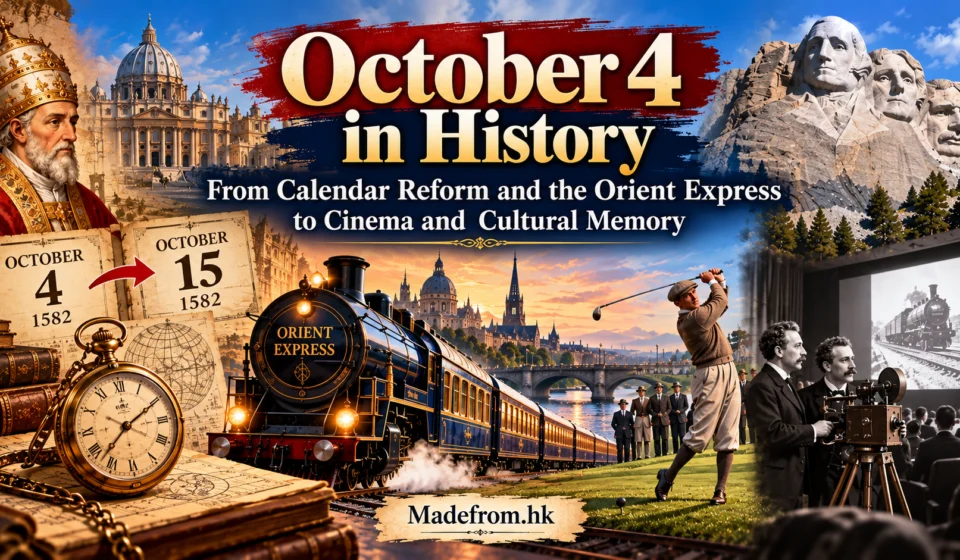
October 4 in History | From Calendar Reform and the Orient Express to Cinema and Cultural Memory
October 4 connects changes in calendars, travel, sport, and culture.
October 4 offers an interesting way to look at history through the changes that gradually became part of ordinary life. Rather than focusing only on political events or major conflicts, the date brings together several developments involving calendars, timekeeping, transportation, sport, monuments, and moving images. In 1582, October 4 marked the final day of the Julian calendar in several Catholic countries, including Italy, Poland, Portugal, and Spain. The following day was officially counted as October 15 under the Gregorian calendar. The change was introduced to correct the accumulated difference between the Julian calendar and the solar year and to bring important seasonal dates into closer alignment with the calendar. The modern calendar used in most of the world developed from this reform. In other words, the date displayed on a phone, computer, newspaper, or website today is connected to a centuries-old attempt to create a more accurate and consistent way of organizing time. Time itself also appears in the history of October 4. In 1675, Dutch scientist Christiaan Huygens was associated with a patent for a pocket watch. Developments such as these were part of a much larger human effort to turn time from an invisible experience into something that could be measured, recorded, and coordinated. Calendars told people what day they were living in, while clocks increasingly allowed societies to organize work, travel, commerce, and everyday routines with greater precision. Centuries later, October 4 became connected with another transformation in how people experienced distance. In 1883, the Orient Express began its first journey from Paris toward the east, linking a series of European countries along its route. The train eventually became one of the most famous symbols of long-distance European rail travel. Railways did more than make journeys faster. They brought people from different regions into closer contact, allowing languages, food, clothing, customs, and lifestyles to cross borders with greater ease. October 4, 1895, also marked the first U.S. Open golf tournament, held at Newport Country Club in Rhode Island. Only 11 players took part in the 36-hole competition, and 21-year-old Englishman Horace Rawlins became the winner. Modern professional sport is now supported by enormous venues, international broadcasting, commercial sponsorship, sophisticated statistics, and global audiences. The early tournament, however, was comparatively small. Its history illustrates how major sporting traditions can begin with modest events before gradually developing into international institutions. Another major cultural landmark began on October 4, 1927, when sculptor Gutzon Borglum started work on the enormous Mount Rushmore project in South Dakota. The faces of four U.S. presidents were eventually carved into the granite mountain, creating a monument that became an important part of the American cultural landscape. The project also demonstrates how societies preserve historical memory through physical spaces. History is not kept only in books and archives; it can also be built into landscapes, monuments, buildings, and public places. October 4 can also be placed within the wider story of cinema. During the final years of the nineteenth century, inventors were searching for practical ways to capture and display moving images. In 1895, Auguste and Louis Lumière obtained a patent for their Cinématographe, a device that combined important functions of filmmaking and projection. Unlike earlier viewing systems that required an individual to look through a small opening, the Lumière system could project moving pictures onto a screen for an audience. Their famous public screening at the Grand Café in Paris on December 28, 1895, became one of the defining moments in the early history of cinema. When these developments are considered together, October 4 reveals a surprisingly coherent story about how human beings gradually changed their relationship with everyday life. Calendar reform helped answer the question, “What day is it?” Better clocks helped answer, “What time is it?” Railways changed the practical meaning of distance by making faraway places easier to reach. Organized sport created shared rules and common experiences, while cinema introduced a new way of preserving and replaying moments of life. The importance of these developments lies partly in how ordinary they eventually became. Few people today think about the centuries of calendar history behind a date on a smartphone. Few passengers consider the long evolution of railway technology when boarding a train. Watching a film or following a sporting event can feel completely normal, even though both activities depend on technological and cultural systems that took generations to develop. This is why October 4 is useful as a historical window. It reminds us that history is not only made by rulers, governments, battles, or famous political decisions. It is also shaped by inventions, standards, journeys, games, images, and systems that slowly become part of everyday life. The calendar on the wall, the clock on a screen, the train timetable, the rules of a sport, and the moving images on a cinema screen all carry traces of earlier generations. Looking back at October 4 therefore gives us more than a list of dates. It offers a way to understand how ideas and inventions move from experimentation into ordinary life, and how the ordinary things around us can themselves become pieces of history.
October 4 reveals how ordinary systems can shape history, from calendars and clocks to railways, sport, monuments, and cinema, gradually transforming everyday human experience.