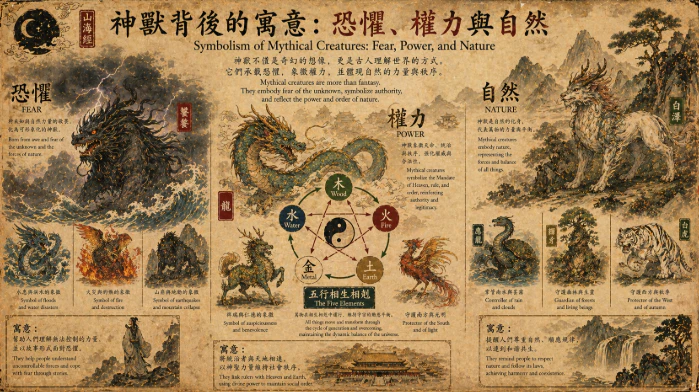
《山海經 052(哲學與象徵)》神獸背後的寓意:恐懼、權力與自然 Symbolism of Mythical Creatures: Fear, Power, and Nature
神獸不只是奇幻形象,它們承載著古人對未知的恐懼、對力量的想像與對自然的敬畏,成為文化中連結人與世界的重要象徵。
Mythical creatures are more than fantasy—they embody fear of the unknown, visions of power, and reverence for nature, serving as symbolic bridges between humanity and the world.
中文
在遠古的記憶之中,世界並非單純由人與自然構成,而是充滿了介於兩者之間的存在,那些被稱為神獸的生靈。牠們既非凡獸,也非神祇,而是混合了力量、象徵與想像的存在。當人類尚未完全理解自然之時,雷電、洪水、山崩與風暴皆帶來難以抗拒的恐懼。於是,這些無形的力量被具象化為神獸的形象:有的吞雲吐火,有的翻江倒海,有的守護山林。牠們既令人畏懼,也令人敬仰。恐懼是神獸誕生的起點。當未知壓迫人心,人們需要一種方式去理解它。於是,猛獸被賦予更誇張的形態,災難被描繪為具意志的存在。這樣的轉化讓人類能夠以故事的形式面對恐懼,而不只是被動承受。同時,神獸也成為權力的象徵。在古代社會,統治者往往借助神獸來強化自身的合法性與威嚴。龍被視為至高無上的存在,象徵天命與皇權;麒麟則代表祥瑞與仁德,預示太平盛世。這些形象不僅出現在傳說之中,也融入建築、器物與儀式之中,成為權力可視化的符號。當人們仰望宮殿屋脊上的獸形雕飾,看到的不只是裝飾,而是權威與秩序的象徵。然而,神獸並非單純的威嚇或統治工具,它們同時也是自然的化身。許多神獸與特定環境緊密相連,例如掌管水域的龍、棲息山林的靈獸、守護四方的神祇。這些形象提醒人們,自然並非可隨意征服的對象,而是一種需要尊重與共存的力量。當人類破壞平衡,神獸便可能化為災難的象徵;當人與自然和諧共處,牠們則成為守護者。這種雙重性使神獸具有深刻的文化意義。它們既代表威脅,也象徵庇護,反映出人類與自然之間微妙而複雜的關係。隨著時間推移,人們對自然的理解逐漸增加,許多神獸不再被視為真實存在,但其象徵意義依然延續。它們出現在藝術、文學與民間信仰之中,成為文化記憶的一部分。當我們重新觀看這些形象,不僅是在欣賞奇幻世界,更是在閱讀古人如何面對恐懼、如何理解力量,以及如何在不確定中尋找秩序。神獸因此不只是傳說,而是一種關於人類自身的隱喻,是在自然與文明之間不斷變化的對話。
English Version
In the earliest layers of human storytelling, the world was never seen as a simple division between humanity and nature. Instead, it was inhabited by beings that stood between these realms—mythical creatures that embodied forces beyond ordinary understanding. These entities were not merely animals nor entirely divine; they were symbolic constructions shaped by fear, imagination, and the need to interpret a powerful and unpredictable environment. Natural phenomena such as storms, floods, and earthquakes were overwhelming experiences, often perceived as expressions of unseen will. To make sense of these forces, early societies transformed them into creatures with form and intention. A raging river could become a dragon, a destructive fire a beast that breathed flames. Through this process, fear became narrative, and chaos became something that could be named and remembered. Yet mythical creatures were not only born from fear—they were also instruments of authority. In many traditions, rulers aligned themselves with powerful creatures to reinforce their legitimacy. The dragon, for instance, symbolized supreme authority and cosmic approval, while other creatures represented harmony, prosperity, or divine favor. These symbols extended beyond stories into architecture, rituals, and objects, embedding power into visual culture. Seeing such creatures was not simply encountering decoration; it was experiencing a coded language of control and order. At the same time, these beings functioned as representations of nature itself. Many mythical creatures were tied to specific environments, embodying the spirit of mountains, rivers, forests, or the sky. They served as reminders that nature was not inert or passive, but alive and deserving of respect. When balance was maintained, these creatures could act as protectors; when disrupted, they could transform into agents of destruction. This duality reflects a deeper understanding of the relationship between humans and the natural world—one defined by both dependence and vulnerability. Over time, as scientific knowledge expanded, belief in the literal existence of such creatures diminished. However, their symbolic power did not fade. They remain embedded in cultural expression, continuing to influence art, literature, and identity. Revisiting these creatures today is not simply an exploration of fantasy, but a way of understanding how earlier societies processed uncertainty, constructed meaning, and negotiated their place within a vast and unpredictable universe. Mythical creatures endure because they speak to something fundamental—the human desire to give shape to fear, to define power, and to find harmony within the forces that surround us.