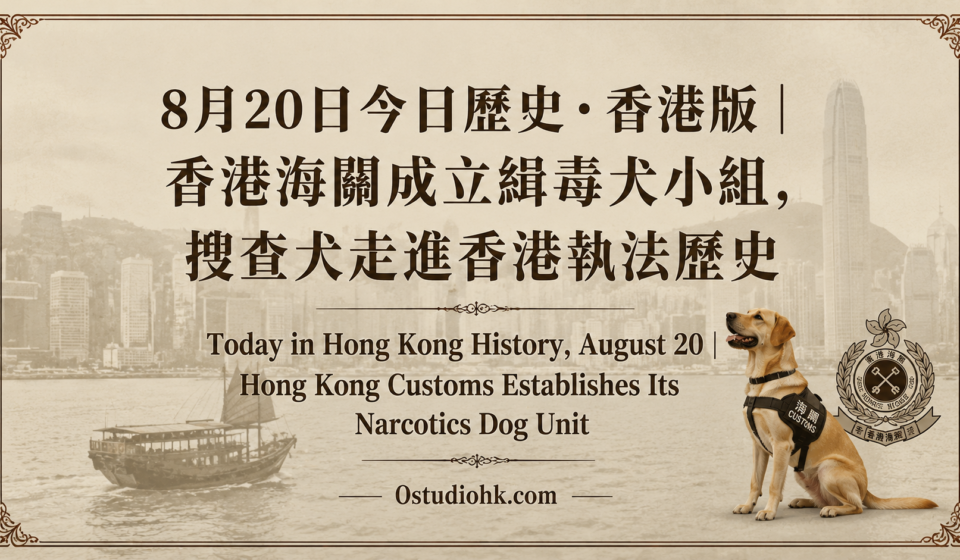
8月20日今日歷史・香港版|香港海關成立緝毒犬小組,搜查犬走進香港執法歷史 | Today in Hong Kong History, August 20 | Hong Kong Customs Establishes Its Narcotics Dog Unit
1978年8月20日,香港海關正式成立緝毒犬小組,以大欖涌海關訓練學校為首個基地。當時小組只有兩隻在美國受訓的搜查犬和兩名領犬員,但這個小小的隊伍,後來逐步發展成香港海關重要的搜查犬力量。
English
On August 20, 1978, Hong Kong Customs formally established its Narcotics Dog Unit. Based initially at the Customs and Excise Training School in Tai Lam Chung, the unit began with just two detector dogs trained in the United States and two handlers, eventually developing into an important part of Hong Kong Customs’ detector-dog operations.
中文版本
如果說起香港海關,很多人第一時間可能會想到口岸、貨物檢查、機場,以及各種執法工作。
但你可能不知道,香港海關的歷史中,還有一群非常特別的「工作夥伴」——搜查犬。
牠們沒有穿制服,也不會說話。
但靠着靈敏的嗅覺,牠們可以協助海關人員尋找藏匿在行李及貨物中的違禁品。
而這段歷史的重要一天,就是:
1978年8月20日。
這一天,香港海關正式成立緝毒犬小組。
小組最初以大欖涌海關訓練學校為基地,只有兩隻在美國接受訓練的搜查犬,以及兩名領犬員。
今天看起來,兩隻狗似乎不是一支很大的隊伍。
但在當時,這其實是一個新的開始。
一隻狗,如何成為海關的工作夥伴?
搜查犬最大的本領,就是嗅覺。
人類主要依靠眼睛觀察。
但狗的世界,很大程度是透過氣味來認識。
經過專業訓練後,搜查犬可以學習辨認特定物質的氣味。
當牠們在行李、貨物或者指定環境中聞到相關氣味時,就會向領犬員作出反應。
因此,搜查犬並不是單純「自己去找東西」。
真正的工作,其實是:
犬隻+領犬員+訓練+海關執法。
四個部分缺一不可。
1978年的緝毒犬小組,正是這種合作模式在香港正式建立的重要一步。
當時香港正處於快速發展的年代。
1970年代的香港,人口增加、經濟發展、國際貿易及交通都不斷擴大。
香港作為亞洲重要的港口及商業城市,貨物和旅客流動越來越頻繁。
而海關需要面對的工作,也隨着城市發展而變得更加複雜。
在這種背景下,利用搜查犬協助執法,是一種相當實用的技術。
其實早在1974年,香港海關的前身「緝私隊」已經引入第一隻搜查犬,名字叫Oliver。
Oliver駐守啟德國際機場,協助進行緝毒工作。
幾年後,到了1978年,海關正式成立緝毒犬小組,令這方面的工作開始變得更加制度化。
而當年的起點非常簡單:
兩隻狗、兩個人。
這就是香港緝毒犬小組最初的規模。
但小組並沒有停留在原來的水平。
到了1980年,搜查犬數目增加至四隻。
這代表搜查犬在香港海關的工作開始受到更大的重視。
到了1987年,香港海關更派出四名領犬員及新的搜查犬到英國接受訓練,以取代已經退休的四隻搜查犬。
這裡有一個很有趣的地方。
原來搜查犬也會「退休」。
牠們不是一部機器。
工作多年後,便需要由新一批搜查犬接替。
而領犬員亦需要接受專業訓練,學習如何與犬隻合作。
所以,一支搜查犬隊伍真正重要的,不只是犬隻本身。
更重要的是:
人與狗之間的合作。
一名好的領犬員,需要了解犬隻的習性。
知道牠平時的反應。
知道牠甚麼時候特別專注。
也知道牠甚麼時候可能只是受到其他氣味干擾。
這種長時間建立的默契,是普通機器很難完全取代的。
到了1988年,緝毒犬小組的基地由大欖涌海關訓練學校遷往啟德機場客運大樓。
從這時開始,小組的緝毒工作由香港海關機場科負責。
想像一下當年的啟德機場。
飛機降落的位置就在九龍市區附近。
機場周圍是密集的城市建築。
而在機場客運大樓內,一群經過專業訓練的搜查犬,正執行自己的工作。
這其實也是香港城市發展的一個小小縮影。
香港越來越國際化。
人流增加。
貨物流動增加。
機場的重要性增加。
執法方式亦跟着進步。
所以,搜查犬的故事表面上是「狗的故事」,背後其實也是香港現代化的一部分。
更有趣的是,這支隊伍後來並沒有一直只負責搜查毒品。
2003年,香港海關因應國際安全環境變化,引入專門搜查爆炸品的搜查犬。
因此,原本的緝毒犬小組開始擴大職能,並改名為海關搜查犬小組。
到了2008年,架構再提升為海關搜查犬組,當時已經有34隻搜查犬及相應數目的領犬員,分駐九個搜查犬基地。
從1978年的:
2隻狗+2名領犬員
發展到後來:
多支搜查犬隊伍+不同專業搜查工作。
這個變化其實相當有意思。
因為它說明一個制度不一定是一開始就很龐大。
有時候,一個新想法只需要幾個人、一兩項新技術,就可以開始。
然後隨着需要增加,慢慢發展成完整的系統。
這種發展模式,其實與香港很多城市服務都很相似。
最初可能只是一個小規模試驗。
後來證明有效。
再增加資源。
最後成為日常運作的一部分。
而搜查犬最特別的地方,是牠們始終是一群真正「工作」的動物。
牠們不是只出現在宣傳照片裡。
牠們需要每天訓練。
需要熟習不同環境。
需要適應機場、貨物、旅客及各種不同氣味。
而領犬員亦需要長時間與牠們合作。
因此,這支隊伍其實包含了一種非常特別的人與動物合作關係。
對香港人來說,狗通常是寵物。
但在海關的世界裡,有些狗是專業工作伙伴。
牠們有自己的工作。
有自己的訓練。
甚至有自己的退休時間。
這也令「香港歷史」突然多了一個很有趣的角度。
我們平時講香港歷史,可能會講:
港鐵。
工業。
高樓大廈。
電影。
電視。
新市鎮。
金融中心。
但原來連一群搜查犬,也參與了香港現代化的過程。
1978年8月20日成立的緝毒犬小組,正是這段小歷史的起點。
今天回望這一天,我們看到的不只是海關歷史。
還看到1970年代香港如何逐步建立更加專業的城市服務。
而最有趣的是,這項工作並不是完全依靠最新科技。
它利用的是一項狗已經擁有數千年的能力:
嗅覺。
人類沒有發明狗的嗅覺。
我們只是學懂如何與牠合作。
這可能就是這段歷史最有趣的地方。
科技不一定只是電腦、機器或者大型設備。
有時候,最有效的工具,可能早已存在於大自然之中。
人類需要做的,是了解它、訓練它,再把它變成一種有系統的工作能力。
1978年8月20日,香港海關用兩隻搜查犬及兩名領犬員開始了這段旅程。
幾十年後,這個小小的隊伍已經發展成更完整的搜查犬系統。
而那兩隻最早的搜查犬,也成為香港執法歷史中一個很特別的開始。
有些香港歷史,不一定發生在高樓大廈或者政府大樓。
有時候,
它就在一隻狗的鼻子前。
English Version
When people think about Hong Kong Customs, they may think of airports, ports, cargo inspections and border control.
But there is another fascinating part of Hong Kong Customs history:
detector dogs.
They do not wear uniforms in the same way as their human colleagues, and they cannot speak.
But with their highly developed sense of smell, trained dogs can help customs officers detect prohibited substances hidden in luggage and cargo.
An important date in the history of this work was August 20, 1978.
On that day, Hong Kong Customs formally established its Narcotics Dog Unit.
The unit was initially based at the Customs and Excise Training School in Tai Lam Chung.
Its original team consisted of just two detector dogs trained in the United States and two handlers.
Today, two dogs may not sound like a very large operation.
But in 1978, it represented a new beginning.
How can a dog become a working partner?
The most important ability of a detector dog is its sense of smell.
Humans mainly understand the world through sight.
Dogs experience their environment very differently.
With professional training, they can learn to recognise particular odours and respond when they detect them.
A detector dog therefore does not simply work alone.
The real system is:
dog + handler + training + customs expertise.
All four are important.
The establishment of the Narcotics Dog Unit in 1978 was an important step in developing this partnership in Hong Kong.
Hong Kong was changing rapidly during the 1970s.
The population was growing, the economy was expanding, and international trade and transportation were becoming increasingly important.
As an international port and commercial centre, Hong Kong was experiencing greater movement of passengers and cargo.
Customs operations therefore became more complex.
Using trained dogs to assist with detection was a practical way of adding another layer of capability.
In fact, the story had begun several years earlier.
In 1974, the predecessor of Hong Kong Customs, the Preventive Service, introduced its first detector dog, Oliver.
Oliver was stationed at Kai Tak International Airport to assist with drug detection operations.
Four years later, the formal Narcotics Dog Unit was established, giving the work a more organised structure.
The original team was remarkably small:
two dogs and two handlers.
That was the beginning.
The unit did not remain at that size.
By 1980, the number of detector dogs had increased to four.
By 1987, Hong Kong Customs sent four handlers and their new detector dogs to Britain for training, replacing four dogs that were approaching retirement.
This reveals another interesting aspect of the story.
Detector dogs can retire.
They are not machines.
After years of work, they eventually need to be replaced by a new generation.
Their handlers also require specialised training to understand how to work effectively with them.
The relationship between a dog and its handler is therefore extremely important.
A good handler needs to understand the dog’s normal behaviour.
They need to recognise changes in its attention.
They need to understand when a reaction is meaningful and when it might simply be caused by another smell.
That kind of long-term partnership is difficult to reproduce with technology alone.
In 1988, the Narcotics Dog Unit moved from the Customs and Excise Training School in Tai Lam Chung to the Kai Tak Airport terminal building.
From that point, its drug-detection work came under the supervision of the Airport Command.
Imagine Kai Tak Airport in those days.
Aircraft were landing close to the densely populated city.
Inside the terminal, specially trained dogs and their handlers were carrying out their work.
The story of the detector dogs therefore reflects part of Hong Kong’s wider modernisation.
As Hong Kong became more international, passenger traffic increased.
Cargo movements increased.
The importance of the airport increased.
And customs methods developed alongside the changing city.
The story later became even more interesting.
The dogs’ responsibilities eventually expanded beyond narcotics.
In 2003, Hong Kong Customs introduced detector dogs specially trained to search for explosives.
The Narcotics Dog Unit was subsequently renamed the Customs Detector Dog Unit, reflecting its wider responsibilities.
By 2008, the organisation had developed into the Customs Detector Dog Division, with 34 detector dogs and corresponding handlers stationed at nine bases.
From:
two dogs and two handlers in 1978
to:
a much larger professional detector-dog organisation decades later.
It is a fascinating example of how a small idea can grow.
A new system does not necessarily begin with a huge organisation.
Sometimes it begins with a few people, a new technique and a small experiment.
If the idea proves useful, resources are added.
Training improves.
The organisation expands.
Eventually, what was once new becomes part of everyday operations.
There is also something special about the fact that these are working animals.
They need regular training.
They need to become familiar with different environments.
They need to work around airports, cargo, passengers and countless different smells.
Their handlers need to develop a close working relationship with them.
For many people in Hong Kong, dogs are pets.
For Customs, some dogs are professional working partners.
They have jobs.
They have training.
And eventually, they have retirement.
That gives Hong Kong history an unusual perspective.
When we think about the history of Hong Kong, we often think about railways, skyscrapers, industry, cinema, television, new towns and finance.
But detector dogs were also part of the city’s modern development.
The Narcotics Dog Unit established on August 20, 1978, was an important beginning.
It reflected the development of more specialised public services in 1970s Hong Kong.
And perhaps the most interesting part is that the technology involved was not necessarily modern technology.
It was a natural ability that dogs have possessed for thousands of years:
their sense of smell.
Humans did not invent that ability.
We simply learned how to work with it.
That may be the most fascinating lesson of this small piece of history.
Technology is not always about computers, machines or giant infrastructure.
Sometimes, the most useful tool is something that already exists in nature.
Human beings simply need to understand it, train it and build a system around it.
On August 20, 1978, Hong Kong Customs began that journey with two dogs and two handlers.
Decades later, that small beginning had grown into a much larger professional detector-dog operation.
Those first dogs therefore occupy a small but memorable place in the history of Hong Kong.
Some stories of Hong Kong history do not happen in skyscrapers or government buildings.
Sometimes,
they begin with a dog’s nose.
總結
中文版本
1978年8月20日,香港海關正式成立緝毒犬小組,最初只有兩隻搜查犬及兩名領犬員。這個小小的隊伍,後來逐步發展成香港海關重要的搜查犬力量,也成為香港城市專業化發展中一段有趣的小歷史。
English Version
On August 20, 1978, Hong Kong Customs established its Narcotics Dog Unit with just two detector dogs and two handlers. From this modest beginning, the unit gradually developed into an important part of Hong Kong’s customs detection operations.