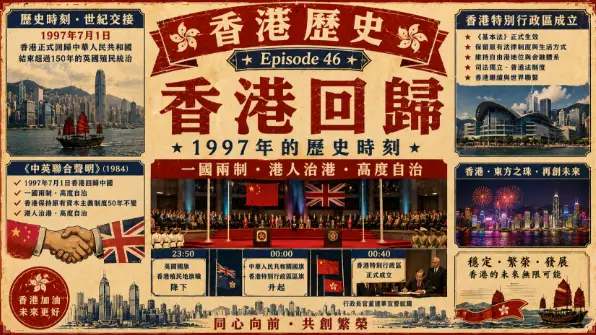
1997年7月1日,香港正式回歸中國,結束超過150年的英國殖民統治。這場歷史性主權移交,不但改變香港政治地位,也成為世界矚目的重大時刻。
On July 1, 1997, Hong Kong officially returned to Chinese sovereignty after more than 150 years of British colonial rule. The handover marked a historic transition that reshaped the city’s political identity and captured global attention.
中文
1997年7月1日,對香港而言,是近代歷史中最重要的轉折時刻之一。經過長達數年的中英談判與過渡安排,香港正式由英國殖民地轉變為中華人民共和國轄下的香港特別行政區。這一天不只是主權移交,更象徵一個時代的結束與另一個新時代的開始。香港與英國的關係,可以追溯至19世紀鴉片戰爭之後。1842年《南京條約》割讓香港島予英國,其後九龍與新界亦先後納入英國統治。經歷超過一個半世紀的殖民地時代後,香港逐漸發展成亞洲重要金融、貿易與國際城市。然而隨著新界租約將於1997年屆滿,香港前途問題最終成為中英兩國必須面對的重要議題。1984年簽署的《中英聯合聲明》,正式確定香港將於1997年回歸中國,同時提出「一國兩制」與「港人治港、高度自治」原則。此後十多年,香港進入過渡時期。政府、商界與普通市民都開始為1997作準備。社會對未來既充滿期待,也存在不安。有人相信中國改革開放將為香港帶來更大發展機會,也有人擔心香港原有制度與生活方式會否改變。回歸前夕,香港街頭氣氛十分複雜。媒體每日討論1997議題,移民潮與投資市場波動曾經出現,但同時香港經濟仍然保持繁榮。維多利亞港兩岸高樓林立,香港已成為全球最重要金融中心之一。許多人開始思考,回歸後的香港將如何定位自己。1997年6月30日晚,全球媒體聚焦香港會議展覽中心。英國皇儲查理斯、首相貝理雅、中國國家主席江澤民與多國代表出席主權移交儀式。午夜時分,英國國旗與香港殖民地旗幟正式降下,中國國旗與香港特別行政區區旗升起,象徵香港正式回歸中國。這一幕成為20世紀亞洲歷史最具象徵性的畫面之一。香港特別行政區亦於同日正式成立,董建華成為首任行政長官。《基本法》開始生效,香港保留原有普通法制度、金融體系與資本主義經濟模式。根據「一國兩制」原則,香港在回歸後五十年內維持原有生活方式不變。回歸後初期,香港社會整體保持穩定,但亦開始面對新的挑戰。1997亞洲金融風暴迅速衝擊香港經濟,樓市與股市大幅波動。不過香港金融制度與聯繫匯率最終成功維持穩定。另一方面,香港與中國內地之間聯繫日漸加深。經濟、旅遊、交通與文化交流快速增加,香港逐漸成為中國與世界之間的重要國際窗口。香港回歸,不只是政治事件,同時也是香港身份與歷史的重要轉變。對部分市民而言,回歸象徵民族歷史與殖民時代結束;對另一些人而言,則意味未來充滿未知與變化。這種複雜情感,深深影響回歸後香港社會發展。從殖民地到特別行政區,香港進入全新歷史階段,而1997年這個年份,也永遠成為香港人共同記憶的重要象徵。直到今天,香港回歸仍然是研究香港歷史、政治與身份認同時無法忽視的重要事件。
English Version
The return of Hong Kong to Chinese sovereignty in 1997 marked one of the most significant political transitions in modern Asian history. After more than a century under British colonial administration, Hong Kong entered a new era as a Special Administrative Region of China. The handover represented far more than a ceremonial transfer of authority. It symbolized the end of empire, the reshaping of East Asian geopolitics, and the beginning of a new relationship between Hong Kong, mainland China, and the international community. Hong Kong’s colonial history began in the nineteenth century following the Opium Wars. Hong Kong Island was ceded to Britain in 1842 under the Treaty of Nanking, followed later by Kowloon and the lease of the New Territories. Over the next 150 years, the city developed into one of the world’s most important trading and financial centers. By the late twentieth century, however, the approaching expiration of the New Territories lease forced Britain and China to confront the issue of Hong Kong’s future. The Sino-British Joint Declaration signed in 1984 established the framework for the handover. China confirmed that it would resume sovereignty over Hong Kong on July 1, 1997, while also promising that the city would maintain its capitalist system, legal structure, and way of life under the principle of “One Country, Two Systems.” During the years leading up to the handover, Hong Kong experienced both optimism and anxiety. Some residents believed closer ties with a rapidly modernizing China would create enormous economic opportunities. Others worried about political freedoms, legal protections, and the preservation of Hong Kong’s unique identity. Throughout the 1980s and 1990s, discussions about the future became a constant part of public life. Migration increased as some families sought alternative futures abroad, while at the same time Hong Kong’s economy continued to thrive. By the mid-1990s, the city stood as one of the world’s leading financial centers, with a globally recognized skyline and a highly international business environment. On the night of June 30, 1997, international attention focused on the Hong Kong Convention and Exhibition Centre where the handover ceremony took place. Chinese President Jiang Zemin, British Prime Minister Tony Blair, Prince Charles, and numerous international representatives attended the historic event. As midnight arrived, the British and colonial Hong Kong flags were lowered, while the national flag of China and the flag of the Hong Kong Special Administrative Region were raised. The moment carried enormous symbolic significance, representing both the conclusion of colonial rule and the beginning of a new political chapter. At the same time, the Hong Kong Special Administrative Region was formally established, with Tung Chee-hwa becoming the first Chief Executive. The Basic Law came into effect, preserving Hong Kong’s legal system, financial institutions, and economic framework under the new constitutional arrangement. In the years immediately following the handover, Hong Kong remained stable but also encountered serious challenges. The Asian Financial Crisis erupted shortly after the transition, causing sharp fluctuations in the stock market and property sector. Nevertheless, Hong Kong’s financial system and linked exchange rate mechanism survived the crisis. Meanwhile, integration between Hong Kong and mainland China accelerated through trade, tourism, transportation, and cultural exchange. The city increasingly positioned itself as an international gateway connecting China with global markets. For many residents, the handover carried powerful emotional meaning. Some viewed it as the end of a painful colonial chapter and a restoration of national sovereignty. Others felt uncertainty about how Hong Kong’s society and freedoms might evolve in the future. These mixed emotions became deeply embedded within post-1997 Hong Kong identity. The return of Hong Kong was therefore not simply a diplomatic event. It represented a historic transformation that redefined the city’s political status, cultural identity, and relationship with the wider world.
總結
1997年香港回歸,標誌殖民地時代正式結束,也開啟香港特別行政區的新歷史。這場歷史轉變,深刻影響香港政治、社會與身份認同發展。
The 1997 handover transformed Hong Kong’s political future and marked the beginning of a new era under Chinese sovereignty. The event continues to shape discussions about identity, governance, and the city’s place between China and the international world.