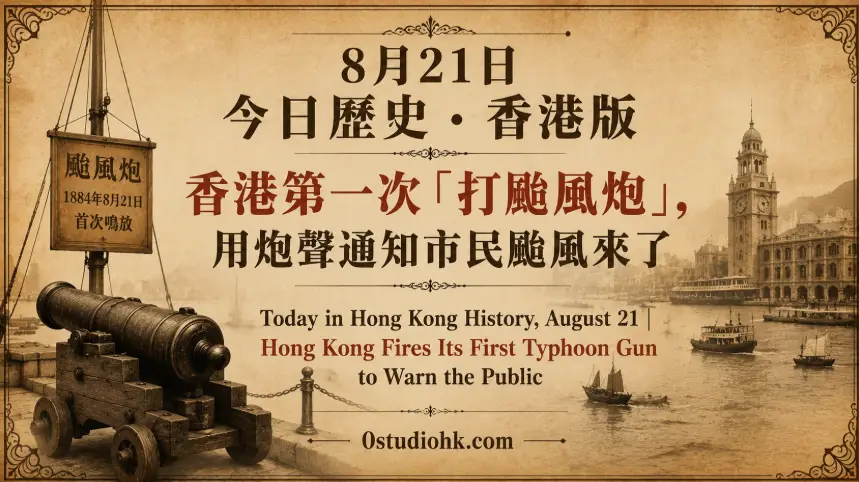
8月21日今日歷史・香港版|香港第一次「打颱風炮」,用炮聲通知市民颱風來了 | Today in Hong Kong History, August 21 | Hong Kong Fires Its First Typhoon Gun to Warn the Public
1884年8月21日,香港天文台首次鳴放「颱風炮」,以炮聲警告市民即將有強風。這套早期香港風暴警報方式,成為今日香港颱風警告系統的一個重要歷史起點。
On August 21, 1884, Hong Kong fired its first “typhoon gun” to warn the public about approaching severe winds. This unusual early warning method became one of the foundations of Hong Kong’s long history of tropical cyclone warning systems.
中文版本
1884年8月21日,香港發生了一件今天聽起來非常特別的事情:香港天文台第一次鳴放「颱風炮」。在沒有電視、收音機、手機,更沒有現代天氣預報的年代,香港人如果要知道颱風可能來臨,不能等待手機通知,也不能打開電視看天氣報告,而是要留意港口及城市裡發出的各種訊號。當時香港天文台成立不久,其中一項重要工作,就是建立一套可以向市民及船隻發出熱帶氣旋警告的方法。1884年,天文台開始採用視覺訊號通知港內船隻,同時以「颱風炮」向本地市民警告即將出現的強風。根據香港天文台的歷史資料,第一枚颱風炮於1884年8月21日鳴放。當時颱風炮設置在尖沙咀警署附近、面向維多利亞港的桅杆腳下。 這個方法非常直接:如果預計香港會受到烈風影響,就鳴炮一次;如果預計風力達到颱風程度,就鳴炮兩次;如果風向可能突然改變,還會再鳴炮提醒市民。對今天的人來說,這種做法可能有點難以想像。現在香港人看到天文台發出八號、九號或十號熱帶氣旋警告,可以透過手機、電視、網站、社交平台及新聞即時知道天氣情況。但在十九世紀的香港,城市還沒有這些現代通訊工具。對於住在海旁、從事航運、漁業或者其他戶外工作的人來說,一聲炮響可能就是非常重要的訊息。當時的香港是一個高度依賴海運的港口城市,維多利亞港每天都有船隻進出,天氣突然轉壞,不只是生活上的不便,更可能直接影響航行安全。因此,建立一套能夠讓人快速知道危險天氣的方法,是當時非常實際的需要。可是,這個「颱風炮」制度也有一個很有趣的問題:**它有時候會令人誤會。**原來這枚炮除了用來警告颱風,還曾經兼任「郵炮」,用來宣布來自倫敦的郵件抵達。換句話說,同一聲炮響,可能代表兩件完全不同的事情。一方面可能是在說:「颱風來了,小心風暴!」另一方面卻可能只是:「倫敦的郵件到了!」香港天文台的歷史資料甚至記載,這種混淆曾經令船隻和市民以為有颱風而尋找地方躲避,但其實當時並沒有颱風。 這個故事很有十九世紀香港的味道。今天我們覺得資訊越快越好,但在當時,最有效的方法可能就是一個大家都聽得到的聲音。城市裡沒有手機,也沒有大型電子顯示屏,所以「聲音」本身就是一種公共資訊工具。颱風炮的背後,其實反映了當時香港城市生活的一個重要特色:**香港是一座靠海而生的城市。**船隻、碼頭、商業及人口都與維多利亞港有密切關係,因此天氣警告並不是一件單純的氣象問題,而是與城市經濟及日常生活直接相關。1884年開始使用颱風炮後,香港的熱帶氣旋警告制度亦逐步發展。1890年,天文台加入夜間風暴訊號,以燈號協助市民及船隻辨認天氣情況。1917年,香港正式引入有編號的熱帶氣旋警告信號,這套制度後來經過多次改變,逐步發展成我們今天熟悉的熱帶氣旋警告系統。 而颱風炮本身並沒有一直使用下去。1907年,香港以爆炸物取代颱風炮,原因是爆炸聲比炮聲更響亮,更容易讓市民注意。當時如果預計香港會受到颱風級風力影響,會使用三枚爆炸物,每枚相隔約十秒發出聲響。這種方法一直使用到1937年,最後一次在香港發出這類爆炸警報是在1937年。 從炮聲到爆炸聲,再由爆炸聲發展到編號訊號,最後進入今天由電視、廣播、網站、手機及各種電子平台即時通知市民的年代,香港的颱風警報其實走過了一條很長的道路。今天我們聽到「一號波」、「三號波」、「八號波」,可能只會覺得這是香港生活的一部分,很少會想到這套制度其實有超過一百年的歷史。而1884年8月21日的第一聲颱風炮,就是這段歷史非常早期的一個起點。更有趣的是,當時的香港天文台甚至還未像今天一樣是一個龐大的現代氣象機構。天文台在1883年成立後,逐步建立氣象觀測、時間服務及風暴警報等工作。最初的設備與今天相比非常簡單,但目的卻很清楚:讓香港人更早知道危險天氣正在接近。 今天回望這件事,最有趣的並不是「以前竟然用炮通知颱風」,而是我們可以從一聲炮響,看見香港城市如何慢慢建立起一套公共資訊系統。那時候沒有數碼科技,人們利用聲音、旗號、燈號和人工觀察來傳遞消息。後來科技進步,訊息變得越來越快,但背後的基本概念一直沒有改變:**當危險天氣來臨,市民需要知道。**1884年8月21日,香港人第一次透過颱風炮收到這種公共警告。今天我們可能只需要看一眼手機,就知道天文台正在發出甚麼信號。但如果把時間倒回一百多年以前,想像尖沙咀警署附近的桅杆旁,一聲炮響穿過維多利亞港,船上的人、碼頭附近的人、城市裡的居民都可能停下來聽一聽,然後開始準備面對天氣變化。這就是一個很小、卻很有香港味道的歷史畫面。它沒有大人物,也沒有轟動世界的政治事件,但它記錄了一座港口城市如何學習保護自己。從第一聲颱風炮,到今天的十號颱風信號,香港的警報方式改變了很多次,但那個最基本的目的,一直沒有改變:在風暴來到之前,先告訴大家。
English Version
On August 21, 1884, something happened in Hong Kong that would sound very unusual today: the territory fired its first “typhoon gun”. At a time when there were no smartphones, television weather reports, radio broadcasts or digital alerts, the sound of a gun was used to warn the local public about dangerous winds. The Hong Kong Observatory had only recently been established, and one of its important early responsibilities was to develop a system that could warn both ships and people on land when tropical cyclones threatened the territory. In 1884, visual signals were used to provide information to ships in the harbour, while the typhoon gun was used as a local warning for the public. According to Hong Kong Observatory records, the first typhoon gun was fired on August 21, 1884. It was positioned near the mast at the Police Barracks in Tsim Sha Tsui, facing Victoria Harbour. The system was surprisingly straightforward. One shot warned that strong winds were expected. Two shots indicated that typhoon-force winds were expected locally. Another shot could be fired if the wind direction was likely to change suddenly. For people today, this sounds almost like something from another world. Modern Hong Kong residents can receive weather warnings through television, websites, mobile phones, social media and countless other channels. In nineteenth-century Hong Kong, none of those technologies existed. For people living near the harbour, working on ships, fishing or carrying out other outdoor activities, a loud warning from the city could be extremely important. Hong Kong was already a major maritime trading centre, and Victoria Harbour was filled with ships and commercial activity. Sudden changes in the weather could therefore affect not only daily life but also navigation and safety. Establishing a simple warning system was a practical necessity for a city so closely connected to the sea. Yet the early typhoon gun had an amusing problem: the same gun could also be used for something completely different. The gun was sometimes used as a “mail gun” to announce the arrival of mail from London. This meant that the same sound could have two completely different meanings. It could mean, “A dangerous storm is approaching,” or it could simply mean, “The mail from London has arrived.” Hong Kong Observatory records note that this caused confusion, and there were occasions when ships and members of the public sought shelter because they believed a typhoon was approaching when the gun had actually been used to announce the arrival of mail. It is a wonderfully old-fashioned detail, but it also tells us something important about nineteenth-century Hong Kong. Today we expect information to arrive instantly and clearly. In the nineteenth century, one of the most effective ways to communicate with a large number of people was simply to make a sound that everyone could hear. There were no electronic displays and no mobile notifications. A loud noise itself could become a public information system. The story of the typhoon gun also reflects the geography of Hong Kong. The city depended heavily on the sea. Ships, ports, trade and communities were closely connected to Victoria Harbour. Weather warnings were therefore not merely a matter of meteorology. They were directly connected with transportation, commerce and everyday safety. After the typhoon gun was introduced, Hong Kong’s warning system gradually became more sophisticated. In 1890, nighttime storm signals using lanterns were introduced to provide additional information. In 1917, Hong Kong introduced its first numbered tropical cyclone warning system. That system was modified several times over the following decades and eventually developed into the warning system familiar to Hong Kong today. The typhoon gun itself did not remain in use forever. In 1907, it was replaced by explosive bombs because they produced louder sounds and could attract public attention more effectively. When hurricane-force winds were expected, three explosives could be fired at intervals of about ten seconds. This method continued until 1937, when the last local use of the explosive warning system was recorded. The journey from gunfire to explosive warnings, then to numbered signals, and eventually to television, radio, websites, mobile phones and digital alerts shows how dramatically Hong Kong’s warning system has evolved. Today, when people hear about Typhoon Signal No. 1, No. 3 or No. 8, they may regard the system as simply another part of everyday Hong Kong life. Few people stop to think that its history stretches back more than a century. The first typhoon gun fired on August 21, 1884, was one of the earliest steps on that long journey. The Hong Kong Observatory itself was also very different from the modern organisation we know today. Established in 1883, it gradually developed services involving meteorological observation, timekeeping and storm warnings. Its equipment was simple compared with today’s technology, but the purpose was already clear: to give people earlier information about dangerous weather. Looking back, the most interesting part of this story is not simply that Hong Kong once used a cannon to warn people about typhoons. It is what that cannon represents. From one loud sound, we can see the early development of a public information system in a growing port city. Before digital technology, people relied on sound, flags, lanterns and human observation. Technology later became faster and more precise, but the fundamental idea never changed: when dangerous weather is approaching, people need to know. On August 21, 1884, Hong Kong took one of its earliest steps towards making sure that people received that warning. Today, we may only need to glance at a phone to find out which signal the Observatory has issued. More than a century ago, however, imagine a gun being fired near the mast at the Tsim Sha Tsui Police Barracks, its sound travelling across Victoria Harbour. Sailors, workers near the waterfront and residents throughout the city might have stopped to listen and prepare for changing weather. It is a small historical scene, but it feels unmistakably like old Hong Kong. There are no famous personalities at the centre of the story and no dramatic political event. Instead, it records how a maritime city gradually learned how to protect its people. From the first typhoon gun to today’s No. 10 signal, Hong Kong’s warning methods have changed many times. But the basic purpose has remained remarkably simple: tell people before the storm arrives.
總結
中文版本
1884年8月21日,香港首次鳴放颱風炮,標誌香港公共熱帶氣旋警報制度的重要起點。一聲炮響,也記錄了香港這座港口城市早期的生活與氣象歷史。
English
On August 21, 1884, Hong Kong fired its first typhoon gun, marking an important early step in public storm warnings. One cannon blast became part of the long history of protecting a city shaped by the sea.