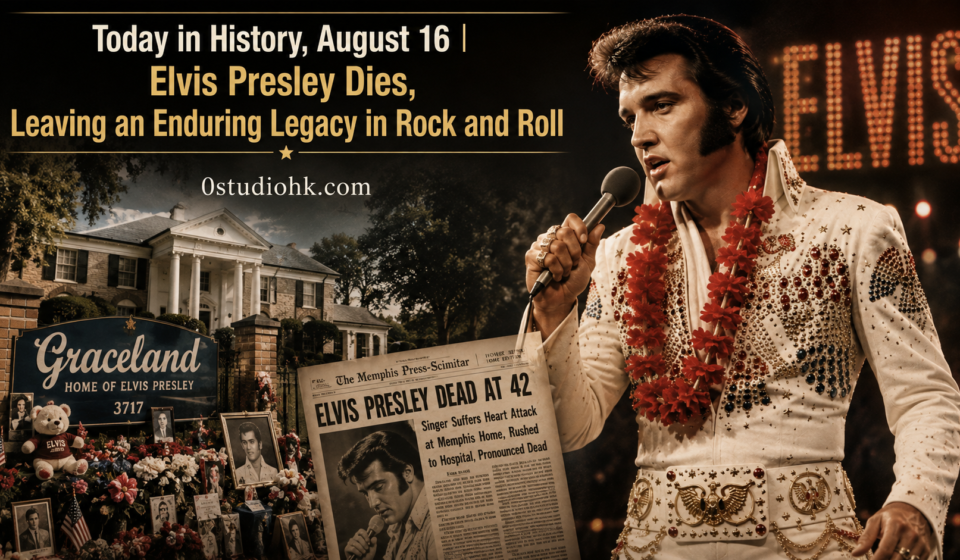
🎵8月16日今日歷史|貓王Elvis Presley逝世,搖滾樂壇巨星時代留下永恆印記 | Today in History, August 16 | Elvis Presley Dies, Leaving an Enduring Legacy in Rock and Roll
1977年8月16日,42歲的貓王Elvis Presley在美國孟菲斯Graceland逝世。他以充滿活力的舞台表演、獨特聲線與突破性的音樂風格改變流行文化,離世消息震動全球,也令無數歌迷聚集Graceland悼念這位「搖滾樂之王」。
On August 16, 1977, Elvis Presley died at the age of 42 at his Graceland home in Memphis. More than a superstar, he had transformed popular music and stage performance. News of his sudden death shocked the world, while thousands of grieving fans gathered at Graceland to remember the King of Rock and Roll.
中文版本
1977年8月16日,一代音樂巨星Elvis Presley在美國田納西州孟菲斯的Graceland逝世,終年42歲。對全球流行音樂而言,這一天不只是一位著名歌手離世的日子,更象徵一個曾經席捲1950年代、改變年輕人文化與娛樂方式的音樂時代留下深刻印記。Elvis被世人稱為「搖滾樂之王」,他的音樂、舞台動作、服裝以及個人形象,早已超越單純歌手的範疇,成為20世紀流行文化最具代表性的符號之一。
Elvis Aaron Presley於1935年1月8日出生於美國密西西比州Tupelo,童年時期生活並不富裕。高中畢業後,他曾經當過貨車司機。1954年,19歲的Elvis走進孟菲斯一家錄音室,希望錄製歌曲送給母親,原本只是一個看似普通的私人行動,卻意外成為他音樂生涯的重要起點。錄音室老闆Sam Phillips注意到他的聲音特色,之後讓他與當地音樂人合作。當Elvis演唱節奏藍調歌曲《That’s All Right》時,他把鄉村音樂元素與黑人節奏藍調的音樂特色融合起來,形成充滿活力的新聲音,逐漸受到聽眾注意。
到了1955年,Elvis的唱片合約由Sun Records轉至RCA,這次轉變令他的事業進入更大的舞台。1956年推出的《Heartbreak Hotel》迅速令他成為全國知名人物,其後《Hound Dog》和《Don’t Be Cruel》等歌曲進一步鞏固他的明星地位。同年,他登上美國著名電視節目《The Ed Sullivan Show》,充滿力量的舞台表演以及具有爭議性的身體動作,令大量年輕觀眾著迷,同時也引起不少家長反感。Elvis的形象因此成為當時美國社會世代文化衝突的一部分。
Elvis的重要性並不只在於唱片銷量。他出現的時代正值美國青年文化快速形成,收音機、唱片、電視與電影開始共同塑造新一代娛樂市場。Elvis把黑人節奏藍調、鄉村音樂與流行音樂元素融合,再透過強烈的舞台表現呈現給大眾,使搖滾樂進一步走向主流。他的成功亦為不同背景的音樂人打開更多市場空間。到了1950年代後期,Elvis已經不再只是地方歌手,而成為全國性的文化現象。
1958年,Elvis被徵召加入美國陸軍,並在西德服役約18個月。即使離開娛樂圈,唱片公司仍然利用他此前錄製的歌曲維持市場熱度。退伍後,他的音樂風格逐漸改變,從早期充滿節奏與活力的搖滾風格,轉向更多抒情及戲劇性的歌曲。同時,他開始大量投入電影事業,在1960年代主演多部電影,包括《G.I. Blues》、《Blue Hawaii》及《Viva Las Vegas》等,並透過電影配樂繼續維持其明星地位。
然而,流行文化從來不會停留在同一個時代。1960年代後期,搖滾音樂出現新的方向,年輕聽眾開始追逐不同的歌手和音樂形式。Elvis的音樂事業一度受到挑戰。不過,1968年的電視特別節目重新喚起大批歌迷的注意,讓他重新回到舞台中心。到了1970年代,他仍然擁有龐大的歌迷群和極高的商業價值,並透過演唱會、電視節目及其他演藝活動維持巨星地位。
到了1970年代中期,Elvis的生活逐漸出現嚴重問題。他的身體狀況下降,長期使用處方藥物亦成為外界關注的問題。即使健康情況已經令人擔憂,他仍然繼續進行演唱會及公開演出。1977年,他仍然安排巡迴演唱活動,而他的最後一場演唱會是在6月26日於印第安納波利斯舉行。原定8月17日開始新的巡演,但就在巡演開始前一天,Elvis的人生突然走到終點。
1977年8月16日下午,Elvis在Graceland住所內被發現失去知覺,隨即被送往孟菲斯的Baptist Memorial Hospital,醫生其後宣布他死亡。當時官方公布的死因與心律不整有關;多年來,Elvis的健康狀況、處方藥物使用以及其他身體問題亦一直受到研究與討論。關於他的死亡原因,後世曾出現不同說法,因此回顧這段歷史時,應把已確認的死亡日期與官方醫療結論,和後來的各種推測區分開來。
Elvis離世的消息很快傳遍世界。大量歌迷前往Graceland,希望向這位陪伴他們成長的歌手作最後告別。原本是一座私人住宅的Graceland,從此逐漸成為Elvis文化的重要象徵,也成為全球歌迷朝聖的地方。Elvis的突然離世讓人們重新思考一位超級明星背後的生活,以及成名、工作壓力、健康與私人生活之間的複雜關係。
Elvis對音樂史的影響直到今天仍然存在。他並不是第一位演唱搖滾音樂的人,但他成功把不同音樂傳統帶進主流市場,並以極具個人特色的形象讓搖滾樂成為全球流行文化的重要部分。他的唱片、電影、舞台表演和服裝風格,都對後來的歌手產生影響。即使數十年過去,Elvis這個名字仍然能讓人聯想到搖滾樂、舞台魅力與1950年代的青年文化革命。
今天回望1977年8月16日,我們看到的並不只是「貓王逝世」這一則新聞,而是一個文化時代的重要轉折。Elvis的一生只有42年,但他的音樂生涯卻深深改變了娛樂產業。他證明了一位歌手可以同時成為音樂明星、電影演員、電視人物以及文化偶像。更重要的是,他的成功說明流行音樂不只是聲音,也可以透過舞台、影像、服裝和青年文化形成一種完整的社會現象。
因此,8月16日成為音樂史上一個令人感慨的日子。對歌迷而言,這是失去偶像的一天;對流行文化而言,則是見證一個傳奇生命結束的日子。Elvis雖然已經離開人世多年,但他的歌曲仍然被播放,他的影像仍然被觀看,而Graceland亦繼續吸引來自世界各地的人們。時間可以帶走一位歌手,卻未必能帶走他留在文化中的聲音。
[audiobook title=”8月16日今日歷史” src=”https://pub-0d950852c1b24118b76198710040037c.r2.dev/wp-content/uploads/2026/08/August_16_out.mp3″]
English Version
August 16, 1977, became one of the most memorable dates in the history of popular music when Elvis Presley died at his Graceland home in Memphis, Tennessee, at the age of 42. Known around the world as the “King of Rock and Roll,” Elvis had transformed the way popular music was performed and experienced. His distinctive voice, energetic stage presence, striking appearance, and rebellious image made him one of the defining entertainers of the twentieth century. His death brought an extraordinary wave of grief from fans across the United States and around the world.
Elvis Aaron Presley was born on January 8, 1935, in Tupelo, Mississippi. His childhood was far from glamorous, and his family lived with limited financial resources. After leaving high school, Elvis worked as a truck driver. His life changed when, at the age of 19, he entered a recording studio in Memphis to make a small recording as a gift for his mother. What began as a personal gesture unexpectedly opened the door to a revolutionary musical career. Sam Phillips, the owner of Sun Records, noticed the young singer’s unusual voice and invited him to work with local musicians. When Elvis recorded “That’s All Right,” he brought together elements of rhythm and blues with country influences, creating a sound that immediately stood out.
Elvis’s career accelerated rapidly. In 1955, his contract was sold by Sun Records to RCA for a then-record $40,000. His first RCA single, “Heartbreak Hotel,” became a national sensation in 1956. Songs such as “Hound Dog” and “Don’t Be Cruel” further established him as one of the most important new performers in American entertainment. His appearances on television, particularly The Ed Sullivan Show, introduced his image to millions of viewers. His energetic movements and distinctive stage style fascinated teenagers while alarming many older viewers. Elvis had become more than a successful singer; he had become a symbol of a rapidly changing generation.
The rise of Elvis coincided with a major transformation in American youth culture. Radio, television, records, cinema, and teenage consumer culture were becoming increasingly connected. Elvis stood at the centre of that transformation. His music drew from several traditions, including rhythm and blues, country music, and popular song, while his stage performances gave the emerging rock-and-roll sound a powerful visual identity. His success helped push rock music into the mainstream and opened new commercial opportunities for performers who followed him. By the end of the 1950s, Elvis was no longer simply a promising young singer from Memphis. He had become an international cultural phenomenon.
In 1958, Elvis was drafted into the United States Army. He served for about 18 months, including time in West Germany. Even while he was away from the entertainment industry, previously recorded material continued to reach his audience. After returning to civilian life in 1960, he changed direction musically and increasingly focused on romantic and dramatic material. He also became heavily involved in Hollywood, appearing in numerous films throughout the 1960s. Movies such as G.I. Blues, Blue Hawaii, and Viva Las Vegas helped keep his name at the centre of popular entertainment, with many of his films also featuring songs that became part of his musical legacy.
Popular music, however, was changing quickly. By the late 1960s, rock music had developed in new directions and younger audiences were discovering different performers and sounds. Elvis’s career had lost some of its earlier momentum, but his 1968 television special helped restore his public image and reminded audiences of his extraordinary stage presence. During the 1970s, he remained a major concert attraction and television personality. Even when his chart success was no longer comparable to the height of the 1950s, his fame remained enormous. His name alone continued to attract audiences wherever he performed.
Behind the public image, however, Elvis was experiencing increasingly serious personal and health difficulties. His physical condition deteriorated during the 1970s, and his dependence on prescription medication became a growing concern. Despite these problems, he continued to perform. In 1977 he was still working on a demanding concert schedule. His final concert took place on June 26 in Indianapolis, and another tour was scheduled to begin on August 17. Instead, on the day before that tour was due to start, Elvis Presley died.
On the afternoon of August 16, Elvis was found unresponsive inside Graceland. He was taken to Baptist Memorial Hospital in Memphis, where doctors pronounced him dead. He was only 42 years old. Contemporary reporting and later historical accounts have discussed several aspects of his health and prescription-drug use. The official medical conclusion at the time was associated with cardiac arrhythmia, while later investigations and biographies have examined a much wider range of health factors. Because many theories have developed around his death over the decades, it is important to distinguish the established facts from later speculation.
News of Elvis’s death spread around the world almost immediately. Thousands of mourners travelled to Graceland, his Memphis home, to pay their respects. The extraordinary response demonstrated the depth of his connection with his audience. For many fans, Elvis had been part of their youth, their memories, and the soundtrack of an entire generation. His death therefore felt less like the passing of an ordinary entertainer and more like the closing of a chapter in modern popular culture.
Graceland itself later became an enduring symbol of Elvis’s legacy. The mansion, once his private home, developed into a major destination for fans and visitors from around the world. People continued to travel there decades after his death, demonstrating how strongly his image and music remained embedded in popular culture. Elvis’s legacy was preserved not only through recordings but also through photographs, films, television appearances, memorabilia, and the stories of the people who had seen him perform.
Elvis’s influence on music history is difficult to measure because it extended far beyond record sales. He was not the first performer to sing rock and roll, nor did he invent every musical element associated with the genre. His importance came from the way he brought different musical traditions together and presented them to a mass audience through an extraordinary combination of voice, movement, image, and charisma. He helped make rock and roll a central part of mainstream entertainment and influenced generations of singers who came after him.
His career also demonstrated how modern celebrity culture was beginning to develop. Elvis was simultaneously a recording artist, television personality, film star, concert performer, and commercial brand. His appearance mattered almost as much as his music, while his stage movements became instantly recognisable. The combination of sound and image helped establish a model for the modern pop superstar. Many later performers would build their careers using similar combinations of music, performance, fashion, television, and visual identity.
Looking back at August 16, 1977, the story is therefore larger than the death of one famous singer. It is the story of the end of a remarkable life that had helped reshape popular culture. Elvis rose from a modest background to become one of the most recognisable entertainers in the world. His career reflected the dramatic changes taking place in American society during the 1950s and 1960s, while his later years showed the enormous pressures that could accompany extraordinary fame.
Decades after his death, Elvis remains a household name. His songs continue to be heard, his performances continue to be studied, and his image continues to appear in films, television, music, advertising, and popular culture. Younger generations who were born long after his death can still encounter his performances and discover why audiences were fascinated by him in the first place. His continued cultural presence demonstrates that an artist’s influence does not necessarily disappear when the artist is gone.
August 16 is therefore remembered as both a day of loss and a date in the history of cultural transformation. For Elvis’s fans, it marked the sudden end of an extraordinary performer. For music history, it marked the passing of one of the central figures in the development of modern popular entertainment. Elvis Presley lived only 42 years, but his career left an influence that reached far beyond his lifetime.
總結
1977年8月16日,42歲的Elvis Presley在Graceland逝世。從貧困少年到「搖滾樂之王」,他以音樂與舞台魅力改變流行文化,留下跨越世代的傳奇。
English
On August 16, 1977, Elvis Presley died at 42, ending the life of a performer who had transformed popular music. From a modest beginning to global superstardom, his influence continues across generations.