
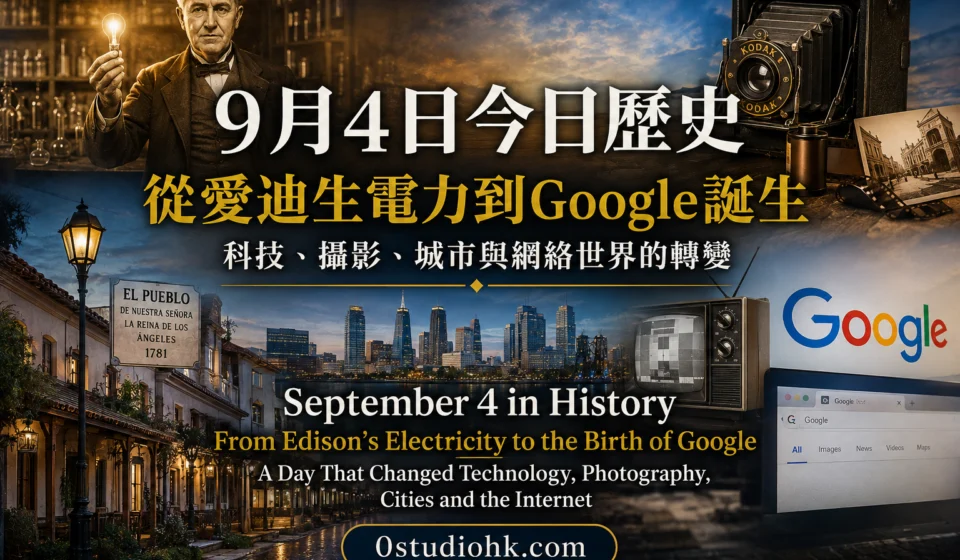
9月4日今日歷史|從愛迪生電力到Google誕生|科技、攝影、城市與網絡世界的轉變|September 4 in History|From Edison’s Electricity to the Birth of Google|A Day That Changed Technology, Photography, Cities and the Internet
9月4日見證電力普及、攝影革命、城市誕生與Google成立,科技在這一天留下多個改變世界的足跡。
English:September 4 connects electricity, photography, urban development and the birth of Google, revealing how technology gradually reshaped modern life.
中文版本
9月4日是一個很有意思的歷史日子,如果避開戰爭與太空探索,仍然可以找到許多直接影響現代生活的重大事件,其中包括電力商業化、攝影普及、城市發展、建築規劃,以及後來改變互聯網使用方式的Google。1882年9月4日,托馬斯・愛迪生(Thomas Edison)在紐約曼哈頓啟動珍珠街發電站(Pearl Street Station),開始向付費客戶提供集中式電力服務。這被視為現代商業電力供應的重要里程碑。當時的城市主要依靠煤氣燈、蠟燭及其他照明方式,而集中發電再透過電力網絡向建築物供電,代表人類開始逐步建立今天熟悉的城市電力系統。珍珠街發電站最初服務的客戶數量並不多,但它展示了一個關鍵概念:電力不再只是實驗室裡的科學成果,而可以成為一種可以生產、分配及收費的公共服務。這個轉變最終影響照明、工業、商業、交通以及家庭生活,電力亦逐漸成為現代城市不可缺少的基礎設施。 同一天的1888年,攝影歷史又出現重要突破。喬治・伊士曼(George Eastman)取得使用卷裝菲林相機的專利,並註冊「Kodak」商標。當時攝影仍然是一項需要相當專業知識的活動,傳統攝影設備笨重、操作複雜,而且需要處理玻璃底片等材料。卷裝菲林令攝影設備更容易攜帶,也令普通人接觸攝影變得更加容易。伊士曼後來以Kodak品牌推動簡化攝影的理念,讓攝影逐漸從專業工作變成大眾可以參與的興趣。這種變化十分重要,因為它不只是改良了一部相機,而是改變了人們記錄家庭、旅行、人物和日常生活的方式。今天手機隨手拍照看似理所當然,其實背後經歷了一百多年技術逐步簡化的過程,而Kodak在這條道路上留下了非常重要的一步。 1781年9月4日,另一個後來成為全球知名城市的地方正式建立。44名西班牙殖民者在今天的美國加州建立El Pueblo de Nuestra Señora La Reina de los Ángeles de Porciúncula,這個聚落後來發展成洛杉磯(Los Angeles)。當時沒有人可以預料,這個小型聚落最終會成為世界上最具影響力的城市之一。今天的洛杉磯與電影、電視、音樂、汽車文化、商業及國際移民密切相關,而它最初只是18世紀加州的一個新聚落。城市的歷史提醒我們,大城市並不是突然出現的,而是經過人口增加、交通建設、產業發展及文化交流,一代又一代逐步形成。 9月4日亦與現代城市規劃及建築有密切關係。1846年出生的美國建築師及城市規劃師丹尼爾・伯納姆(Daniel H. Burnham),正是在這一天出生。他後來成為芝加哥建築學派的重要人物之一,參與設計多座具有代表性的建築,也推動大型城市規劃。伯納姆尤其重視城市整體規劃,而不是只集中於單一建築。他參與的《芝加哥規劃》對後來的城市發展思想產生深遠影響,提出有系統地處理道路、公園、公共空間及城市成長的方法。今天人們談論城市規劃、公共空間及城市美學時,很多概念都可以追溯到19世紀末及20世紀初的城市規劃運動。 進入20世紀,1951年9月4日,美國出現電視廣播史上的重要時刻:首次進行橫跨美國東西岸的現場電視廣播。這代表電視不再只是地方性的娛樂媒體,而開始具備把同一個節目即時送到遙遠地區的能力。當時的技術條件與今天完全不同,跨洲傳輸需要複雜的通訊設施,但這類突破為後來的全國新聞、現場節目、體育賽事及大型電視活動奠定了基礎。電視後來成為20世紀最重要的大眾媒體之一,也改變了人們獲取新聞及娛樂的方式。 1985年9月4日,科學界又有一項重要發現。研究人員發現了Buckminsterfullerene,也就是由碳原子組成的一種特殊分子,後來通常稱為「Buckminsterfullerene」或「巴克球」(buckyball)。它屬於富勒烯(fullerene)家族,因其結構與建築師Buckminster Fuller設計的穹頂有相似之處而得名。這項發現為碳元素的研究打開新的方向,後來對材料科學、奈米科技及化學研究產生影響。 而到了1998年9月4日,一個對今天互聯網使用方式影響極大的名字正式出現:Google。Larry Page與Sergey Brin在史丹福大學研究期間開始研究網頁搜尋及互聯網資料之間的關係,並於1998年9月4日正式成立Google公司。當時互聯網上的資料已經快速增加,如何從大量網頁中找到真正有用的資訊,開始成為一個越來越重要的問題。Google的搜尋方法令使用者更容易找到相關資訊,後來更逐步發展成全球最具影響力的科技公司之一。今天我們輸入一個問題、幾個關鍵字,就可以在數秒內找到大量資料,已經成為日常生活的一部分;但在互聯網早期,搜尋資訊遠沒有今天方便。Google的成立因此不只代表一家公司誕生,也象徵互聯網由一個充滿實驗性的資訊網絡,逐步變成普通人每天使用的全球資訊工具。 回望9月4日,可以看到一條很有趣的科技發展脈絡:愛迪生讓電力逐漸走出實驗室,進入城市生活;伊士曼讓攝影變得更容易接近普通人;城市規劃者開始思考如何讓快速成長的城市更有秩序;電視突破地域限制,讓資訊可以即時傳送到更遠的地方;科學家探索碳元素的新結構;而Google則讓人們在互聯網的巨大資訊海洋中更容易尋找答案。這些事情看似分散於不同年代和不同領域,但其實都有一個共同方向,就是「讓原本困難的事情變得更加容易」。照明變得容易,拍照變得容易,城市生活變得更有系統,跨地域觀看節目變得可能,而尋找資訊更成為日常動作。歷史真正有趣的地方,往往不是某一天發生了一件驚天動地的大事,而是許多看似普通的技術改進,在幾十年甚至一百年後,已經徹底改變我們生活的方式。9月4日正好讓我們看到這種變化:從電燈到相機,從城市規劃到電視,再從科學研究到搜尋引擎,人類不斷把新的想法變成可以使用的工具,而這些工具最終又反過來改變社會。
English Version
September 4 offers a fascinating collection of stories about technology, photography, cities, science and the development of the modern information society. Without focusing on wars or space exploration, the date still contains several events that had a direct influence on everyday life. One of the most important took place in 1882, when Thomas Edison opened the Pearl Street Station in lower Manhattan and began supplying electricity to paying customers. The station represented an important step in the development of commercial electric power. Before systems like this existed, urban lighting depended heavily on gas, candles and other forms of illumination. Edison and his colleagues were demonstrating that electricity could be generated centrally, distributed through a network and sold as a practical service. The first station was small by modern standards, but the principle was revolutionary. Electricity could become part of the infrastructure of an entire city rather than remaining primarily an experimental technology. Over the following decades, electrical networks expanded and transformed factories, offices, shops, streets and homes. Lighting hours became less dependent on daylight, machinery could be powered more efficiently, and cities could develop new forms of commercial and industrial activity. The modern world is almost impossible to imagine without electricity, and September 4, 1882, represents one of the important early steps toward that reality. September 4 also marks a major moment in the history of photography. In 1888, George Eastman received a patent for a camera using roll film and registered the Kodak trademark. Photography at the time could still be complicated, expensive and difficult for ordinary people. Earlier photographic systems often required heavy equipment and specialised knowledge, while glass plates and chemical processing made photography far less convenient than it is today. Roll film helped simplify the process and made cameras more portable. Eastman’s Kodak business later promoted a philosophy of making photography easier for ordinary customers, helping transform photography from a specialist activity into a popular hobby. This change had consequences far beyond the camera industry. Once photography became easier to use, people could record family occasions, holidays, friends, streets and everyday experiences on a much larger scale. Modern smartphone photography may seem completely natural, but the idea that almost anyone can carry a camera and instantly record a moment is the result of more than a century of technological simplification. Kodak was one of the major steps along that path. Another important September 4 story began in 1781, when 44 Spanish settlers established a settlement in what is now California. The settlement was formally named El Pueblo de Nuestra Señora La Reina de los Ángeles de Porciúncula and eventually became Los Angeles. At the time, there was no way to predict that this small settlement would grow into one of the world’s most influential cities. Modern Los Angeles is closely associated with film, television, music, entertainment, automobiles, international business and immigration. Its history demonstrates that major cities do not appear overnight. They develop through population growth, transportation, investment, industry and cultural exchange over generations. A settlement that once seemed relatively small can eventually become a global centre whose influence reaches far beyond its original location. September 4 is also connected with the history of modern urban planning through the birth of Daniel H. Burnham in 1846. Burnham became one of the important architects and city planners associated with the development of the Chicago School and the transformation of American cities in the late nineteenth and early twentieth centuries. His work went beyond individual buildings. He was interested in how streets, parks, public spaces, transportation and architecture could work together as part of a larger urban system. His Plan of Chicago, developed with Edward H. Bennett, became one of the best-known examples of large-scale American urban planning. Burnham’s ideas reflected a growing recognition that rapidly expanding cities needed deliberate planning rather than simply allowing development to happen without coordination. Many modern discussions about public spaces, transportation corridors and organised urban growth can be connected to this period of planning history. Another technological milestone came in 1951, when the United States carried out the first live transcontinental television broadcast. The event demonstrated that television could connect audiences across enormous distances in real time. Television technology was still developing, and such a broadcast required complex communication infrastructure. Nevertheless, the achievement helped establish the possibility of nationwide live television, opening the way for national news programmes, live entertainment, sports coverage and major public events. Television would become one of the defining mass-media technologies of the twentieth century, changing how millions of people received information and experienced entertainment. September 4, 1985, brought an important scientific discovery involving carbon. Researchers identified Buckminsterfullerene, a remarkable molecular structure made entirely from carbon atoms. It became one of the best-known members of the fullerene family and was later commonly associated with the nickname “buckyball.” Its unusual structure attracted enormous scientific interest because carbon was already known in several important forms, yet this newly recognised molecular arrangement revealed another possibility. The discovery opened new areas of research in chemistry and materials science and later became relevant to the broader development of nanotechnology. Then, in 1998, September 4 became associated with one of the most influential developments in the history of the internet. Larry Page and Sergey Brin, who had been researching information retrieval and the structure of the World Wide Web at Stanford University, formally founded Google on September 4, 1998. The internet was already growing rapidly, but finding useful information among an expanding number of websites was becoming increasingly difficult. Search engines existed before Google, but Page and Brin developed methods for analysing relationships between web pages in order to improve the relevance of search results. Google eventually grew far beyond its original search-engine role and became one of the world’s most influential technology companies. Today, typing a few words into a search box and receiving thousands or millions of possible results within seconds feels completely ordinary. In the early internet era, however, finding reliable information was much less convenient. Google’s rise helped transform the web from a rapidly expanding collection of pages into an information environment that ordinary people could navigate with relative ease. Looking across these events, September 4 reveals a remarkable pattern. Edison helped move electricity from experimental science toward everyday infrastructure. Eastman’s roll-film technology helped make photography more accessible. Burnham encouraged cities to think about growth as a planning problem rather than simply a consequence of population expansion. Television technology demonstrated that information and entertainment could cross a continent almost instantly. Scientists discovered new possibilities within one of the most familiar elements on Earth, while Google made the rapidly expanding internet easier to navigate. These developments belong to very different fields, yet they share a common theme: making difficult things easier and more accessible. Electricity made artificial light and powered machinery widely available. Simplified cameras allowed ordinary people to record their lives. Urban planning attempted to make growing cities more manageable. Television connected distant audiences, while search engines helped people navigate an enormous amount of information. History is often remembered through dramatic events, but the quieter history of technology can be just as important. A new power system, a simpler camera, a better city plan or a more effective search method may not seem revolutionary on the day it appears. Yet decades later, such innovations can become so deeply embedded in everyday life that people forget they were once new ideas. September 4 gives us a chance to look at that process and recognise how modern life was gradually constructed through thousands of discoveries, inventions and practical improvements. From electric light to digital search, the story is ultimately about people finding new ways to extend what they can do, record what they see, organise the places where they live and find the information they need.
總評
中文版本:9月4日串連電力、攝影、城市規劃、電視、材料科學與搜尋引擎,展現科技如何把曾經陌生的創新,逐步變成現代生活不可缺少的一部分。
English Version:September 4 connects electricity, photography, urban planning, television, materials science and internet search, showing how once-new inventions gradually became essential parts of everyday life.