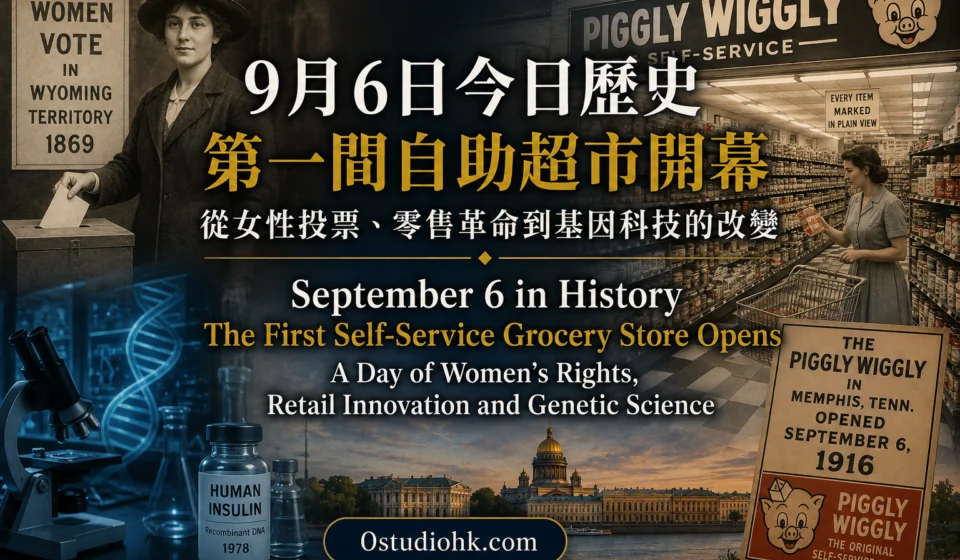
9月6日今日歷史|第一間自助超市開幕|從女性投票、零售革命到基因科技的改變|September 6 in History|The First Self-Service Grocery Store Opens|A Day of Women’s Rights, Retail Innovation and Genetic Science
9月6日見證女性投票、零售自助化與基因科技突破,許多今天熟悉的生活方式,都在這一天留下足跡。
English:September 6 brings together milestones in voting rights, retail innovation and biotechnology that helped reshape everyday life and modern society.
中文版本
9月6日是一個很適合從日常生活角度閱讀的歷史日子,因為這一天發生的幾件事情,並沒有停留在歷史課本之中,而是一直延伸到我們今天的生活。1870年9月6日,美國懷俄明州拉勒米的Louisa Ann Swain參加地方選舉並投下選票,成為美國有記錄以來最早依法投票的女性之一。當時美國女性在全國層面仍然沒有普遍的投票權,但懷俄明領地早在1869年已經通過法律,容許女性參與選舉,因此Swain得以在地方選舉中行使投票權。這件事情的重要性,不只是某一位女性走進投票站,而是反映19世紀社會開始重新思考女性在公共生活中的角色。投票權代表的不只是選擇政治人物,也代表一個人是否被視為有能力參與決定社會未來。多年之後,美國女性才在全國層面取得憲法保障的投票權,但Swain的故事仍然成為女性參政歷史中的重要一頁。(timeanddate.com) 如果說女性投票代表社會制度逐漸改變,那麼1916年9月6日發生在美國田納西州孟菲斯的事情,則直接改變了普通人購買食物的方法。Clarence Saunders開設了第一間Piggly Wiggly自助式雜貨店。當時一般雜貨店的購物方式與今天非常不同,顧客通常需要站在櫃檯前,告訴店員自己想買甚麼,再由店員從貨架後方取出商品。Piggly Wiggly則讓顧客自己走進店內、拿起籃子、沿著店內通道選擇商品,最後到收銀處付款。這種模式今天看起來再普通不過,但在1916年卻是一項相當大的零售創新。自助購物改變了顧客與商品之間的關係,消費者第一次可以直接看見大量商品、比較不同品牌及自行決定購買甚麼。這種設計也令零售商開始重新思考貨架陳列、商品包裝、價格標示、店舖動線及收銀流程。今天我們走進超市,推著購物車或拿著購物籃,自行挑選麵包、飲品、蔬菜、日用品,再到收銀機付款,幾乎已經成為全球城市生活的一部分;但這套模式並不是一直存在,而是經過一百多年零售業不斷改良形成。Piggly Wiggly的出現,因此可以被視為現代超市文化的重要起點之一。 這件事尤其值得從零售歷史角度重新理解,因為它不只是「第一間自助超市」這麼簡單。自助購物意味著店舖需要讓顧客自己完成更多工作,而零售商則需要利用更清晰的商品分類、包裝、價格和店內動線,讓顧客能夠快速找到所需要的東西。換句話說,現代超市的很多基本概念,其實都與這種早期自助零售模式有關。到了今天,零售業更進一步發展出條碼、POS系統、自助收銀、電子價格牌、會員系統、網上訂購及自動補貨等技術,但核心概念仍然沒有完全改變:讓顧客更方便地找到商品、作出選擇並完成交易。9月6日也見證了科學研究如何從實驗室走進普通人的生活。1978年,美國科學家宣布成功利用基因工程技術,讓經過改造的大腸桿菌製造人類型胰島素。這項研究是基因重組技術發展的重要里程碑,研究人員將與人類胰島素有關的遺傳資訊引入細菌,使這些微生物能夠生產具有醫療用途的胰島素。當時這是一個非常嶄新的概念,因為科學家不再只是從動物組織取得所需物質,而是開始利用生物工程技術讓微生物成為生產工具。這項突破後來促成重組DNA藥物的發展,1982年人類重組胰島素Humulin正式上市,成為第一批進入市場的重組DNA藥物之一。這個故事的重要性在於,它展示了現代生物科技的一個基本思想:不是單純尋找自然界已有的材料,而是利用基因與細胞本身的機制,建立新的生產方法。今天基因工程、生物製藥及合成生物學已經成為重要科學領域,而9月6日這段歷史正好讓我們看到其中一個關鍵轉折。 9月6日亦是一個城市名稱重新回到歷史傳統的日子。1991年,蘇聯時期稱為列寧格勒(Leningrad)的城市正式恢復聖彼得堡(Saint Petersburg)這個歷史名稱。這個城市在不同歷史時期曾經使用不同名稱,而名稱的改變往往不只是文字上的變化,也反映社會、政治及文化對城市身份的理解。恢復原名後,「Saint Petersburg」再次成為這座城市在國際上廣泛使用的名稱。城市名稱看似只是一個標籤,但它其實可以承載歷史記憶、文化傳統以及居民對家鄉的認同。從一個城市名稱的改變,我們可以看到歷史如何影響現代人的生活,而城市本身也會透過名字保留不同年代留下的痕跡。 如果把這些事件放在一起,9月6日呈現出一條非常有趣的歷史線索:女性開始獲得更多參與公共生活的機會;顧客開始可以自己走進商店選購商品;科學家開始利用基因工程生產重要藥物;城市則重新思考自己的歷史身份。這些事情沒有一件需要靠戰爭才能解釋,也不需要放到太空探索的背景中。它們都是與普通人生活直接相關的改變。今天我們可以投票、走進超市自行購物、使用現代醫療產品,以及在地圖上看到熟悉的城市名稱,背後都有一段漫長的歷史。歷史真正有趣的地方,往往就在這些我們已經習以為常的事情裡。9月6日提醒我們,社會進步不一定是突然發生的巨大轉折,而可以是一張選票、一間新式商店、一項實驗室突破,甚至是一個城市重新使用自己的名字。當這些小小的變化累積起來,最終就會形成我們今天所熟悉的生活方式。
English Version
September 6 offers a fascinating look at how ordinary life can be transformed by changes in rights, retail, science and culture. One of the earliest milestones connected with the date occurred in 1870, when Louisa Ann Swain cast a ballot in a local election in Laramie, Wyoming. Wyoming Territory had already passed legislation allowing women to vote, making it possible for Swain to participate in an election at a time when women across much of the United States still lacked voting rights. Her action became part of the wider history of women’s participation in public life. The importance of the event goes beyond one woman placing a ballot in a box. Voting represents the recognition that individuals should have a voice in decisions affecting their communities and their future. National voting rights for American women would not arrive until decades later, but early examples such as Swain’s demonstrated that the idea of women participating in elections was already becoming a reality in some parts of the country. Her story therefore belongs to the much larger history of social change and political participation. (timeanddate.com) If women’s voting rights represented a change in society, another September 6 event transformed something much more familiar: the way people buy groceries. On September 6, 1916, Clarence Saunders opened Piggly Wiggly in Memphis, Tennessee, widely recognised as the first self-service grocery store. Before self-service shopping became common, customers usually stood at a counter and told a shop assistant what they wanted. The employee then collected the products from shelves behind the counter. Piggly Wiggly introduced a completely different experience. Customers could enter the store, take a basket, walk through the aisles, select their own products and bring them to a checkout. Today this process seems so ordinary that it is difficult to imagine a supermarket working any other way. In 1916, however, it represented a major change in retail. Customers could see a much wider selection of products directly, compare brands and prices and make purchasing decisions without asking a shop assistant to retrieve every item. The new system also required retailers to rethink how stores were organised. Product displays, packaging, price labels, aisle layouts and checkout procedures all became increasingly important. The basic self-service concept eventually spread far beyond one store and became one of the foundations of modern grocery retail. From today’s perspective, the importance of Piggly Wiggly is not simply that it was an early supermarket. Self-service changed the relationship between shoppers and products. Customers became active participants in the shopping process, while retailers had to make stores easier to navigate and products easier to identify. The development of modern supermarkets continued for more than a century, bringing barcode scanners, point-of-sale systems, self-checkout machines, electronic price displays, loyalty programmes, online ordering and increasingly sophisticated inventory systems. Yet the basic idea remains surprisingly similar to the principle introduced by early self-service stores: make it easier for customers to find products, compare choices and complete a purchase. This is why September 6 is particularly interesting from a retail-history perspective. A simple change in store design eventually influenced the shopping habits of millions of people around the world. The date also marks an important moment in the development of modern biotechnology. In 1978, scientists in the United States announced that they had successfully produced human-type insulin using genetically engineered bacteria. Researchers used genetic engineering techniques to introduce the information needed to produce human insulin into a strain of Escherichia coli. The bacteria could then be used as biological factories for producing the substance. This was a major step in the development of recombinant DNA technology. Instead of relying only on materials obtained from animal sources, scientists were beginning to use the machinery of living cells to produce medically important substances. The breakthrough helped demonstrate the potential of biotechnology to manufacture medicines in new ways. In 1982, recombinant human insulin, marketed as Humulin, became the first recombinant DNA drug to reach the market. The story illustrates one of the central ideas of modern biotechnology: scientists can use genetic information and cellular processes to create useful biological products rather than simply extracting them from nature. Genetic engineering, biotechnology and biopharmaceutical production have since developed into major scientific fields, and the work announced in 1978 represents an important step along that path. September 6 also marks a significant change in the identity of a major European city. In 1991, the Russian city known for decades as Leningrad officially restored its historic name, Saint Petersburg. The city had carried different names during different periods of its history, and changing a city’s name can represent much more than a simple administrative decision. Names can carry memories, traditions and ideas about identity. Restoring the name Saint Petersburg therefore connected the modern city once again with its earlier historical heritage. A city name may appear to be nothing more than a label on a map, but it can contain layers of cultural memory. The story demonstrates how history continues to influence the way people understand the places where they live. When these events are considered together, September 6 reveals a remarkable pattern. A woman gaining the opportunity to vote represented a change in social participation. A new grocery-store model changed the relationship between shoppers and retailers. Genetic engineering opened a new way to produce an important medicine. A historic city name was restored, reconnecting modern identity with the past. These stories may appear unrelated, but they share a common feature: each changed something that ordinary people could experience in everyday life. We often think of history through dramatic political events, but some of the most lasting changes happen quietly. A ballot can represent a new social possibility. A shopping aisle can transform consumer behaviour. A laboratory experiment can eventually affect millions of patients. A city name can preserve cultural memory for future generations. September 6 therefore provides an excellent reminder that modern life was not created in a single moment. It developed through countless decisions, experiments and innovations. The supermarket aisle where we pick up our own groceries, the medicines produced through biotechnology, the right to participate in public life and the names of the cities we recognise all have histories behind them. Looking at September 6 from this perspective makes history feel much closer to everyday life. Progress does not always arrive as a dramatic event. Sometimes it begins with one person casting a vote, one shop changing its layout, one scientific team trying a new technique or one city choosing to reconnect with its historical identity. Over time, those changes can become so familiar that we forget they were once new. September 6 reminds us to look again at the ordinary things around us and ask how they came to exist. Behind many familiar habits and systems is a story of experimentation, persistence and social change.
總評
中文版本:9月6日從女性投票到自助超市,再到基因工程與城市名稱重塑,展現社會進步如何透過日常生活中的細小改變,逐步影響整個世界。
English Version:September 6 shows how everyday life can change through voting rights, self-service shopping, biotechnology and cultural identity, proving that lasting progress often begins with seemingly simple ideas.