🎵8月15日今日歷史|日本宣布投降,第二次世界大戰走向終結 | Today in History, August 15 | Japan Announces Surrender, Bringing World War II Toward an End
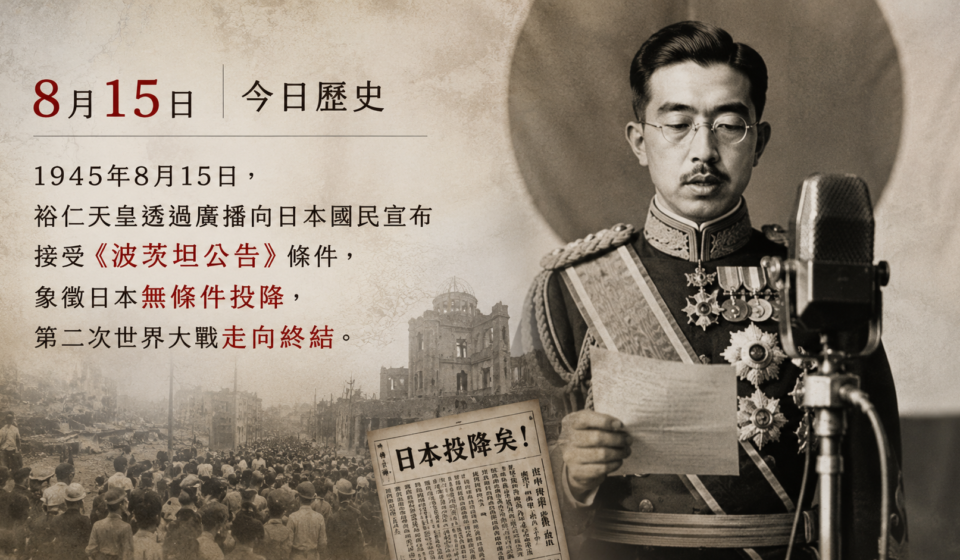
1945年8月15日,日本裕仁天皇透過廣播向全國宣布接受《波茨坦公告》條件,要求日本停止戰事。這段罕見的皇室聲音,象徵太平洋戰爭進入終局,也成為世界走出第二次世界大戰的重要歷史時刻。
On August 15, 1945, Emperor Hirohito addressed the Japanese people by radio and announced Japan’s acceptance of the Allied surrender terms. The message marked a dramatic turning point in the Pacific War and signaled that the six-year global conflict was moving toward its final conclusion.
中文版本
1945年8月15日,是第二次世界大戰歷史上一個令人難以忘記的日子。這一天,日本全國透過廣播聽到裕仁天皇的聲音,得知日本政府決定接受盟軍提出的投降條件。對當時的人來說,這不只是一次政治宣告,更意味著一場持續多年的戰爭即將停止。由於時區不同,盟軍方面在8月14日已經公開日本投降的消息,而在日本則是8月15日中午正式由天皇向國民宣布,因此8月14日與8月15日後來都曾被稱為「對日勝利日」或V-J Day。
1945年的亞洲仍然籠罩在戰爭陰影之下。歐洲戰場早在同年5月德國投降後結束,但日本與盟軍之間的戰爭仍在太平洋及亞洲持續。7月26日,美國、中國及英國發表《波茨坦公告》,要求日本接受投降條件;其後蘇聯亦加入相關要求。日本政府最初仍然沒有立即接受。到了8月6日,廣島遭到原子彈轟炸;8月9日,長崎再次遭到原子彈攻擊。同一時期,蘇聯於8月8日對日宣戰,紅軍隨後進入滿洲地區。日本所面對的軍事與政治壓力在短短數日內急劇增加。
在這個關鍵時刻,日本政府內部對是否投降仍存在嚴重分歧。日本最高決策層經過激烈討論後,裕仁天皇最終作出支持接受投降條件的決定。天皇的決定並沒有立即令所有反對投降的軍人接受現實。8月15日凌晨,甚至有軍方人士企圖阻止天皇的投降廣播,試圖控制皇宮並尋找已經錄製好的錄音。這場企圖阻止投降宣告的行動最終失敗。
到了8月15日中午,日本民眾第一次透過廣播直接聽見天皇的聲音。裕仁天皇以當時較為正式、一般民眾並不熟悉的宮廷語言宣讀終戰詔書,表示日本已決定接受《波茨坦公告》的條件。這次廣播並沒有以簡單直接的方式反覆使用「投降」一詞,而是以接受盟軍條件、停止戰事及為和平作出選擇的方式傳達訊息。對許多日本民眾而言,這是前所未有的經驗,也是戰爭即將結束的明確訊號。
消息傳出後,美國及其他盟國很快出現慶祝活動。經歷多年戰爭的人們終於等待到槍聲逐漸停止的時刻。不過,8月15日並不等同於日本完成法律及外交上的正式投降。真正具有正式法律文件性質的投降儀式,是在1945年9月2日於東京灣的美國戰艦密蘇里號上舉行。日本代表簽署《日本投降書》,正式接受盟軍條件,日本帝國大本營及其控制下的武裝力量宣布無條件投降。
9月2日的正式投降文件共有八個主要段落,內容包括日本接受《波茨坦公告》、命令所有日本軍隊停止敵對行動、向盟軍投降,以及釋放盟軍戰俘與被拘留的平民等。文件亦確立日本政府及天皇權力將受到盟軍最高統帥的安排與監督。美國、中國、英國、蘇聯及其他盟國代表在東京灣共同見證這場歷史性儀式。
因此,8月15日最重要的歷史意義,並不只是「一場戰爭結束」這麼簡單。它代表一個長達數年的全球衝突開始進入戰後時代,也揭開了亞洲政治、國際關係及日本社會重建的新階段。第二次世界大戰帶來的巨大傷亡、城市破壞、難民問題、戰俘遭遇,以及原子武器首次被使用所帶來的震撼,都使1945年的和平具有非常沉重的代價。對亞洲許多曾經受到戰爭影響的地區而言,8月15日同樣具有不同而深刻的歷史記憶。
今天回望1945年8月15日,我們可以看到一個重要的歷史轉折:戰爭的結束不是單純由某一個日期完成,而是一連串政治決定、軍事行動與外交安排共同形成的結果。8月15日是日本向國民宣布接受投降條件的重要日子,而9月2日則是正式簽署投降文件的日子。兩個日期共同構成第二次世界大戰最後階段的重要歷史坐標。
更值得記住的是,和平從來不是理所當然。1945年的人們在戰火之後面對的,是如何重建城市、社會與國際秩序的巨大課題。戰爭可以在文件上結束,但它留下的創傷往往需要數十年甚至更長時間才能逐漸消退。8月15日因此既可以被視為勝利與和平的象徵,也是一個提醒後人珍惜和平、理解戰爭代價的歷史日子。
[audiobook title=”8月15日今日歷史” src=”https://pub-0d950852c1b24118b76198710040037c.r2.dev/wp-content/uploads/2026/08/August_15_out.mp3″]
English Version
August 15, 1945, became one of the defining dates in the final chapter of the Second World War. On that day, the Japanese people heard Emperor Hirohito speak on the radio and learned that Japan had decided to accept the Allied terms of surrender. For millions of people living through years of war, the announcement represented far more than a political decision. It signaled that the fighting was finally approaching its end. Because of the time difference between Japan and the United States, the announcement of Japan’s surrender became public in the Allied world on August 14, while August 15 was the date remembered in Japan. Both dates have subsequently been associated with Victory over Japan Day, or V-J Day.
The announcement came after an extraordinary sequence of events during the summer of 1945. Germany had already surrendered in May, ending the war in Europe, but the conflict in the Pacific and Asia continued. On July 26, the United States, China, and Britain issued the Potsdam Declaration, calling on Japan to accept surrender terms. The Soviet Union later joined the Allied position. The Japanese government did not immediately accept the demand. Then, on August 6, an atomic bomb was dropped on Hiroshima. Three days later, another atomic bomb was dropped on Nagasaki. At the same time, the Soviet Union declared war on Japan on August 8 and launched an offensive into Japanese-held Manchuria. Japan’s strategic position deteriorated dramatically within a matter of days.
Inside Japan, the question of surrender remained deeply controversial. Political and military leaders debated what course the country should take as the war situation became increasingly desperate. Emperor Hirohito ultimately supported accepting the Allied terms. Yet the emperor’s decision did not immediately end resistance among those who opposed surrender. In the early hours of August 15, a group of military officers attempted to prevent the emperor’s surrender broadcast. The rebels sought control of the Imperial Palace and tried to locate the recorded message before it could be transmitted. Their attempt failed, allowing the broadcast to proceed.
At noon on August 15, the Japanese public heard Emperor Hirohito’s voice on national radio for the first time. His message was delivered in formal court language that many ordinary listeners found difficult to understand. Rather than presenting a simple statement in everyday language, the emperor announced that Japan had decided to accept the provisions of the Potsdam Declaration. He spoke of the need to endure hardship and pursue peace. The broadcast became a remarkable moment in Japanese history because the emperor, whose voice had previously been unavailable to the general population through radio, was now directly communicating the consequences of the country’s defeat.
Across the Allied world, news of the Japanese decision brought enormous celebrations. After years of global conflict, families and communities could finally look toward a future without the immediate threat of continued fighting. In the United States and other Allied countries, crowds gathered in public spaces to celebrate what appeared to be the end of the war. Yet there was an important distinction between the August 15 announcement and the formal legal surrender. Japan had announced its acceptance of the Allied terms, but the official surrender document still had to be signed.
That formal ceremony took place on September 2, 1945, aboard the USS Missouri in Tokyo Bay. Japanese representatives signed the Instrument of Surrender, formally accepting the Allied conditions and proclaiming the unconditional surrender of the Japanese Imperial General Headquarters and Japanese armed forces under its control. General Douglas MacArthur accepted the surrender on behalf of the United States, China, the United Kingdom, the Soviet Union, and the other Allied nations represented at the ceremony. The signing provided the formal conclusion to Japan’s participation in the Second World War.
The surrender document was more than a ceremonial statement. It contained specific instructions concerning the cessation of hostilities, the surrender of Japanese forces, the preservation of military and civilian property, and the release and protection of Allied prisoners of war and civilian internees. It also established that the authority of the Japanese Emperor and government would operate under the authority of the Supreme Commander for the Allied Powers during the implementation of the surrender terms. In this way, the document laid down the framework for the transition from wartime Japan to the postwar order.
The significance of August 15 therefore extends far beyond the announcement itself. It marked the beginning of a new historical era in Asia and around the world. The end of the Pacific War opened a period of reconstruction, political transformation, occupation, and the reshaping of international relations. The war had left enormous destruction behind. Cities had been devastated, millions of people had been killed or displaced, prisoners and civilians had suffered under wartime conditions, and the use of atomic weapons had introduced an entirely new dimension to the history of warfare. The transition from war to peace was therefore filled with both relief and enormous uncertainty.
For many societies across Asia, August 15 also carried memories shaped by their own wartime experiences. The end of Japanese military expansion meant the collapse of an imperial order that had affected large parts of East and Southeast Asia. Yet the end of occupation did not automatically resolve every political, social, or economic problem. New conflicts and rivalries would emerge in the postwar world, while nations and communities attempted to rebuild from the devastation left by years of fighting.
Looking back today, August 15 reminds us that the end of a major war is rarely defined by a single moment. Japan’s radio announcement on August 15 and the formal surrender ceremony on September 2 were different stages of the same historic process. One communicated the decision to accept surrender; the other formally documented and implemented that decision. Together, they represent the final transition from the Second World War toward a new international era.
The most enduring lesson may be that peace carries responsibilities of its own. Ending a war does not immediately erase its consequences. Societies must rebuild homes, institutions, economies, relationships, and trust. Survivors must live with memories of loss, while future generations must decide what lessons should be carried forward. August 15 can therefore be remembered not only as a day of victory, but also as a day to consider the human cost of war and the difficult work required to preserve peace.
總結
1945年8月15日,日本宣布接受盟軍投降條件,象徵第二次世界大戰進入最後終結階段。真正的正式投降則於9月2日在東京灣完成。這一天提醒我們,和平的背後往往承載著沉重代價。
English
August 15, 1945, marked Japan’s public acceptance of surrender terms and the final turning point of World War II. The formal surrender followed on September 2. Together, the two dates remind us that peace often begins only after an immense human cost.