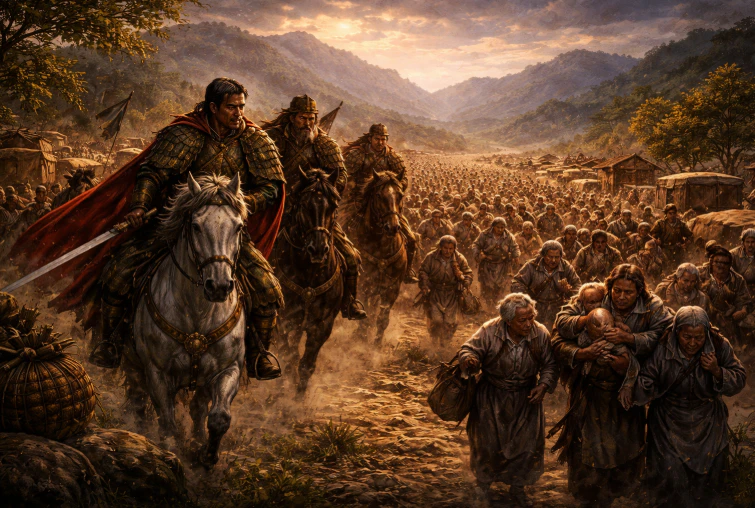
荊州局勢急轉直下,權力與猜忌交織,劉備一步步被推向邊緣。蔡夫人的決策,既是家族保護,也是政治賭注。這一回,是人心與命運的分水嶺。
Jing Province stands on the brink. Suspicion, ambition, and survival collide as Liu Bei is quietly pushed aside. Lady Cai’s choice is both protection and gamble—a turning point shaped by fragile loyalties.
中文
荊州之地,本為安穩之所,自三國演義筆下卻暗潮洶湧。
劉表病重,氣息漸弱,府中燈火不熄,卻人人心思各異。長子劉琦遠在江夏,次子劉琮近侍身旁。此時此刻,繼承之位,不再只是家事,而是整個荊州命運的歸屬。
蔡夫人端坐內堂,神情冷靜。她出身世家,深知權力從不容遲疑。她明白,一旦劉琦繼位,蔡氏一族將失去立足之地;而劉琮年幼,反可由她與族人掌控。於是,她召集親信,密議立嗣之策。
夜深時分,燭影搖曳,言語低聲卻鋒利如刀。
「國不可一日無主。」
「長幼有序,然亦需審時度勢。」
這些話語,看似為國,實則為己。
另一邊,劉備居於新野,表面安然,實則四面受制。他素以仁義著稱,得人心甚多,亦因此招來猜忌。蔡氏一族對他尤為忌憚,認為其勢力日盛,終將威脅荊州。
劉備心中並非不知。他與諸葛亮夜談時曾言:「此地非久留之所。」然而,天下未定,他仍希望尋得一處安身立命之地。
風雨欲來,消息如暗流般傳開——蔡夫人已定計,將立劉琮。
劉表臨終之際,氣若游絲,終未明言。這份沉默,反成了權力爭奪的縫隙。蔡夫人趁機發動,聯合蔡瑁等人,迅速控制局勢,封鎖消息,不使外傳。
當劉備得知消息時,一切已成定局。
他沒有憤怒,也沒有反抗,只是長嘆一聲。
「人心如此,亦在情理之中。」
但他明白,留下來只會成為犧牲品。
於是,他決定離開。
這不是敗退,而是一種選擇——在亂世之中,活下去,比堅持更重要。
百姓聞訊,扶老攜幼,隨劉備南行。塵土飛揚之中,是一支沒有軍令卻自發形成的隊伍。他們追隨的,不只是人,而是一種希望。
劉備回望荊州城,目光深沉。
那裡有未竟的理想,也有不得不放下的現實。
而此時的荊州,表面平靜,實則已埋下更大的風暴。
蔡夫人或許得到了她想要的權力,卻也打開了命運的另一扇門——一扇通往戰火與覆滅的門。
歷史的車輪,從不為個人停下。
這一回,沒有刀光劍影,卻比戰場更為殘酷。
因為真正的勝負,不在兵刃,而在人心。
English Version
Jing Province had long been considered a place of refuge—fertile, strategic, and relatively untouched by the chaos tearing apart the rest of the land. Yet beneath its calm surface, tension had been quietly building.
Governor Liu Biao was dying. His illness lingered, draining not only his strength but also the stability of his domain. With his breath fading, the question of succession became unavoidable—and dangerous.
Two sons stood at the center of the storm. Liu Qi, the elder, governed from afar in Jiangxia, distant both physically and politically. Liu Cong, the younger, remained close to the inner court, sheltered but vulnerable.
In theory, tradition favored the elder son. In reality, power belonged to those who could seize it.
Lady Cai understood this better than anyone.
She was not merely a wife in mourning—she was a strategist. Her family’s influence depended entirely on who inherited Jing Province. If Liu Qi rose to power, her position would collapse. If Liu Cong succeeded, she could shape the future from behind the curtain.
So she acted.
Quietly, efficiently, and without hesitation.
Meetings were held behind closed doors. Trusted allies were summoned. Words like “stability” and “order” were spoken often, but beneath them lay a sharper truth: survival.
Meanwhile, Liu Bei remained in Xinye, an honored guest—and an unspoken threat.
He had built a reputation not through force, but through virtue. People trusted him. Soldiers respected him. And that, in a fractured world, was more dangerous than any army.
Lady Cai and her allies saw what Liu Biao perhaps refused to admit: Liu Bei’s presence was a risk. If allowed to stay, he might one day become the true center of power in Jing Province.
Liu Bei sensed the shift.
He was not blind to politics, nor naïve to human nature. In private discussions with Zhuge Liang, he acknowledged the truth—this was not a place where he could remain indefinitely.
Still, leaving was not an easy choice.
Jing Province offered opportunity, stability, and a foothold in a collapsing world. But it also carried danger—silent, patient, and closing in.
Then the decision was made.
Lady Cai moved swiftly, declaring Liu Cong as the rightful successor. The transition was executed with precision. Information was controlled. Opposition was neutralized before it could even take shape.
By the time Liu Bei heard the news, it was already over.
No confrontation.
No appeal.
No turning back.
He chose not to resist.
Instead, he prepared to leave.
Some might call it retreat. Others would recognize it as wisdom. In times like these, survival was not cowardice—it was strategy.
What followed was something no one had anticipated.
The people came with him.
Families abandoned their homes. Elders walked beside soldiers. Children clung to carts filled with what little they could carry. They did not move under orders. They followed out of belief.
Liu Bei was no longer just a leader—he had become a symbol.
As he departed, he turned once to look back at Jing Province.
There was no bitterness in his gaze, only a quiet understanding. Some battles were never meant to be fought. Some losses were necessary to shape what came next.
Behind him, Jing Province settled into uneasy calm.
Lady Cai had secured power—but at a cost she could not yet see. By choosing control over balance, she had set the stage for greater conflict.
History rarely punishes immediately.
But it never forgets.
This chapter is not defined by war, but by decisions—small, calculated, and irreversible. It reminds us that the most decisive moments often happen in silence, long before the first arrow is fired.