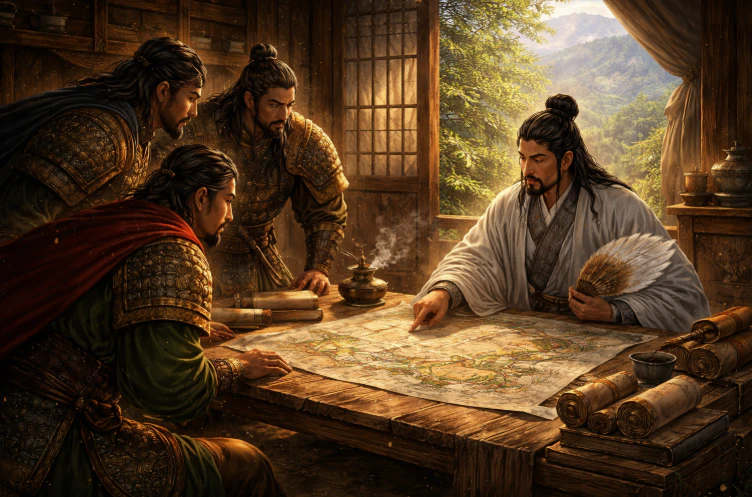
一場對談,改變天下格局。草廬之中,未出山的智者,已看清三分天下的輪廓。劉備此行,不只是求才,更是尋找未來。
A quiet conversation reshapes history. In a humble cottage, a strategist who has yet to step into power already sees the map of a divided empire. Liu Bei comes seeking more than talent—he seeks destiny.
中文小說寫法(約1200字)
天下大勢,分久必合,合久必分。
當亂世進入新的節點,真正決定未來的,不再只是兵力,而是眼光。
此時的劉備,尚無根基。寄人籬下,輾轉於荊州之地,雖有名望,卻無實權。他的理想遠大,但現實卻屢屢受限。
他需要一個人。
一個能看見未來的人。
於是,他三次前往隆中,只為拜訪一位尚未出仕的隱士——諸葛亮。
隆中山野,竹影搖曳,風聲清遠。這裡遠離戰火,卻孕育著改變天下的智慧。
第一次,諸葛亮不在。
第二次,仍不得見。
旁人或許早已放棄,但劉備沒有。他知道,真正的價值,從不輕易可得。
第三次,他終於踏入草廬。
諸葛亮端坐其中,神情從容,彷彿早已預料這一刻。
兩人相對而坐。
沒有寒暄太久,話題迅速切入本質——天下。
諸葛亮開口,語氣平靜,卻句句直指核心。
他指出,當今局勢已非單一勢力可統。北方為曹操所據,挾天子以令諸侯;江東由孫權掌控,根基穩固;而荊州、益州,則是未來的關鍵。
「若欲成事,當先據荊州,以觀天下;再取益州,以成基業。」
這不是空談,而是一條清晰的路徑。
他進一步分析地勢、人心與軍力,提出聯吳抗曹之策,形成三足鼎立之局。
這,便是後世所稱的「隆中對」。
劉備聽後,久久無言。
他不是第一次聽到謀略,但從未有人將未來描繪得如此完整,如此具體。
這不只是計策,而是一個世界的藍圖。
他心中明白,眼前之人,正是自己苦尋已久的答案。
於是,他放下身段,以誠相邀。
諸葛亮並未立即應允。
他觀察劉備,不只是看其言辭,更看其心志。
最終,他點頭。
那一刻,歷史悄然轉向。
諸葛亮出山,不只是加入一個勢力,而是將一個尚未成形的夢,變成可實現的方向。
劉備從此不再只是流亡之主,而開始擁有真正的戰略核心。
隆中依舊寧靜,草廬依舊簡陋。
但這片土地,已經見證了一場無聲的革命。
沒有戰鼓,沒有刀劍。
卻比任何戰役更重要。
因為從這一刻起,天下三分,不再只是可能,而是必然。
English Version
History does not always turn on battlefields.
Sometimes, it shifts quietly—in a place far removed from war, where the future is spoken into existence before a single move is made.
When Liu Bei arrived in Longzhong, he was not a ruler. Not truly.
He was a man with a name, a reputation, and a dream—but no land to anchor it. He had wandered from one alliance to another, surviving through resilience rather than power.
What he lacked was not courage.
It was direction.
He needed someone who could see beyond the present chaos—someone who could impose order on uncertainty.
That someone was Zhuge Liang.
At the time, Zhuge Liang was unknown to the world. He had no official title, no army, no visible influence. Yet those who had encountered him spoke of a mind unlike any other.
Liu Bei sought him out.
Once, and failed.
Twice, and failed again.
Most leaders would have stopped there. Persistence, after all, can look a lot like desperation. But Liu Bei understood something crucial: true talent is rarely convenient.
On the third visit, he finally met him.
The setting was unremarkable—a simple cottage, surrounded by nature. But the conversation that followed would redefine the political landscape of an entire era.
Zhuge Liang did not speak like a man offering advice.
He spoke like someone describing a structure that already existed.
He laid out the reality with precision. Cao Cao controlled the north, wielding imperial authority as both shield and weapon. Sun Quan held the southeast, secure and stable. Between them lay regions not yet fully claimed—Jing Province and Yi Province.
These, Zhuge Liang argued, were the keys.
Control Jing, and you gain strategic flexibility.
Secure Yi, and you establish a lasting foundation.
Then, align with Sun Quan. Resist Cao Cao.
Three powers. Balanced. Interdependent.
A divided world—not as a failure, but as a system.
This was not guesswork. It was design.
Liu Bei listened, and something shifted within him.
For the first time, his ambitions were not just ideals—they were steps. Measurable. Achievable. Real.
He recognized what stood before him.
Not just a strategist, but a mind capable of shaping history.
So he asked.
Not as a lord commanding service, but as a man inviting partnership.
Zhuge Liang did not answer immediately.
He studied Liu Bei carefully. Strategy was not just about plans—it was about people. A vision meant nothing without someone capable of carrying it forward.
In the end, he agreed.
And with that decision, the balance of the Three Kingdoms began to take form.
Zhuge Liang’s entry into Liu Bei’s service did not create power overnight. But it created something more important: coherence.
From that point on, Liu Bei was no longer drifting.
He had a path.
The world outside Longzhong remained unchanged—for now. Wars would continue. Alliances would shift.
But beneath it all, a new structure had been set in motion.
Not by force.
But by understanding.