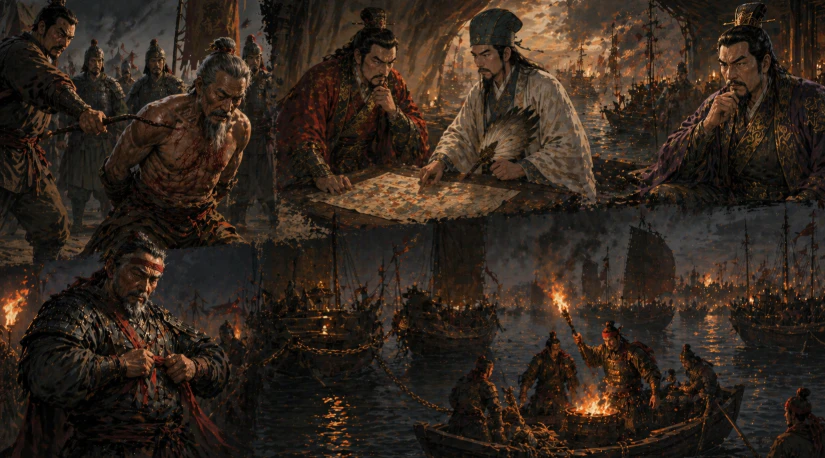
赤壁未燃,勝負已動。當計謀層層相扣,真假難辨,戰爭的關鍵不再是兵力,而是誰能掌控對手的判斷。
Before the flames of Red Cliffs ignite, the outcome is already shifting. In a web of deception, victory belongs to the one who controls perception.
中文
江面風靜,卻暗藏殺機。
赤壁之戰將至,兩軍對峙,卻未動兵。真正的戰場,不在江上,而在人心。
江東營中,周瑜正與諸葛亮密議。
敵強我弱,若正面交鋒,勝算難測。
唯一的機會,在於「騙」。
而騙,必須真。
周瑜沉聲道:「欲破曹軍,須先使其信我。」
諸葛亮輕搖羽扇,目光深遠。
「既要其信,便需有人赴死之局。」
這句話落下,營中氣氛凝重。
此計,非尋常之計。
這是苦肉之計。
此時,一人挺身而出。
那是黃蓋。
他年事已高,卻氣度沉穩。
「願以此身,成此大計。」
語氣平靜,卻無退意。
計畫開始。
周瑜當眾斥責黃蓋,言辭激烈,甚至命人重杖。
皮開肉綻,血流滿地。
這一切,不只是戲,更是證明。
因為曹操需要看到的,是「真」。
消息很快傳出。
對岸的曹操聞之,果然動心。
一位受辱的老將,若來投降,豈不正中其懷?
懷疑,開始鬆動。
而另一邊,計謀尚未完成。
單有苦肉,尚不足以致勝。
還需一環。
那便是「連環」。
曹軍船隻眾多,卻各自為陣。
若能將其連接,則可一舉焚之。
諸葛亮早已洞察此點。
他以風向為依據,計算時機。
東風未起,一切皆空。
時間,一點點逼近。
江面之上,看似平靜,實則已布滿棋子。
黃蓋整裝待發,船上滿載火種。
曹操亦已準備接納「投降」。
兩軍之間,一場以信任為名的欺騙,即將完成。
風,終於轉動。
不是偶然,而是必然。
諸葛亮仰望天際,神情淡然。
他等待的,不是機會,而是時機。
赤壁的火,尚未點燃。
但勝負,已悄然傾斜。
English Version
The battlefield at Red Cliffs was not yet ablaze—but the war had already begun.
Not with swords or ships, but with ideas.
Cao Cao’s forces were vast, disciplined, and confident. On paper, they should have dominated the coming battle.
But war is rarely decided on paper.
In the Wu camp, Zhou Yu and Zhuge Liang understood a simple truth: they could not win through strength alone.
They needed something more dangerous.
Belief.
If Cao Cao could be made to believe in a false reality, then his strength could be turned against him.
That was the foundation of their strategy.
And at its core was sacrifice.
Huang Gai stepped forward willingly.
He was not the strongest general, nor the most celebrated—but he possessed something more valuable: credibility.
His age, his reputation, and his loyalty made him the perfect candidate.
The plan required him to appear broken.
Publicly humiliated.
Visibly betrayed.
Zhou Yu played his role perfectly, lashing out in anger, ordering punishment severe enough to leave no doubt.
The beating was real.
The blood was real.
And that was precisely why it worked.
When word reached Cao Cao, it carried authenticity.
Here was a general who had been wronged—who might seek revenge or refuge.
Suspicion gave way to opportunity.
Cao Cao allowed himself to believe.
But deception alone was not enough.
It needed a second layer.
While Huang Gai prepared his “defection,” another strategy unfolded quietly—the linking of Cao Cao’s ships.
His fleet, though powerful, suffered from instability. Many of his soldiers were not accustomed to naval combat.
To solve this, the ships were chained together, creating a stable platform.
A practical solution.
And a fatal mistake.
Zhuge Liang had anticipated this.
Fire, once introduced, would spread uncontrollably.
But one element remained uncertain.
The wind.
Without the right direction, the entire plan would fail.
So they waited.
Not passively, but with precision.
When the wind shifted—when the conditions aligned—the final phase began.
Huang Gai’s ships moved forward, carrying not surrender, but destruction.
From Cao Cao’s perspective, everything made sense.
From reality’s perspective, everything was already lost.
The fire had not yet started.
But the outcome had already been written.