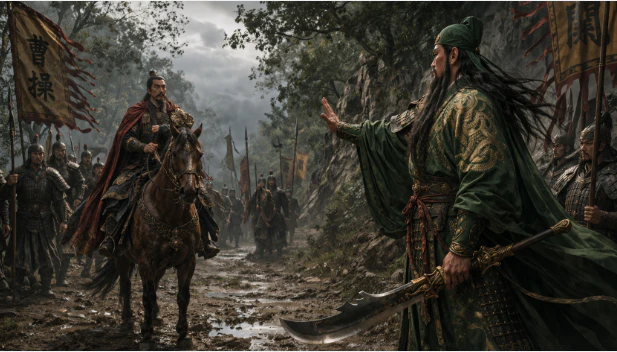
戰後餘燼未冷,一場追擊演變為人心試煉。狹路相逢之際,刀未出鞘,選擇卻已決定未來走向。
After the flames, the pursuit becomes a trial of conscience. On a narrow road, no blade is drawn—yet a single choice reshapes the future.
中文
江面火光漸遠,餘煙如霧。
赤壁之戰既定勝負,然而戰爭並未真正結束。
敗軍仍在逃,追兵仍在動。
天地之間,仍充滿未完的緊張。
曹操率殘軍北撤,軍心散亂,兵疲馬困。
昔日氣勢如虹的軍隊,如今只剩求生之念。
但曹操依舊冷靜。
他知道,真正的危險,不在火中,而在退路。
華容道,便是關鍵。
這條道路狹窄泥濘,兩側林木密布。
若有伏兵,將無處可逃。
然而,他仍選擇前行。
因為這是唯一的出口。
同一時間,聯軍已布下追擊之網。
劉備深知此戰意義重大,派出精兵設伏。
而守於華容道的,是關羽。
他立於道中,長刀未動,神情沉穩。
風聲穿林而過,帶來遠方的馬蹄聲。
曹操出現了。
兩軍對峙,氣氛凝結。
一邊是敗軍之主,一邊是守關之將。
勝負,本應毫無懸念。
但戰場,忽然變得安靜。
曹操望向關羽,神色從容。
他未急於求生,也未顯驚慌。
他開口,提起往昔。
提起曾經的禮遇,提起彼此之間未言明的情義。
那不是辯解,而是一種提醒。
提醒對方,這場戰爭之外,還有另一層關係。
關羽沉默。
他的手握刀更緊。
眼前,是敵。
心中,卻是義。
他追隨劉備,是為忠。
他念及曹操,是為恩。
忠與恩,在此刻交錯。
無人能替他選擇。
時間彷彿停滯。
風聲與呼吸聲交織。
終於,關羽輕輕揮手。
「讓路。」
士兵震驚。
曹操未再多言,只深深一望,策馬而過。
那一瞬間,沒有歡呼,沒有殺聲。
只有一個決定,悄然改變了未來。
關羽仍立於原地。
他沒有後悔。
因為他選擇的,不只是放人,而是守住自己。
華容道上,沒有勝敗。
只有人心。
English Version
The aftermath of Red Cliffs was not quiet—it was uncertain.
Victory had been claimed, but not secured.
Cao Cao was still alive.
And as long as he lived, the balance of power remained unfinished.
Retreat became his only option.
His once-mighty army had been reduced to fragments, scattered and exhausted. Yet Cao Cao himself remained composed, focused not on what was lost, but on what could still be preserved.
Survival.
The route ahead—Huarong Road—offered escape, but also danger. Narrow, unstable, and vulnerable to ambush, it was the kind of path where a single misstep could end everything.
Still, he moved forward.
Because there was no alternative.
Meanwhile, Liu Bei’s forces anticipated this movement.
They understood what capturing Cao Cao would mean—not just a victory, but a conclusion.
Guan Yu was chosen to intercept.
He took position at the critical point, where escape would either succeed or fail.
When Cao Cao arrived, the confrontation did not begin with action.
It began with recognition.
These were not strangers meeting in battle.
They shared history—respect, favors, moments that existed outside of war.
Cao Cao spoke carefully, not to persuade, but to remind.
That what stood between them was more than enmity.
Guan Yu listened.
And in that moment, the clarity of the battlefield dissolved.
His role was clear: stop the enemy.
But his values complicated that clarity.
He was bound by loyalty to Liu Bei.
Yet he was also bound by gratitude to Cao Cao.
These obligations could not coexist.
One had to give way.
No command could resolve it.
No strategy could guide it.
Only judgment.
So Guan Yu made a decision that defied expectation.
He stepped aside.
Cao Cao passed.
The war did not end there—but its direction changed.
Because in that moment, power was not the deciding force.
Character was.