赤壁戰前,時間與資源成為勝負關鍵。當十萬箭的期限壓下,局勢看似無解,卻也正是智慧登場之時。
Before Red Cliffs, time becomes the sharpest weapon. Faced with an impossible demand for arrows, strategy replaces strength, and genius reshapes reality.
中文
江風漸緊,戰雲低垂。
江東水寨內,戰備已然展開。船隻排列如林,兵士日夜操練,整個軍營瀰漫著一種將戰未戰的壓迫感。
然而,在這樣的氣氛之中,一場無形的較量,悄然醞釀。
周瑜坐於帳中,神情沉穩,卻心思深遠。
他清楚,真正能影響戰局的,不只是兵力,更是人。
尤其是那位來自蜀中的軍師——諸葛亮。
此人言辭縝密,洞察局勢,若任其發揮,恐將左右整場戰局。
周瑜不願讓主導權旁落。
於是,他設下一局。
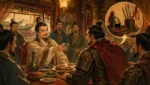
「軍中缺箭十萬,三日內可否備齊?」
語氣平靜,卻如刀鋒。
這不是請求,而是試探。
諸葛亮微微一笑,未見絲毫遲疑。
「三日?不需。」
眾人愕然。
他補上一句:「三日之內,必可交付。」
這一答,既是承諾,也是挑戰。
夜深,江面霧氣瀰漫。
諸葛亮靜坐帳中,似乎並未為此事憂慮。
他不急於製造箭矢,因為他知道,真正的答案,不在營中,而在江上。
第三日清晨,濃霧瀰天。
天地之間,一片朦朧。
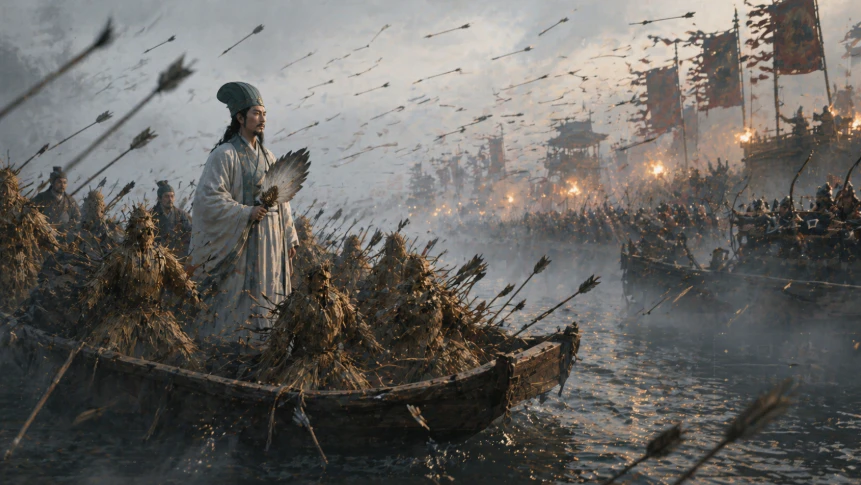
諸葛亮下令,調集數十艘草船,船上紮滿稻草人,排列如兵。
隨後,他親自登船,順江而下。
江水無聲,霧氣如幕。
船隊緩緩逼近曹軍水寨。
對岸,曹操聞報,大驚。
霧中不見敵情,只見船影重重,似有大軍來襲。
他不敢輕動,只下令放箭。
霎時間,箭如雨下。
萬箭齊發,落於草船之上。
稻草人承受箭雨,船身逐漸沉重。
諸葛亮立於船頭,神情淡然。
他不是來攻,而是來取。
一輪箭雨之後,他命令掉頭。
船隊緩緩退去。
待霧散之時,船上已密佈箭矢,如林而立。
十萬之數,輕而易舉。
當他返回水寨時,眾人無不震驚。
周瑜亦沉默良久。
這不是運氣,而是計算。
不是巧合,而是掌控。
他終於明白,眼前之人,不只是軍師,更是難以預測的變數。
諸葛亮將箭奉上,語氣平靜。
仿佛這一切,本就理所當然。
風,仍在江上流動。
戰,尚未真正開始。
但有些勝負,已經悄然分出高下。
English Version
The days leading to Red Cliffs were filled with preparation—but also tension.
Within the Wu camp, everything moved with purpose. Ships were reinforced, soldiers trained relentlessly, and strategies were refined again and again.
Yet beneath all this activity, another contest was unfolding.
Zhou Yu understood that war was not just about armies.
It was about control.
And control depended on influence—on who truly shaped the course of events.
Zhuge Liang’s presence disrupted that balance.
He was calm where others were tense, certain where others hesitated. And that made him dangerous.
So Zhou Yu decided to test him.
Not through confrontation, but through impossibility.
He demanded ten thousand arrows within three days—a logistical challenge that bordered on absurd.
It was a trap disguised as necessity.
Zhuge Liang accepted without hesitation.
That alone was unsettling.
While others scrambled for solutions, Zhuge Liang remained composed. He did not rush to gather materials or mobilize craftsmen.
Because his plan did not involve making arrows.
It involved taking them.
On the third day, a dense fog covered the river. Visibility dropped to almost nothing.
It was the perfect condition.
Zhuge Liang ordered a fleet of small boats, each lined with straw figures designed to resemble soldiers. Then he led them toward Cao Cao’s camp.
From across the river, the scene was unclear—only shapes moving through the mist, suggesting an approaching force.
Cao Cao reacted cautiously. Without clear visibility, he chose not to engage directly. Instead, he ordered volleys of arrows.
Thousands of them.
The arrows struck the straw figures, embedding themselves deep into the bundles. The boats absorbed the assault without resistance.
Zhuge Liang stood calmly as the arrows rained down.
He had turned defense into supply.
After enough volleys, he ordered the fleet to withdraw.
When the fog lifted, the boats returned—not empty, but loaded with exactly what had been demanded.
Arrows.
Thousands of them.
What had seemed impossible was now complete.
Zhou Yu saw the result and understood its implication.
This was not luck.
It was design.
Zhuge Liang had not solved the problem.
He had redefined it.
And in doing so, he demonstrated something far more significant than tactical skill.
He demonstrated control over perception itself.
The battle had not yet begun.
But already, the balance between two great minds had shifted.