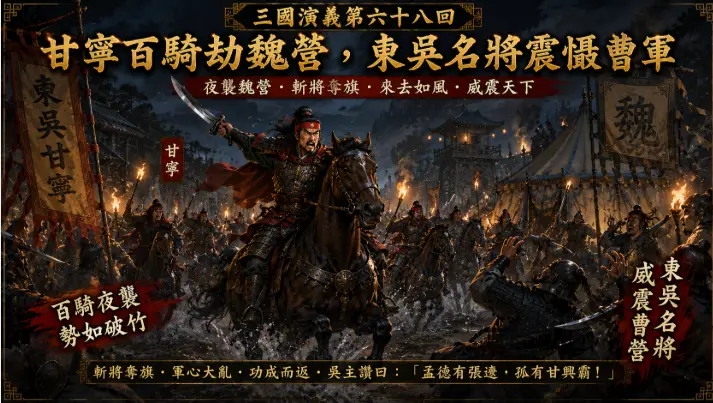
漢中局勢驟變之際,江東前線亦暗潮洶湧。一場深夜奇襲,不僅震動曹營,更讓天下見識東吳猛將的膽識。
As tensions rise across the empire, a daring night raid transforms the battlefield. One bold commander proves that courage can be as powerful as an army.
中文
濡須口江風凜冽。
冬夜籠罩大地,江面波光黯淡。
自從曹操取得漢中之後,聲勢再度攀升。
北方大軍南下,直逼江東防線。
而東吳上下,也感受到前所未有的壓力。
營帳之內,孫權凝視軍報。
曹軍營寨綿延數十里。
火把如星河般散布江岸。
如此龐大的軍勢,即使久經沙場的將領也難免憂心。
眾將議論紛紛。
有人主張堅守。
有人建議等待時機。
就在此時,一人挺身而出。
那便是甘寧。
他身披錦袍,目光銳利。
昔日江上豪傑,如今已成東吳名將。
他望向孫權。
「願率百騎夜襲曹營。」
帳中瞬間寂靜。
百騎?
面對數十萬曹軍?
許多人甚至懷疑自己是否聽錯。
然而甘寧神色如常。
彷彿談論的並非九死一生之事。
孫權沉默片刻。
最終緩緩點頭。
因為他知道,戰爭有時需要的,不只是兵力。
還有膽氣。
夜色漸深。
百名精銳悄然集結。
沒有戰鼓。
沒有號角。
只有寒風掠過鎧甲的細微聲音。
甘寧翻身上馬。
長刀映著月光。
隨即率隊出發。
黑暗之中,隊伍如幽影般前進。
很快便接近曹軍營寨。
守軍毫無察覺。
就在距離營門不遠之處,甘寧突然大喝。
戰馬衝鋒。
刀光瞬間撕裂黑夜。
曹營大亂。
睡夢中的士兵驚慌失措。
火把四處翻倒。
喊殺聲響徹夜空。
百騎如同利箭直插營心。
所到之處,無人能擋。
甘寧親自斬殺數名敵將。
隨後迅速撤離。
整個過程短暫而猛烈。
當曹軍大批援軍趕到時,襲擊者早已消失在夜色之中。
天亮之後,消息傳遍兩軍。
曹營震動。
東吳士氣大振。
而孫權親自迎接甘寧歸來。
看著這位滿身風塵的將軍,他忍不住感嘆:
「孟德有張遼,孤有甘興霸。」
一句話,成為後世美談。
這場夜襲改變不了天下格局。
卻改變了軍心。
有時候,真正的力量不在兵馬多少。
而在於有人敢於面對恐懼,率先衝入黑暗。
English Version
The balance of power in China continued to shift after Cao Cao secured Hanzhong.
His influence expanded once more, and attention soon turned toward the south.
Along the Yangtze frontier, the armies of Wu prepared for what many believed would be another major confrontation.
The atmosphere was tense.
Reports arriving at Sun Quan’s headquarters described enormous Wei encampments stretching across the landscape.
Rows of fires illuminated the night like a second horizon.
The scale of Cao Cao’s military presence was impossible to ignore.
Many officers advocated caution.
Some argued that defensive preparations should remain the priority.
Others suggested patience until conditions became more favorable.
Then Gan Ning stepped forward.
Unlike many commanders, he was never comfortable with hesitation.
Before joining Wu, Gan Ning had built a reputation as a daring river warrior whose confidence bordered on recklessness.
Yet again and again, that boldness had produced results.
Standing before Sun Quan, he proposed something extraordinary.
He requested permission to lead only one hundred cavalrymen into the heart of Cao Cao’s camp under cover of darkness.
The proposal shocked the assembly.
Against such overwhelming numbers, the mission seemed impossible.
But Gan Ning’s expression never changed.
To him, surprise could achieve what numbers could not.
After a brief silence, Sun Quan approved the plan.
As night settled across the battlefield, a carefully selected group of riders assembled.
No drums announced their departure.
No banners revealed their movement.
They rode through darkness guided only by determination and experience.
The closer they came to the Wei camp, the quieter the world seemed.
Then, suddenly, the silence exploded.
Gan Ning launched the attack with devastating speed.
The defenders had little time to react.
Soldiers were awakened by shouting, fire, and confusion.
Horsemen surged through the camp like a storm.
Blades flashed beneath torchlight.
Command structures collapsed temporarily as panic spread through the ranks.
The objective was never conquest.
It was disruption.
And disruption succeeded brilliantly.
After inflicting maximum confusion, Gan Ning withdrew before the larger Wei forces could organize an effective response.
By dawn, the raiders had returned safely.
News of the operation spread rapidly.
Within Cao Cao’s army, embarrassment and frustration replaced confidence.
Within Wu’s camps, morale soared.
The achievement became symbolic proof that courage and initiative could challenge even the strongest opponent.
When Gan Ning returned, Sun Quan personally praised him.
The ruler of Wu understood the deeper significance of the raid.
Military victories are measured in territory.
But leadership is often measured in inspiration.
Gan Ning had given his soldiers something priceless—belief.
And on that cold night beside the river, belief proved more powerful than numbers.
-150x150.jpg "三國演義第六十八回:甘寧百騎劫魏營,東吳名將震懾曹軍 | Romance of the Three Kingdoms Chapter 68 Gan Ning’s Night Raid on Wei Camp")