漢中與益州局勢方定,東吳與曹魏的對抗再度升溫。一場看似兵力懸殊的戰役,卻因一位名將改寫結果。
As tensions rise between Wu and Wei, an outnumbered defense becomes one of the most legendary victories of the Three Kingdoms era.
中文
合肥城外,戰雲密布。
自赤壁之後,江東與曹魏始終對峙。
雙方雖未爆發全面決戰,但邊境衝突從未停止。
而這一次,孫權決定親自出征。
大軍集結。
旌旗連綿數十里。
戰船沿江而上,騎兵步卒齊備。
據傳兵力超過十萬。
整個江東都相信,這次合肥必定能被攻下。
消息傳至魏營。
守城將領們無不神情凝重。
因為合肥兵力有限。
城中守軍遠不及東吳大軍。
然而,有一人始終神色平靜。
那便是張遼。
昔日跟隨呂布征戰天下的猛將,如今已成曹魏最可靠的名將之一。
他仔細閱讀曹操留下的密令。
沉思良久。
最終,他作出一個令人震驚的決定。
主動出擊。
當眾將得知後,皆大吃一驚。
敵軍十萬。
己方不過數千。
守城尚且艱難,何況出戰?
但張遼十分清楚。
若任由孫權大軍從容佈陣,合肥終將陷入被動。
唯有先聲奪人,方能打亂敵軍部署。
黎明之前。
城門悄然開啟。
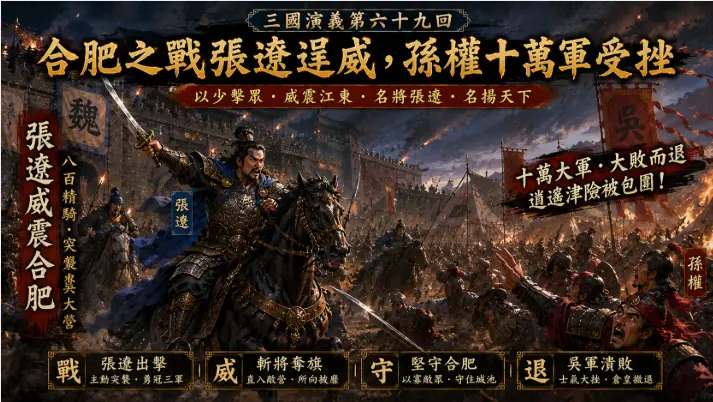
八百精騎列隊而出。
夜風掠過鎧甲。
所有人都知道,這或許是一場有去無回的衝鋒。
然而沒有人退縮。
因為領軍之人是張遼。
天色微亮。
東吳軍營尚未完全整備。
就在此時,魏軍騎兵突然殺入。
喊殺聲震天。
馬蹄如雷。
東吳前軍瞬間大亂。
張遼手持長刀,直衝中軍。
所到之處,無人能擋。
許多士兵甚至來不及穿上盔甲。
整個營地陷入混亂。
孫權聞訊大驚。
急忙調兵應對。
然而張遼來勢太快。
轉眼已衝至核心區域。
東吳將領紛紛迎戰。
雙方激烈廝殺。
血染戰場。
最終,張遼成功突破敵陣後全身而退。
當他返回城中時,士氣已截然不同。
原本佔據絕對優勢的東吳軍,開始出現猶豫。
而魏軍則士氣高昂。
隨後數日,孫權雖持續進攻。
卻始終無法攻破城防。
加上疫病與補給壓力逐漸增加。
東吳大軍最終被迫撤退。
退軍途中,更發生逍遙津驚險一幕。
孫權險些被魏軍包圍。
幸賴部下拼死護衛,方得脫身。
合肥之戰就此落幕。
天下震動。
人們記住的不只是勝敗。
更是張遼以數千之眾對抗十萬大軍的膽識。
有時候,一位真正的名將,足以改變整場戰爭。
English Version
The city of Hefei stood as one of the most important frontiers between Wei and Wu.
For years, both sides had tested each other’s defenses through raids, skirmishes, and political maneuvering.
Now, Sun Quan intended to settle the matter through force.
Confident in Wu’s growing strength, he personally led a massive army toward Hefei.
The scale of the expedition was impressive.
Columns of soldiers stretched across the landscape, while supply lines followed close behind.
To many observers, the outcome seemed inevitable.
Hefei appeared isolated and vulnerable.
Its defenders were heavily outnumbered.
Yet within the city walls, Zhang Liao saw the situation differently.
A veteran commander renowned for discipline and courage, he understood that numerical superiority alone did not guarantee victory.
The greatest danger was allowing Wu’s forces time to organize a complete siege.
Once that happened, Wei’s chances would diminish rapidly.
Therefore, he chose a course of action few expected.
Rather than waiting behind the walls, he would attack first.
Before dawn, a small strike force assembled.
The mission bordered on madness.
Only a fraction of the defenders would participate, while the enemy numbered in the tens of thousands.
Yet hesitation never entered Zhang Liao’s mind.
Speed and surprise would be his weapons.
As the first light appeared on the horizon, Wei cavalry erupted from the city gates.
The attack struck the Wu camp before preparations were complete.
Soldiers scrambled to arm themselves.
Commanders rushed to restore order.
Confusion spread faster than commands could be issued.
At the center of the assault rode Zhang Liao himself.
His objective was psychological as much as military.
By striking directly at the heart of the enemy camp, he aimed to create uncertainty among troops who expected an easy victory.
The strategy worked brilliantly.
Wu’s front lines collapsed into disorder.
Reports of Zhang Liao’s advance spread rapidly, magnifying fear throughout the encampment.
Although the raid lasted only a short time, its impact endured for the entire campaign.
Wei’s defenders gained confidence.
Wu’s soldiers lost momentum.
In the days that followed, repeated assaults failed to break Hefei’s defenses.
Disease, logistical strain, and declining morale gradually weakened Sun Quan’s position.
Eventually, withdrawal became unavoidable.
The retreat itself nearly ended in disaster when Sun Quan faced danger near Xiaoyao Ford.
Only the determination of his bodyguards prevented catastrophe.
When news of the campaign spread across China, admiration focused overwhelmingly on Zhang Liao.
Military historians would remember Hefei not as a battle won through numbers, but through leadership.
It became a lasting example of how initiative, courage, and timing can overcome even the most intimidating odds.
-150x150.webp "三國演義第六十九回:合肥之戰張遼逞威,孫權十萬軍受挫 | Romance of the Three Kingdoms Chapter 69 Zhang Liao’s Heroic Defense at Hefei")