Today in History: September 20 – First Cannes Film Festival, BBC TV, and Google-YouTube
September 20 connects cinema, broadcasting, television, the Internet and business innovation in the evolution of modern communication and entertainment.
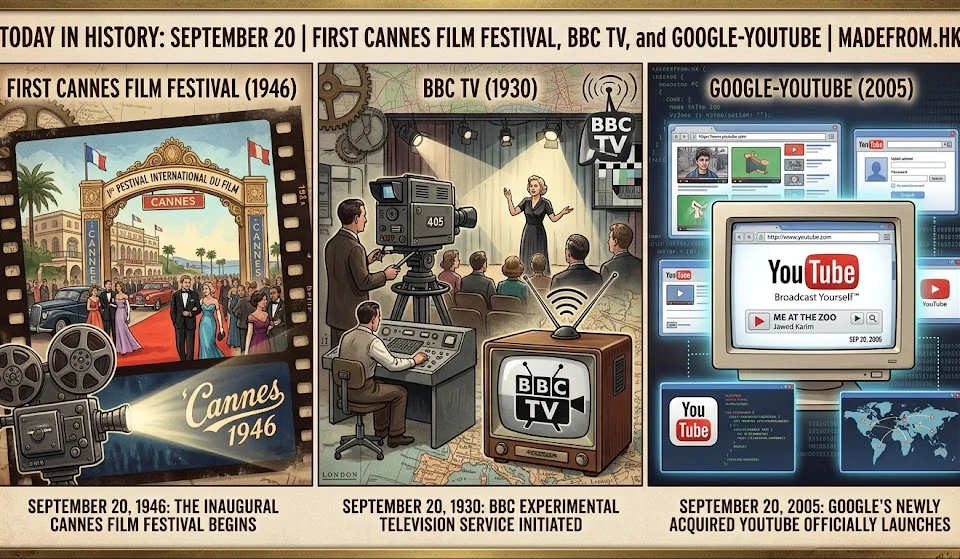
September 20 offers a fascinating journey through cinema, broadcasting, television, literature, the Internet and popular culture. Rather than focusing only on political events, the date allows us to examine how people gradually developed new ways to tell stories, share information and experience entertainment. One of the most important cultural milestones connected with September 20 is the Venice International Film Festival, which began in 1932 and eventually became one of the world’s most prestigious film festivals. Venice helped establish the idea that cinema could be more than commercial entertainment. Films could also be treated as artistic and cultural works, while festivals could bring filmmakers, actors, producers, critics and audiences together in the same place. The development of major film festivals reflected the growing importance of cinema during the twentieth century. Film eventually became a global language capable of crossing national and linguistic boundaries. A story created in one country could be watched and appreciated by audiences thousands of miles away. September 20 also provides a useful connection with the history of British broadcasting and television. The BBC conducted early television experiments during the late 1920s, and in 1936 it launched one of the world’s earliest regular public television services. Television transformed domestic entertainment. Newspapers delivered printed information, and radio brought voices and music into the home, but television added moving images. Audiences could now watch news, drama, sport, music and educational programmes from their living rooms. The arrival of television therefore changed not only entertainment but also the rhythm of family life. People began organising parts of their evenings around scheduled programmes, and television gradually became one of the defining mass-media technologies of the twentieth century. September 20 can also be viewed through the development of the Internet and search technology. Google was formally founded in September 1998 by Larry Page and Sergey Brin. What began as a search engine eventually developed into one of the most influential Internet companies in the world. The importance of search engines is easy to underestimate because searching for information now feels completely natural. In the early days of the Web, however, finding useful information among a rapidly growing number of pages was much more difficult. Search technology made the Internet significantly more practical by helping users locate relevant information quickly. Google developed methods for analysing relationships between web pages and ranking results, contributing to a new way of navigating online information. Today, a person can search for a historical fact, restaurant, product, person or location within seconds. This has changed the relationship between people and knowledge. Information is no longer something that must always be physically located in a book, library or newspaper archive. Much of it can be reached almost instantly through a connected device. September 20 also reflects the development of modern consumer and brand culture. During the twentieth century, companies increasingly realised that a product could represent more than its practical function. Design, packaging, advertising, shops and celebrity associations could give a product a distinct identity. Luxury brands such as Gucci became part of this broader transformation in consumer culture, demonstrating how fashion and design could create powerful international identities. People do not always purchase a branded product simply because it performs a particular function. They may also be buying an image, a style, a story or a sense of belonging. This transformation helped create the modern concept of the global lifestyle brand. Literature provides another important September 20 connection. American writer Upton Sinclair was born on September 20, 1878. His best-known novel, “The Jungle,” published in 1906, examined the harsh conditions experienced by workers in Chicago’s meatpacking industry. The book attracted enormous public attention and helped generate concern about food production, working conditions and consumer protection. Sinclair’s experience demonstrated that literature could influence public debate. A novel did not have to exist only for entertainment. It could also reveal problems that many people had not fully understood and encourage society to demand change. This remains an important role for journalism, documentary filmmaking, literature and other forms of public storytelling today. September 20 also has a connection with international cinema through Sophia Loren, who was born in 1934 and became one of Italy’s most internationally recognised actresses. Her career lasted for decades and helped demonstrate how European cinema could produce stars with global audiences. The international success of actors such as Loren reflected the growing connections between national film industries, international distribution and global popular culture. Cinema was becoming increasingly international, and audiences were becoming more willing to watch stories and performances from outside their own countries. Popular television provides another September 20 story. In 1990, “The Fresh Prince of Bel-Air” premiered in the United States. The sitcom became an important part of 1990s popular culture and helped transform Will Smith from a successful musician into a major international actor. The programme followed a young man who moved in with wealthy relatives in Bel-Air and used comedy to explore family relationships, social class, identity, growing up and cultural differences. Its success demonstrated that television comedy could entertain audiences while also discussing real social questions. The stories associated with September 20 therefore share a surprisingly clear theme: communication and cultural circulation. Film festivals bring stories from different countries together. Television brings images and narratives into people’s homes. Literature can expose social problems and influence public discussion. Search engines make enormous quantities of information easier to access. Television programmes can turn social experiences into stories that millions of people share. These developments may seem unrelated, but they all concern the way people receive, interpret and exchange information. Human beings have continually searched for better ways to watch, listen, read and understand the world around them. The path from cinema screens to television sets, from printed books to search engines and from scheduled broadcasts to streaming services represents a long history of technological and cultural adaptation. Today, a person can watch a film on a phone, search for information online, read an e-book and stream a television series at almost any time. None of this appeared suddenly. It was built through generations of experimentation in cinema, broadcasting, publishing, computing and telecommunications. September 20 is therefore worth remembering because it shows that modern culture depends not only on famous creators and performers but also on the technologies and institutions that allow their work to reach audiences. When a new medium appears, it changes more than the way information is delivered. It can change how people organise their time, how businesses operate and how societies share experiences. Early television audiences could not have imagined the enormous number of channels and services available today. Early Internet users could not have imagined a world where search engines could answer questions within seconds. Early film audiences could not have imagined that cinema would become a global industry capable of reaching billions of people. Each generation becomes accustomed to technologies that once seemed extraordinary. This is one of the most interesting lessons of September 20. History is not simply about old objects and famous names. It is also about the systems that gradually become invisible because they work so well. The cinema, television, newspaper, radio and Internet have all changed dramatically, yet their basic purpose remains remarkably consistent: connecting people with information, stories and ideas. The technology changes, but the human desire to communicate remains. September 20 therefore offers a snapshot of the long journey from traditional media to the digital world. It reminds us that the modern information environment was built one innovation at a time, and that today’s apparently effortless access to culture and knowledge is the result of more than a century of technological and creative development.
September 20 shows how cinema, television, literature and the Internet gradually transformed the way people receive information, stories and entertainment.