Today in History: September 18 – The New York Times, Tiffany & Co., and the CIA
September 18 connects newspapers, jewellery, science, broadcasting and television, revealing how familiar parts of modern life gradually emerged.
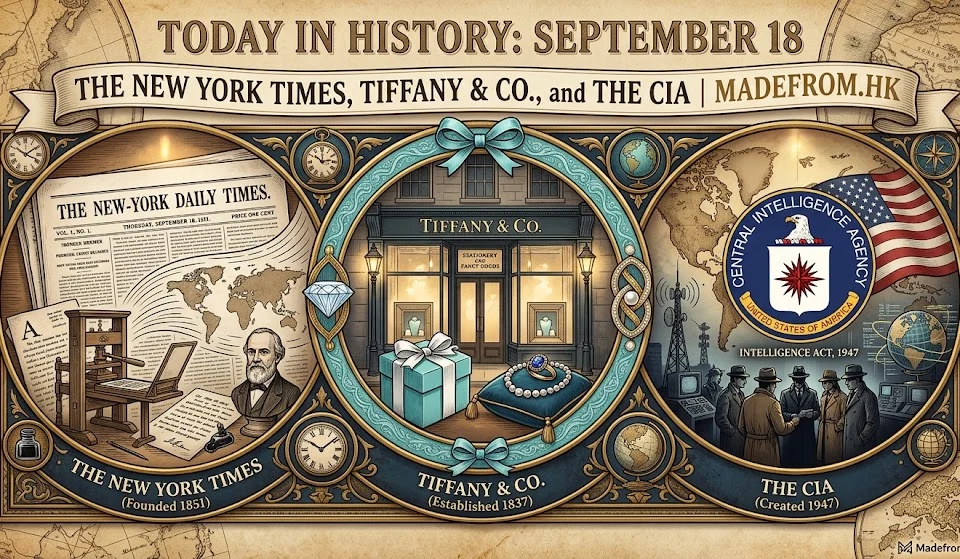
September 18 offers a fascinating look at how modern everyday life developed through newspapers, business brands, science, broadcasting, television and digital technology. Rather than focusing only on dramatic political events, the date reveals the quieter changes that shaped the way people receive information, enjoy entertainment, recognise brands and use technology. One of the most significant events associated with September 18 occurred in New York in 1851, when the first issue of the New-York Daily Times was published. The newspaper later became The New York Times, one of the world’s best-known newspapers. In the nineteenth century, newspapers were among the most important ways for ordinary people to understand what was happening beyond their immediate communities. A daily paper could bring political news, business information, advertisements, cultural stories, sports reports and international developments into the home. Newspapers were not simply sources of information; they also created a shared public conversation. People could read the same stories, discuss them with neighbours and form opinions about events happening far away. The rise of The New York Times reflects the wider development of professional journalism and the growing importance of newspapers in urban society. Today, people scroll through news on smartphones and websites, but the basic idea remains familiar: information is gathered, edited and delivered regularly to a broad audience. September 18 also has an important place in the history of commercial branding. In 1837, Charles Lewis Tiffany and John B. Young established Tiffany and Young in New York, a business that eventually developed into the famous jewellery company Tiffany & Co. The company initially operated as a stationery and luxury goods store before becoming increasingly associated with jewellery. Tiffany’s later success illustrates an important change in modern consumer culture. A product can be valuable because of its materials and craftsmanship, but a brand can add another layer of meaning. Design, packaging, reputation and cultural associations can turn an ordinary object into a symbol of status, celebration or personal memory. Tiffany’s distinctive blue packaging eventually became so strongly associated with the company that the colour itself became part of the brand identity. This demonstrates how modern business is not simply about making products. It is also about creating visual recognition and emotional connections with customers. Science provides another fascinating September 18 connection. French physicist Léon Foucault was born on September 18, 1819, and later became famous for the Foucault pendulum, an elegant experiment demonstrating that the Earth rotates. In 1851, Foucault demonstrated his pendulum at the Panthéon in Paris. The experiment used the changing orientation of a swinging pendulum to provide visible evidence of Earth’s rotation. What made the demonstration particularly impressive was its simplicity. There was no need for a spacecraft or a complicated modern laboratory. A carefully designed pendulum could reveal the movement of the planet itself. The Foucault pendulum subsequently became a famous feature of science museums and educational institutions around the world. September 18 also belongs to the early history of broadcasting. In 1927, the Columbia Phonograph Company developed a radio network involving sixteen stations, an important step in the development of what would eventually become CBS. Radio transformed the relationship between audiences and information. Before broadcasting became widespread, families depended heavily on newspapers, books and live performances for information and entertainment. Radio allowed voices, music, drama, comedy and news to enter homes directly through the air. It became one of the foundations of twentieth-century mass culture and created experiences that could be shared by millions of people at the same time. Television later expanded this idea by adding moving images to the experience. On September 18, 1964, ABC premiered “The Addams Family,” bringing the eccentric characters created by cartoonist Charles Addams to television audiences. The programme centred on a strange but remarkably close-knit family whose interests and behaviour were deliberately different from conventional ideas of family life. Its humour came partly from the contrast between the family’s unusual worldview and the supposedly normal world around them. The popularity of “The Addams Family” demonstrated that mainstream entertainment could embrace characters who did not fit traditional expectations. The franchise later expanded into films, animated series and other forms of entertainment, becoming a cultural symbol that has continued across generations. September 18 is also the birthday of Greta Garbo, born in Sweden in 1905. Garbo became one of the most recognisable film stars of the early twentieth century, known for her distinctive screen presence and enigmatic public image. She appeared in films including “Anna Christie,” “Grand Hotel” and “Ninotchka.” Garbo’s importance lies not only in her performances but also in the development of modern celebrity culture. The early film industry was learning how to create and promote stars whose personalities became almost as important as the films themselves. Garbo’s reserved public image and decision to step away from the spotlight helped strengthen her mystique. The idea of a celebrity having a carefully constructed public identity is now familiar, but many of its foundations were established during the early decades of cinema. Technology provides yet another September 18 connection through the development of electronic reading. Barrett Comiskey, born on September 18, 1975, was one of the key inventors associated with electronic ink technology. E Ink eventually became widely used in electronic readers, allowing digital text to be displayed in a way that resembles printed paper rather than a conventional glowing screen.The technology helped make digital reading more comfortable and practical, particularly for people who wanted to read books for long periods. Today, e-readers allow thousands of books to be carried in a single lightweight device, yet the visual experience can still resemble a traditional printed page. When these stories are placed together, September 18 becomes almost like a small museum of modern everyday life. The newspaper represents the age of printed information. Tiffany represents the rise of modern branding and luxury retail. Foucault represents scientific ideas becoming visible through elegant experiments. Radio represents the beginning of mass electronic broadcasting. “The Addams Family” represents television’s ability to turn unusual characters into cultural icons. Greta Garbo represents the emergence of modern celebrity culture. Electronic ink represents the continuing evolution from paper to digital reading. These developments belong to different centuries and different industries, but they share an important theme: communication. Newspapers communicate through printed words. Radio communicates through sound. Television communicates through images and sound. Books communicate ideas across generations. Brands communicate identity through design and symbols. Digital reading technologies continue the long history of making written information easier to carry and access. This is one reason September 18 is worth remembering. History is often taught through major political events, but much of the world we experience every day has been shaped by quieter developments. The newspaper we read, the brand we recognise, the television programme we watch and the device on which we read a book all have histories. They were once new ideas, technologies or business experiments. Over time, successful innovations became so familiar that their origins became easy to forget. September 18 allows us to look behind those ordinary experiences and see the people and ideas that helped create them. The date also demonstrates how different forms of media constantly replace and influence one another. Newspapers came before radio, radio influenced television, television expanded popular culture, and digital technology transformed the distribution of written and visual information. Yet older forms rarely disappear completely. Newspapers continue to exist alongside digital journalism. Television remains influential alongside streaming services. Printed books continue to exist alongside e-books. Vinyl records have even returned as a popular cultural format after decades of being considered outdated. Modern life is therefore not a simple story of one technology replacing another. It is a process of adaptation, reinvention and cultural memory. September 18 captures that process particularly well. From the first issue of a newspaper to the development of a global jewellery brand, from a pendulum revealing the movement of the Earth to radio entering the home, from an eccentric television family to digital ink designed to resemble paper, the date shows how innovation can gradually become part of ordinary life. The most interesting part of history is often not the moment when something becomes famous, but the long process through which it becomes familiar. September 18 reminds us that the modern world was built not only by major events, but also by newspapers, shop windows, scientific demonstrations, radio programmes, television characters and new ways of reading. These everyday developments may seem ordinary now, but each one once represented a new possibility.
September 18 shows how newspapers, brands, science, broadcasting, television and digital reading gradually became part of modern everyday life.