
Skip to content
madefrom.hk madefrom.hk

Rewriting culture, history and memories beyond language and borders.

madefrom.hk madefrom.hk

Rewriting culture, history and memories beyond language and borders.

  • 0 Senses
  • Comics
    • Strange Tales
  • Column
    • Knowledge Hub
      • 生活篇
      • 食品篇
      • 科技篇
      • 超市篇
    • Life & Technology
    • Hong Kong Guide
    • Today in History
    • City Stories
    • Anime & Manga
    • Game Magazine
    • Toy Club
    • Language of Flowers
    • Street Notes
    • All Things
    • Music Memories
    • Chinese Idioms
    • Cantonese Sayings
    • Movie Magazine
  • Original Stories
    • 不可思議故事
    • 十三號的約定
    • 星座宮神話
    • 香港山怪談
    • 香港都市靈異傳說
  • Adapted Stories
    • romance of the three kingdoms
    • hong kong places
    • dream of the red chamber
    • strange tales
    • The house on the borderland
    • usherhouse
    • Theblackcat
  • History
    • History in 80 Seconds
    • 當年報章摘要
    • 香港歷史
    • 世界名作家
    • World Biographies
  • Movies
    • USA
    • japan
    • Korea
    • Taiwan
    • HONGKONG
    • India
    • china
    • france
    • Tunisia
    • Germany
    • Jordan
    • Switzerland
    • sweden
    • Spain
    • Palestine
    • Norway
    • Argentina
    • Brazil
  • ACG
    • Winter 2026 Anime
    • Summer 2026 Anime
    • ACGHK
      • 2016
      • 2018
      • 2019
      • 2023
      • 2024
    • 創天綜合同人祭
      • 同人表演
    • 音樂
    • 電玩
      • 玩具資訊
      • 遊戲資訊
    • 遊戲
      • SNK Neo Geo
      • PlayStation 2
      • Arcade
      • NEWS
  • 旅行
    • Hong Kong Travel
      • 土瓜灣
      • 舊建築
      • 街道
      • 單車
      • 文化
      • 交通
      • 香港書展
      • 表演
      • 廟宇
      • 教堂
      • 香港書展
      • 分享會
      • 紀念活動
      • 文化活動
      • 活動
      • 寵物
      • 巴士
      • 電車
      • 機場
      • 飲食
        • 上環
        • 中環
        • 筲箕灣
        • 西環
        • 天后
        • 旺角
        • 荔枝角
        • 佐敦道
        • 太子
        • 大角咀
        • 深水埗
        • 油麻地
        • 長沙灣
        • 黃大仙
        • 尖沙咀
        • 油塘
        • 葵芳
        • 屯門
        • 元朗
        • 上水
        • 粉嶺
        • 荃灣
        • 渡輪
      • 心理測驗
    • Macau Travel
    • International Travel
    • 日本旅遊
    • Taiwan Travel
    • Thailand Travel
  • Archive
    • 文化生活
    • 莎拉有約
  • 0 Senses
  • Comics
    • Strange Tales
  • Column
    • Knowledge Hub
      • 生活篇
      • 食品篇
      • 科技篇
      • 超市篇
    • Life & Technology
    • Hong Kong Guide
    • Today in History
    • City Stories
    • Anime & Manga
    • Game Magazine
    • Toy Club
    • Language of Flowers
    • Street Notes
    • All Things
    • Music Memories
    • Chinese Idioms
    • Cantonese Sayings
    • Movie Magazine
  • Original Stories
    • 不可思議故事
    • 十三號的約定
    • 星座宮神話
    • 香港山怪談
    • 香港都市靈異傳說
  • Adapted Stories
    • romance of the three kingdoms
    • hong kong places
    • dream of the red chamber
    • strange tales
    • The house on the borderland
    • usherhouse
    • Theblackcat
  • History
    • History in 80 Seconds
    • 當年報章摘要
    • 香港歷史
    • 世界名作家
    • World Biographies
  • Movies
    • USA
    • japan
    • Korea
    • Taiwan
    • HONGKONG
    • India
    • china
    • france
    • Tunisia
    • Germany
    • Jordan
    • Switzerland
    • sweden
    • Spain
    • Palestine
    • Norway
    • Argentina
    • Brazil
  • ACG
    • Winter 2026 Anime
    • Summer 2026 Anime
    • ACGHK
      • 2016
      • 2018
      • 2019
      • 2023
      • 2024
    • 創天綜合同人祭
      • 同人表演
    • 音樂
    • 電玩
      • 玩具資訊
      • 遊戲資訊
    • 遊戲
      • SNK Neo Geo
      • PlayStation 2
      • Arcade
      • NEWS
  • 旅行
    • Hong Kong Travel
      • 土瓜灣
      • 舊建築
      • 街道
      • 單車
      • 文化
      • 交通
      • 香港書展
      • 表演
      • 廟宇
      • 教堂
      • 香港書展
      • 分享會
      • 紀念活動
      • 文化活動
      • 活動
      • 寵物
      • 巴士
      • 電車
      • 機場
      • 飲食
        • 上環
        • 中環
        • 筲箕灣
        • 西環
        • 天后
        • 旺角
        • 荔枝角
        • 佐敦道
        • 太子
        • 大角咀
        • 深水埗
        • 油麻地
        • 長沙灣
        • 黃大仙
        • 尖沙咀
        • 油塘
        • 葵芳
        • 屯門
        • 元朗
        • 上水
        • 粉嶺
        • 荃灣
        • 渡輪
      • 心理測驗
    • Macau Travel
    • International Travel
    • 日本旅遊
    • Taiwan Travel
    • Thailand Travel
  • Archive
    • 文化生活
    • 莎拉有約
Close

Search

HistoryHistory in 80 Seconds

Today in History: October 3|German Reunification: A Country Reunited After 45 Years

2026-10-03

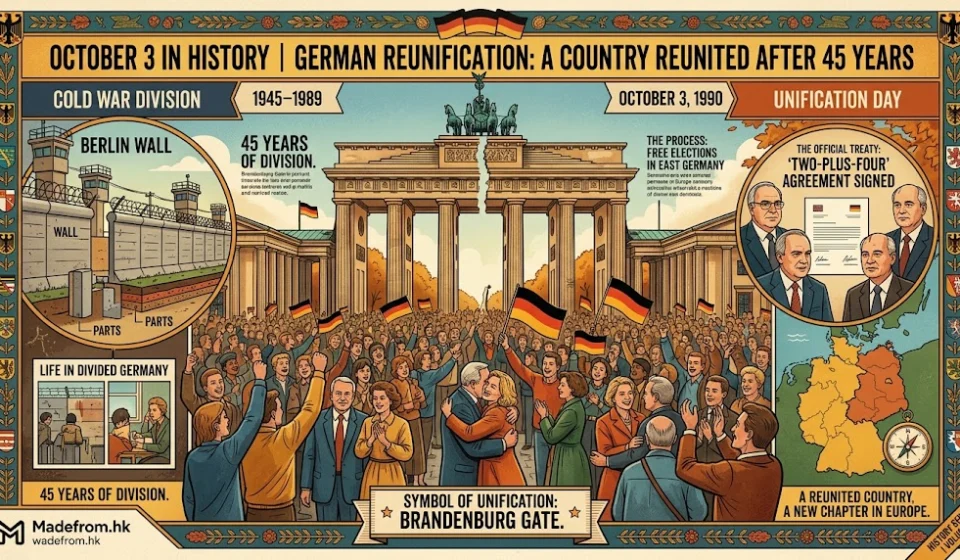
On October 3, 1990, East and West Germany officially reunited, ending 45 years of division and creating a major turning point in modern European history.

October 3, 1990, became one of the defining dates in modern German and European history. On that day, the German Democratic Republic, commonly known as East Germany, formally joined the Federal Republic of Germany, or West Germany. The reunification brought together a country that had been divided for more than four decades and marked a major change in the political landscape of Europe. The division of Germany had emerged from the aftermath of the Second World War. Germany was divided into occupation zones, and in 1949 two separate German states were established. West Germany developed as a federal republic closely connected with Western Europe and the United States, while East Germany developed as a socialist state within the Soviet sphere of influence. The division was not simply political. Over time, the two societies developed different economic systems, institutions and everyday experiences. Berlin became the most visible symbol of the division. Although the city was located inside East Germany, it was itself divided between East and West. When the Berlin Wall was constructed in 1961, the separation became even more concrete. Families, friends and residents who lived on opposite sides faced severe restrictions on movement, and the wall became one of the most recognizable symbols of the Cold War. By the late 1980s, however, the political situation in Eastern Europe was changing rapidly. Soviet leader Mikhail Gorbachev introduced reforms, while political movements demanding greater freedom gained strength across several Eastern European countries. East Germany also experienced growing public pressure for political reform and greater freedom of movement. On November 9, 1989, the Berlin Wall was opened. Crowds gathered at crossing points, and the barrier that had divided Berlin for decades rapidly lost its practical meaning. The opening of the wall did not automatically create a united Germany, but it transformed the political possibilities. What had previously appeared difficult or even impossible suddenly became achievable. During 1990, East and West Germany moved through a rapid series of political, economic and diplomatic negotiations. East Germany held its first and only free parliamentary election in March 1990, producing a government that supported rapid movement toward German reunification. On May 18, East and West Germany signed a treaty establishing a monetary, economic and social union. It came into effect on July 1, bringing the West German currency and broader economic structures into East Germany. The two sides then signed the Unification Treaty on August 31, establishing the legal framework for East Germany’s accession to the Federal Republic. The final step came on October 3, 1990. Legally, the process did not create an entirely new German state. Instead, the five states that had made up East Germany joined the Federal Republic of Germany. This is why October 3 became Germany’s national holiday, known as the Day of German Unity, or Tag der Deutschen Einheit. The reunification had consequences far beyond Germany itself. Europe was undergoing a much broader transformation as the Cold War approached its end. The political systems of Eastern Europe were changing, Soviet influence was declining and new relationships were developing between European countries. A united Germany therefore became part of a fundamentally different European environment. Yet reunification was not simply a matter of removing a border and combining two governments. East and West Germany had developed separately for more than forty years, leaving major differences in economic structures, industries, infrastructure, wages, employment and living standards. Political integration could happen quickly, but social and economic integration required much more time. For many people in East Germany, reunification brought important new freedoms, including freedom of movement, new political choices and access to a much larger economic system. At the same time, the transition created serious economic difficulties. Many East German companies were unable to compete successfully in the new market environment, and unemployment increased in several regions as the old economic system disappeared. These experiences became an important part of the post-reunification story. For this reason, the history of October 3 should not be reduced simply to images of celebration after the Berlin Wall opened. Reunification was both an extraordinary political achievement and the beginning of a long process of social and economic adjustment. Major historical events often work in this way. A single date can become a powerful symbol, but the deeper consequences may take decades to develop. October 3, 1990, represented the formal completion of a process that had moved through several stages: the creation of two German states in 1949, the construction of the Berlin Wall in 1961, the opening of the wall in 1989 and finally the reunification of Germany in 1990. Together, these events form one of the clearest stories of political change in twentieth-century Europe. Today, October 3 is celebrated throughout Germany as German Unity Day. It commemorates the moment when the country’s long political division formally ended. For ordinary people, however, reunification meant much more than treaties and constitutional arrangements. It meant that families separated by borders could reconnect more freely, that Berlin could once again function as one city, and that people who had lived under different political systems could begin building a shared future. The story also demonstrates that borders and political systems are not necessarily permanent. They can last for generations, but historical circumstances and public choices can eventually change them. October 3 therefore stands not only as Germany’s national day but also as an important symbol of Europe’s transition from division toward greater political integration. It remains a reminder that historical change can sometimes happen much faster than people expect once circumstances begin to shift.

October 3, 1990, marked the formal reunification of Germany after 45 years of division, becoming one of the defining turning points in modern European history.

Post Views: 13
延伸閱讀
當年報章摘要|海外信託銀行送禮|慶祝兒童節 | Overseas Trust Bank Presents Gifts|Children’s Day Celebration
兒童節在當年的香港,是社會及商界關注兒童的一個特別日子。報章除了報道社會新聞,也會刊登一些與兒童節有關的活動消息。 當日報紙報道,海外信…
香港歷史第三十二章:香港城市擴張 殖民地發展 基建人口變遷 | Hong Kong urban expansion colonial growth infrastructure population change
十九世紀末至二十世紀初,香港由港口據點逐步轉化為密集都市,殖民政府透過填海、規劃與基建工程,推動城市空間擴張,亦改變社會結構與生活方式,…
Galileo Galilei|改變宇宙觀的科學先驅:近代科學之父的革命 | Galileo Galilei | The Father of Modern Science Who Challenged the Cosmos | 世界名人錄
伽利略·伽利萊(Galileo Galilei)是17世紀最具影響力的科學家之一,被後世稱為「近代科學之父」。他透過改良望遠鏡觀測天空,…
5月5日歷史上的今天|文化與戰爭交織的時刻 On This Day: May 5 and the Interwoven Stories of Culture and Conflict
5月5日蘊含文化傳承與歷史事件交錯的意義,從節慶象徵到戰爭轉折,展現人類如何在傳統與變局中不斷前行。May 5 is a date sh…

Tags:

German ReunificationOctober 3
Author

admin

Follow Me
Other Articles
A black-and-white manga cover for Corpse Transformation from Liaozhai featuring a terrified traveler whispering "Play dead!" while a creepy silhouette lurks in the dark doorway of a desolate inn.
Previous

Corpse Transformation|Strange Tales|English Comic Edition

Next

Cantonese Sayings | No Cover on the Chicken Coop | English Comic Edition

語言 | language

繁體中文
English
  • Patreon
  • Facebook
  • Instagram
  • YouTube
  • Bluesky
  • Tumblr
  • LinkedIn
  • Terms of Service
  • Privacy Policy
  • Contact
  • About Us
  • Advertising
  • Column Sponsorship

Content & Corrections

This website covers films, animation, games, cultural columns, and other related content and information. Our information is primarily based on publicly available sources, official announcements, and editorial research. Content may be revised or updated when new information becomes available.
If you notice any errors, believe that information needs to be corrected, or have updated official information that may be added, please contact us by email:
📧 [email protected]
We will review the information and make updates as soon as possible after verification.
Thank you for your help and understanding.

  • Strange Tales | The Water-Spouting Maiden | English Comic Edition
  • Original Stories | Myths of the Constellations | Episode 2 | The Silent Guardian | English Comic Edition
  • Global Tourism Resilience Day: Building a Tourism Sector That Can Recover and Adapt
  • Cantonese Sayings | No Cover on the Chicken Coop | English Comic Edition
  • Today in History: October 3|German Reunification: A Country Reunited After 45 Years

ACG HK anime Chinese Mythology Dream of the Red Chamber Hong Kong History On This Day Romance of the Three Kingdoms Silent film world history 三國演義 世界歷史 中國古典小說 中國神話 今日歷史 劉備 動畫 動畫電影 古典文學 台灣旅遊 專欄 小說連載 山海經 廣東話歇後語 影評 恐怖電影 推薦 日本動畫 日本電影 曹操 林黛玉 歷史上的今天 澳門 紅樓夢 經典電影 美國電影 聊齋志異 賈寶玉 電影 電影劇情介紹 飲食 香港文化 香港旅遊 香港歷史 香港都市傳說 香港電影

Copyright 2021 - 2026 — 0studiohk.com | madefrom.hk. All rights reserved.