
Skip to content
madefrom.hk madefrom.hk madefrom.hk

Rewriting culture, history and memories beyond language and borders.

madefrom.hk madefrom.hk madefrom.hk

Rewriting culture, history and memories beyond language and borders.

  • Comics
    • Strange Tales
    • Myths of the Constellations
  • Column
    • Knowledge Hub
      • 生活篇
      • 食品篇
      • 科技篇
      • 超市篇
    • Life & Technology
    • Hong Kong Guide
    • Today in History
    • City Stories
    • Anime & Manga
    • Game Magazine
    • Toy Club
    • Language of Flowers
    • Street Notes
    • All Things
    • Music Memories
    • Chinese Idioms
    • Cantonese Sayings
    • Movie Magazine
  • Original Stories
    • 不可思議故事
    • 十三號的約定
    • 星座宮神話
    • 香港山怪談
    • 香港都市靈異傳說
  • Adapted Stories
    • romance of the three kingdoms
    • hong kong places
    • dream of the red chamber
    • strange tales
    • The house on the borderland
    • usherhouse
    • Theblackcat
  • History
    • History in 80 Seconds
    • 當年報章摘要
    • 香港歷史
    • 世界名作家
    • World Biographies
  • Movies
    • USA
    • japan
    • Korea
    • Taiwan
    • HONGKONG
    • India
    • china
    • france
    • Tunisia
    • Germany
    • Jordan
    • Switzerland
    • sweden
    • Spain
    • Palestine
    • Norway
    • Argentina
    • Brazil
  • ACG
    • Winter 2026 Anime
    • Summer 2026 Anime
    • ACGHK
      • 2016
      • 2018
      • 2019
      • 2023
      • 2024
    • 創天綜合同人祭
      • 同人表演
    • 音樂
    • 電玩
      • 玩具資訊
      • 遊戲資訊
    • 遊戲
      • SNK Neo Geo
      • PlayStation 2
      • Arcade
      • NEWS
  • 旅行
    • Hong Kong Travel
      • 土瓜灣
      • 舊建築
      • 街道
      • 單車
      • 文化
      • 交通
      • 香港書展
      • 表演
      • 廟宇
      • 教堂
      • 香港書展
      • 分享會
      • 紀念活動
      • 文化活動
      • 活動
      • 寵物
      • 巴士
      • 電車
      • 機場
      • 飲食
        • 上環
        • 中環
        • 筲箕灣
        • 西環
        • 天后
        • 旺角
        • 荔枝角
        • 佐敦道
        • 太子
        • 大角咀
        • 深水埗
        • 油麻地
        • 長沙灣
        • 黃大仙
        • 尖沙咀
        • 油塘
        • 葵芳
        • 屯門
        • 元朗
        • 上水
        • 粉嶺
        • 荃灣
        • 渡輪
      • 心理測驗
    • Macau Travel
    • International Travel
    • 日本旅遊
    • Taiwan Travel
    • Thailand Travel
  • Archive
    • 文化生活
    • 莎拉有約
  • Comics
    • Strange Tales
    • Myths of the Constellations
  • Column
    • Knowledge Hub
      • 生活篇
      • 食品篇
      • 科技篇
      • 超市篇
    • Life & Technology
    • Hong Kong Guide
    • Today in History
    • City Stories
    • Anime & Manga
    • Game Magazine
    • Toy Club
    • Language of Flowers
    • Street Notes
    • All Things
    • Music Memories
    • Chinese Idioms
    • Cantonese Sayings
    • Movie Magazine
  • Original Stories
    • 不可思議故事
    • 十三號的約定
    • 星座宮神話
    • 香港山怪談
    • 香港都市靈異傳說
  • Adapted Stories
    • romance of the three kingdoms
    • hong kong places
    • dream of the red chamber
    • strange tales
    • The house on the borderland
    • usherhouse
    • Theblackcat
  • History
    • History in 80 Seconds
    • 當年報章摘要
    • 香港歷史
    • 世界名作家
    • World Biographies
  • Movies
    • USA
    • japan
    • Korea
    • Taiwan
    • HONGKONG
    • India
    • china
    • france
    • Tunisia
    • Germany
    • Jordan
    • Switzerland
    • sweden
    • Spain
    • Palestine
    • Norway
    • Argentina
    • Brazil
  • ACG
    • Winter 2026 Anime
    • Summer 2026 Anime
    • ACGHK
      • 2016
      • 2018
      • 2019
      • 2023
      • 2024
    • 創天綜合同人祭
      • 同人表演
    • 音樂
    • 電玩
      • 玩具資訊
      • 遊戲資訊
    • 遊戲
      • SNK Neo Geo
      • PlayStation 2
      • Arcade
      • NEWS
  • 旅行
    • Hong Kong Travel
      • 土瓜灣
      • 舊建築
      • 街道
      • 單車
      • 文化
      • 交通
      • 香港書展
      • 表演
      • 廟宇
      • 教堂
      • 香港書展
      • 分享會
      • 紀念活動
      • 文化活動
      • 活動
      • 寵物
      • 巴士
      • 電車
      • 機場
      • 飲食
        • 上環
        • 中環
        • 筲箕灣
        • 西環
        • 天后
        • 旺角
        • 荔枝角
        • 佐敦道
        • 太子
        • 大角咀
        • 深水埗
        • 油麻地
        • 長沙灣
        • 黃大仙
        • 尖沙咀
        • 油塘
        • 葵芳
        • 屯門
        • 元朗
        • 上水
        • 粉嶺
        • 荃灣
        • 渡輪
      • 心理測驗
    • Macau Travel
    • International Travel
    • 日本旅遊
    • Taiwan Travel
    • Thailand Travel
  • Archive
    • 文化生活
    • 莎拉有約
Close

Search

繁體中文
HistoryWorld Biographies

Galileo Galilei|改變宇宙觀的科學先驅:近代科學之父的革命 | Galileo Galilei | The Father of Modern Science Who Challenged the Cosmos | 世界名人錄

2026-03-21

伽利略·伽利萊(Galileo Galilei)是17世紀最具影響力的科學家之一,被後世稱為「近代科學之父」。他透過改良望遠鏡觀測天空,發現木星衛星、金星相位以及月球表面凹凸不平等現象,為日心說提供強而有力的證據。伽利略同時在力學與實驗方法方面作出重要貢獻,推動科學從哲學思辨轉向以觀測與實驗為基礎的研究方式。雖然他的學說與當時教會的宇宙觀發生衝突,但他的研究最終改變了人類對宇宙與自然法則的理解。

Galileo Galilei (1564–1642) was an Italian astronomer, physicist, and mathematician widely regarded as the “father of modern science.” He played a crucial role in the Scientific Revolution by improving the telescope and making groundbreaking astronomical observations, including the moons of Jupiter and the phases of Venus. Galileo strongly supported the heliocentric theory proposed by Nicolaus Copernicus, which placed the Sun at the center of the universe. His advocacy brought him into conflict with the Roman Catholic Church, leading to his trial by the Inquisition. Despite opposition, Galileo’s work transformed scientific methodology, emphasizing observation, experimentation, and mathematical analysis.

在人類科學史上,有些人物的思想足以改變整個世界對宇宙的理解。伽利略·伽利萊正是這樣的一位人物。他以觀測與實驗為基礎,挑戰長久以來被視為權威的宇宙觀,並推動科學進入一個嶄新的時代。由於他對天文學與物理學的重大貢獻,後世普遍將他視為「近代科學之父」。

伽利略於1564年出生於義大利城市比薩。當時的義大利正處於文藝復興時期,藝術、哲學與科學思想蓬勃發展。伽利略的父親是一名音樂家,同時也是思想開放的知識分子,這樣的家庭環境對伽利略的思考方式產生重要影響。

年輕時的伽利略最初在比薩大學學習醫學,但很快便對數學與自然哲學產生更濃厚興趣。他開始研究古希臘學者亞里士多德的自然哲學,同時也逐漸發現其中許多理論缺乏實驗證據。伽利略認為,自然界的規律應該透過觀察與實驗來理解,而不是僅依賴古代權威的說法。

關於伽利略最著名的故事之一,是他在比薩斜塔進行自由落體實驗。雖然歷史學者對這個故事的細節有所爭議,但可以確定的是,伽利略透過實驗證明不同重量的物體在自由落體時會以相同速度下降,這與亞里士多德認為「重物落得更快」的說法完全不同。這項研究為後來的經典力學奠定重要基礎。

伽利略在研究運動規律時,也提出了慣性概念的雛形。他指出,如果沒有外力影響,物體會保持原本的運動狀態。這一思想後來被牛頓發展成為著名的慣性定律。

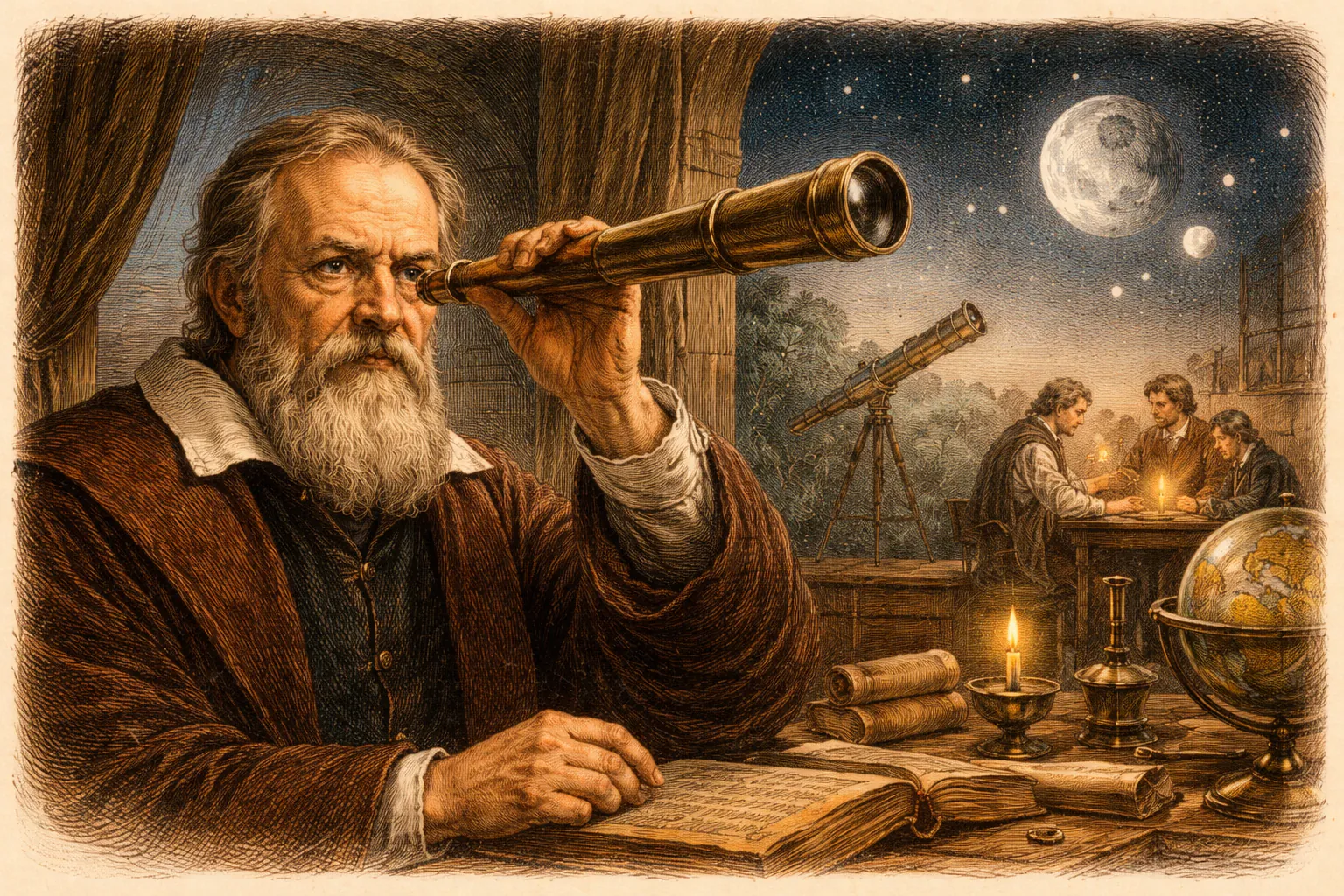
然而真正讓伽利略名聲傳遍歐洲的,是他對天文學的觀測。1609年,荷蘭發明了望遠鏡。伽利略聽聞此事後,迅速自行製作並改良望遠鏡,使其放大倍率大幅提升。這使他成為最早使用望遠鏡系統性觀測天空的科學家之一。

透過望遠鏡,伽利略觀察到許多前所未見的現象。他發現月球表面並不像人們想像的那樣光滑,而是充滿山脈與坑洞,這顯示天體與地球一樣具有不完美的地形。他還觀察到銀河其實由無數星星組成,而不是一條朦朧的光帶。

1610年,伽利略發現四顆圍繞木星運行的衛星,後來被稱為「伽利略衛星」。這項發現具有重大意義,因為它證明宇宙中存在圍繞其他天體運行的物體,而不一定全部都圍繞地球。這對長久以來的地心說造成強烈衝擊。

伽利略還觀察到金星會出現類似月亮的相位變化。這一現象只有在金星繞太陽運行的情況下才能解釋,因此成為支持日心說的重要證據。日心說最早由波蘭天文學家哥白尼提出,但在當時仍然存在巨大爭議。

伽利略的觀測成果被整理成《星際信使》一書出版,很快在歐洲引起轟動。許多學者對他的發現感到震驚,也有人對他的結論提出質疑。科學界與宗教界對宇宙結構的看法開始出現激烈辯論。

在當時的歐洲,教會仍然是學術權威的重要來源。地心說長期被視為與聖經解釋相符合的宇宙觀,因此日心說被認為具有爭議性。伽利略公開支持日心說,並以觀測證據加以論證,這使他逐漸與教會產生衝突。

1632年,伽利略出版《關於兩大世界體系的對話》,以對話形式討論地心說與日心說。書中內容明顯支持日心說,因此引起羅馬宗教裁判所的注意。1633年,伽利略被迫接受審判,最終被判定為「強烈懷疑異端」,並被要求公開放棄支持日心說的立場。

傳說在宣讀判決後,伽利略低聲說出一句著名的話:「然而地球仍然在轉動。」雖然這句話的真實性存在爭議,但它象徵了科學真理與權威之間的衝突。

審判之後,伽利略被軟禁在家中,但仍然持續進行研究。在晚年,他完成了另一部重要著作《兩種新科學》,總結了自己在力學與材料學方面的研究成果。這本書後來對牛頓與其他科學家產生深遠影響。

伽利略於1642年去世,享年77歲。雖然他在生前曾遭遇迫害,但他的科學思想逐漸被後世接受。隨著近代科學的發展,日心說成為公認的宇宙模型,而伽利略的實驗方法也成為科學研究的重要基礎。

回顧歷史,伽利略最大的貢獻並不只是天文發現,而是他所建立的科學方法。他強調透過觀察、實驗與數學分析來理解自然規律,這種方法使科學從哲學思辨轉變為實證研究。

正因如此,許多歷史學家將伽利略視為現代科學革命的重要人物。他讓人類第一次真正用儀器觀測宇宙,也讓人們意識到自然界的運行可以用數學與物理法則解釋。

今天,人類已經能夠發射太空探測器、觀測遙遠星系,但這一切的起點,都可以追溯到17世紀那位將望遠鏡指向天空的義大利科學家。伽利略的勇氣與求知精神,不僅改變了科學史,也改變了人類理解宇宙的方式。

English Version

Galileo Galilei stands as one of the most pivotal figures in the history of science, a man whose work not only transformed astronomy and physics but also redefined the very method by which knowledge is pursued. Born in 1564 in Pisa, Italy, Galileo lived during a time when traditional Aristotelian views of the universe still dominated intellectual thought. Through his observations, experiments, and unwavering commitment to truth, he helped usher in the Scientific Revolution and laid the groundwork for modern scientific inquiry.

Galileo’s early education was influenced by his father, a musician and scholar who encouraged independent thinking. Initially enrolled at the University of Pisa to study medicine, Galileo soon shifted his focus to mathematics and natural philosophy. It was here that he began questioning established ideas, particularly those derived from Aristotle, whose authority had gone largely unchallenged for centuries.

One of Galileo’s earliest contributions was his work on motion. Through experiments—some of which he reportedly conducted by dropping objects from the Leaning Tower of Pisa—he demonstrated that objects fall at the same rate regardless of their mass, contradicting Aristotelian physics. He also studied the motion of pendulums and developed principles that would later influence the study of time and mechanics.

Galileo’s most famous achievements, however, came from his work in astronomy. In 1609, after learning of the invention of the telescope, he constructed his own improved version and turned it toward the heavens. What he observed would forever change humanity’s understanding of the universe. He discovered four moons orbiting Jupiter—now known as the Galilean moons—providing clear evidence that not all celestial bodies revolve around the Earth. He also observed the phases of Venus, which supported the heliocentric model proposed by Nicolaus Copernicus.

In addition, Galileo observed that the surface of the Moon was not smooth and perfect, as previously believed, but rugged and marked by mountains and craters. He also identified countless stars invisible to the naked eye, revealing the vastness of the cosmos. These discoveries challenged the long-standing geocentric model and provided strong support for a Sun-centered universe.

Galileo published his findings in works such as Sidereus Nuncius (The Starry Messenger), which brought him both fame and controversy. His support for heliocentrism, however, placed him in direct conflict with the Roman Catholic Church, which held that the Earth was the center of the universe in accordance with traditional interpretations of Scripture.

In 1633, Galileo was tried by the Roman Inquisition and found “vehemently suspect of heresy.” He was forced to recant his support for heliocentrism and spent the remainder of his life under house arrest. Despite this, he continued his work, producing Discourses and Mathematical Demonstrations Relating to Two New Sciences, which laid the foundations for modern physics, particularly in the study of motion and materials.

What distinguishes Galileo is not only his discoveries but his method. He championed the use of systematic experimentation and mathematical description, moving away from reliance on authority and tradition. His approach emphasized that knowledge should be grounded in observation and evidence, a principle that remains central to science today.

Galileo’s influence extended beyond his own work. His ideas inspired later scientists such as Isaac Newton, who built upon Galileo’s studies of motion to develop the laws of mechanics and universal gravitation. In this way, Galileo serves as a crucial link between the Renaissance and the modern scientific age.

Despite the challenges he faced, Galileo’s legacy endured. He is often remembered as a symbol of intellectual courage—a thinker willing to challenge established beliefs in pursuit of truth. His conflict with the Church has come to represent the broader tension between science and authority, though modern perspectives recognize the complexity of this historical relationship.

Galileo died in 1642, the same year that Isaac Newton was born, symbolically marking the transition from one era of scientific discovery to another. Today, he is celebrated as a pioneer whose work transformed our understanding of the universe and established principles that continue to guide scientific exploration.

In many respects, Galileo did more than observe the heavens—he changed the way humanity sees them. By combining observation, experimentation, and mathematical reasoning, he helped create a new framework for understanding reality. His contributions remain a cornerstone of modern science, and his legacy continues to inspire generations of thinkers and explorers.

Ultimately, Galileo Galilei’s significance lies in his relentless pursuit of truth and his willingness to question the accepted wisdom of his time. His work represents a turning point in human history, one that shifted the foundations of knowledge from authority to evidence, from tradition to discovery.
Views: 14
延伸閱讀
8月25日 今日歷史:伽利略展示望遠鏡開啟天文新紀元 Today in History (August 25): Galileo Demonstrates Telescope
1609年8月25日,伽利略向威尼斯參議院展示折射望遠鏡,開啟人類探索宇宙的新紀元。 On August 25, 1609, Galil…
六月十日大事紀|June 10 On This Day – Benjamin Franklin’s Famous Kite Experiment
1752年6月10日前後,美國開國元勳兼科學家班傑明·富蘭克林進行了著名的風箏實驗。這項實驗幫助人類進一步了解閃電與電力的關係,也為現代…
維爾納·海森堡與德國:量子力學革命與不確定性原理的誕生|Werner Heisenberg and Germany: The Quantum Revolution and the Uncertainty Principle | 世界名人錄
在20世紀的德國,維爾納·海森堡提出不確定性原理,徹底改變人類對微觀世界的理解與物理學基礎。In 20th-century German…
安東尼·范·列文虎克:微生物世界的開拓者 / Antonie van Leeuwenhoek: Pioneer of the Microscopic World | 世界名人錄 
安東尼·范·列文虎克是首位揭開微生物世界面紗的科學家,他的觀察改變了人類對生命的理解。English: Antonie van Leeu…

Tags:

Galileo Galilei世界歷史名人伽利略伽利略衛星天文學史天文學家文藝復興時期日心說望遠鏡觀測物理學史科學史科學革命義大利科學家近代科學之父
Other Articles
English Version There was a time when going to the cinema in Hong Kong was not a quiet, solitary activity but a lively and collective experience. Entire streets were defined by the presence of theatres, their facades illuminated by bright signage and large film posters that captured the imagination of passersby. These cinema streets were vibrant corridors of anticipation, where the act of watching a film began long before stepping into the auditorium. People gathered outside in long, winding queues, each person holding the same expectation—the promise of a story waiting to unfold on the big screen. The queue itself was part of the ritual. It was not uncommon for people to wait patiently, sometimes for hours, especially when a highly anticipated film was released. Conversations flowed easily among strangers, sparked by shared excitement or curiosity. There was a sense of collective participation, as if everyone in line was already part of the same audience before the film even started. This atmosphere created a unique bond, turning what could have been a simple wait into an experience filled with energy and connection. Ticket booths played a central role in this scene. Small windows framed by metal grilles became the gateway to another world. The exchange was brief but meaningful—money passed through, tickets returned, and with them, access to a moment of escape. The physical ticket itself carried significance, often kept as a small souvenir of the experience. Unlike digital confirmations today, these paper tickets had a tangible presence, reinforcing the sense that something special was about to happen. Once inside, the cinema offered a different kind of immersion. Large screens, dim lighting, and the collective silence of the audience created an environment where attention was fully focused. Reactions were shared in real time—laughter, gasps, applause—each emotion amplified by the presence of others. The communal nature of the experience made every screening slightly different, shaped by the audience as much as by the film itself. This shared engagement added depth to the act of watching, transforming it into something more than passive consumption. Cinema streets also reflected the diversity of Hong Kong’s film culture. Local productions stood alongside international releases, offering a wide range of choices that catered to different tastes. Posters displayed outside theatres served as visual invitations, each one competing for attention through bold imagery and dramatic titles. These streets became informal galleries of storytelling, where the city’s cinematic identity was constantly on display. As technology and consumer habits evolved, the landscape of cinema began to change. Multiplexes replaced standalone theatres, and online booking eliminated the need for physical queues. While these developments brought convenience and efficiency, they also altered the social dimension of the experience. The spontaneous interactions, the shared anticipation, and the vibrant street atmosphere gradually faded, replaced by quieter, more individualized forms of viewing. Yet, the memory of Hong Kong’s cinema streets continues to resonate because it represents a time when entertainment was deeply intertwined with public space and community. It was an era when watching a film was not just about the story on the screen, but about the journey leading up to it—the wait, the crowd, the collective excitement. These elements created a richness that extended beyond the film itself, embedding the experience within the fabric of everyday life. The legacy of these cinema streets serves as a reminder that cultural experiences are shaped not only by content but by context. It highlights the importance of shared spaces in creating meaningful connections and underscores the value of moments that bring people together. Although the physical landscape has changed, the spirit of those bustling streets endures in memory, continuing to influence how people think about cinema and community.
Previous

香港戲院街的年代:那些排隊買票與滿座掌聲的日子 | Hong Kong Cinema Streets: The Era of Queues, Tickets, and Applause | 今日回望 | 第十九章

Next

香港歷史第二章:最早的香港居民|Hong Kong History Chapter 2 — The Earliest Inhabitants of Hong Kong

No Comment! Be the first one.

Leave a Reply Cancel reply

You must be logged in to post a comment.

  • Patreon
  • Facebook
  • Instagram
  • YouTube
  • Bluesky
  • Tumblr
  • LinkedIn

Register|Lost your password?

  • Terms of Service
  • Privacy Policy
  • Contact
  • About Us
  • Register
  • Login
  • Password Reset
  • Advertising
  • Column Sponsorship
  • plus member

Content & Corrections

This website covers films, animation, games, cultural columns, and other related content and information. Our information is primarily based on publicly available sources, official announcements, and editorial research. Content may be revised or updated when new information becomes available.
If you notice any errors, believe that information needs to be corrected, or have updated official information that may be added, please contact us by email:
📧 [email protected]
We will review the information and make updates as soon as possible after verification.
Thank you for your help and understanding.

  • Myths of the Constellations | Episode 7 | The Cost of Fire |English Comic Edition 
  • Strange Tales | The Monster in the Buckwheat  | English Comic Edition 
  • Strange Tales|Hunting a Fox | English Comic Edition
  • Myths of the Constellations|Episode 6|After the Fracture|English Comic Edition
  • Strange Tales|Biting a Ghost | English Comic Edition

ACG HK anime Chinese Mythology Dream of the Red Chamber Hong Kong History On This Day Romance of the Three Kingdoms Silent film world history 三國演義 世界歷史 中國古典小說 中國神話 今日歷史 劉備 動畫 動畫電影 古典文學 台灣旅遊 專欄 小說連載 山海經 廣東話歇後語 影評 恐怖電影 推薦 日本動畫 日本電影 曹操 林黛玉 歷史上的今天 澳門 紅樓夢 經典電影 美國電影 聊齋志異 賈寶玉 電影 電影劇情介紹 飲食 香港文化 香港旅遊 香港歷史 香港都市傳說 香港電影

Copyright 2021 - 2026 — 0studiohk.com | madefrom.hk. All rights reserved.