
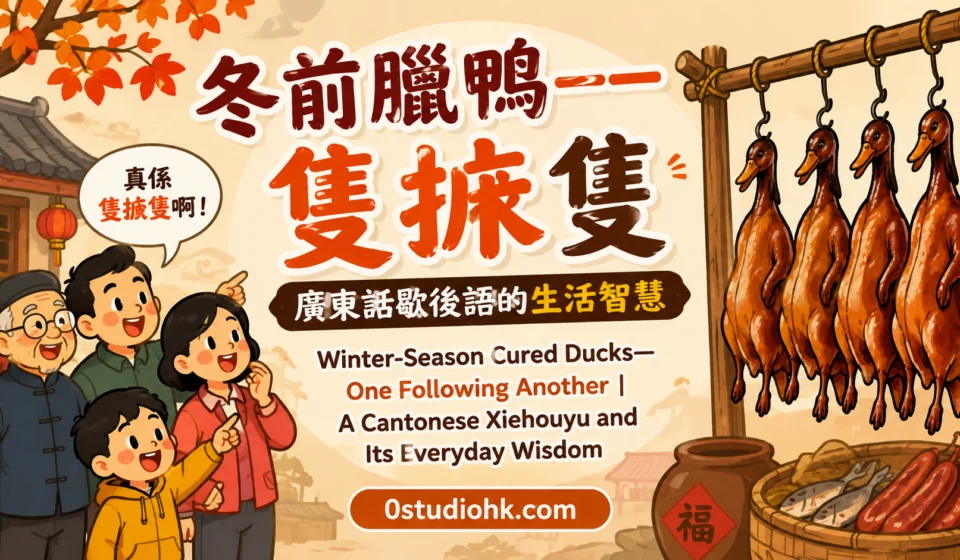
冬前臘鴨——隻掕隻|廣東話歇後語的生活智慧 | Winter-Season Cured Ducks—One Following Another | A Cantonese Xiehouyu and Its Everyday Wisdom
廣東話歇後語「冬前臘鴨——隻掕隻」,表面講的是臘鴨,背後講的卻是人與人之間的排列、搭配與相處。香港人熟悉的「秋風起,食臘味」,正好帶出臘鴨與冬季生活的關係。這句歇後語有不同寫法及解釋,常見版本包括「隻掕隻」、「一隻帶一隻」等,核心都離不開一隻接着一隻、彼此相連的意思。
The Cantonese saying “Winter-season cured ducks—one following another” comes from a familiar scene in traditional food culture, but its meaning extends far beyond cured meat. It evokes the image of ducks being placed together in sequence, side by side or one after another. In everyday Cantonese, the expression can describe people who appear together as a group, people who are closely connected, or two people whose differences somehow make them an interesting pair. Like many Cantonese expressions, its humour comes from taking an ordinary household image and turning it into a sharp observation about human relationships.
意思
「冬前臘鴨——隻掕隻」是一句很有廣東生活氣息的歇後語。「冬前」可以理解為冬至前後的臘味季節,而臘鴨本身就是傳統廣東臘味之一。秋冬天氣轉涼、空氣比較乾燥,正是製作和享用臘味的時候,因此「臘鴨」很容易令人聯想到一家人準備過冬、曬臘味、辦年貨的傳統生活。這句歇後語最直接的畫面,就是一隻臘鴨接着一隻臘鴨,彼此相連、排列在一起,所以「隻掕隻」帶有一隻跟住一隻、一個接一個的意思。不同資料對這句歇後語的寫法和引申意思略有差異,有資料寫成「一隻帶一隻」,也有資料解作排列整齊、秩序分明,甚至用來形容攜親帶友一同出現;亦有民間說法把它延伸到兩個人外貌或性格上的差異,例如一個高大、一個細小,一個活潑、一個沉靜,兩個人走在一起反而形成鮮明對比。 所以,這句說話真正有趣的地方,不只是「一隻接一隻」的表面意思,而是廣東人很喜歡由生活細節觀察人情世態:有些人不是完全一樣才可以走在一起,反而正因為彼此不同,才形成一種有趣的組合。假如一家人出街,大人帶着小朋友,前面一個、後面一個,浩浩蕩蕩走在一起,也可以令人聯想到「隻掕隻」的畫面;如果一對朋友性格一個急、一個慢,旁人又可能笑說他們「冬前臘鴨——隻掕隻」。因此,這句歇後語既可以帶有輕鬆幽默的味道,也可以用來形容一群人接連出現、彼此相伴的情況。它沒有複雜的典故,卻把傳統臘味、季節生活和人際觀察放在同一句短短的廣東話裡,正是歇後語最有魅力的地方。
Meaning
“Winter-season cured ducks—one following another” is a vivid Cantonese expression rooted in the traditional food culture of southern China. Cured duck is part of the familiar winter food tradition associated with the cooler months, when families would prepare preserved meats for the season and for the Lunar New Year. The phrase creates a simple but memorable picture: one cured duck beside another, arranged together in a continuous line. That image gives the expression its basic sense of people or things appearing closely together, one after another. Different sources record slightly different Cantonese characters and interpretations, including versions equivalent to “one accompanying another,” while some explanations emphasize orderly arrangement or a group arriving together. In everyday speech, however, the expression becomes more interesting when it is applied to people. It can describe a group of relatives or friends who arrive together, with one person seemingly bringing another along. It may also be used humorously when two people with noticeably different appearances, personalities, or habits are seen together. One may be quiet while the other is talkative; one may be energetic while the other is calm; one may be tall while the other is short. Their differences do not necessarily create conflict—instead, they make the pair memorable. This is typical of Cantonese humour: an ordinary object from daily life becomes a metaphor for human behaviour. The saying does not need a grand historical story to make its point. A row of preserved ducks is enough to remind people of how individuals naturally form groups, follow one another, accompany one another, or simply happen to be placed side by side. It can therefore carry a light-hearted tone rather than a harsh criticism. When someone says that a group is “冬前臘鴨——隻掕隻,” the listener can immediately picture people arriving one after another. That visual quality is one reason Cantonese xiehouyu are so memorable. They turn something familiar in the kitchen, market, or street into a compact observation about society and relationships. The expression also reminds us that traditional Cantonese language often preserves fragments of an older way of life: winter weather, preserved food, family gatherings, markets, and the habit of joking about people through everyday objects.
用法
「冬前臘鴨——隻掕隻」通常用在比較口語、帶少少幽默感的場合。例如一班親朋戚友一個帶一個出席聚會,或者一群人接住接住出現,就可以笑說:「今日真係冬前臘鴨,隻掕隻咁嚟!」如果兩個人經常一起出現,而且性格、外貌或習慣有明顯差異,也可以借這句說話打趣。不過,使用時最好留意對方關係和場合,因為歇後語本身帶有玩笑意味,熟人之間使用最自然。這句說話的重點不是批評,而是利用「一隻跟一隻」的畫面製造幽默感。
Usage
The expression works best in casual Cantonese conversation, especially when people are joking with friends, relatives, or colleagues. If a group keeps arriving one after another, someone might jokingly say that they are like cured ducks in winter—one following another. It can also be used when two people are often seen together despite having very different personalities or appearances. The humour comes from the visual comparison rather than from serious criticism. Because Cantonese xiehouyu often depend on shared cultural knowledge and timing, the expression sounds most natural when spoken lightly and among people who understand the joke. It is less suitable for formal writing or situations where a literal and precise description is required.
小故事:
阿明屋企有四兄弟姊妹,平日各有各忙,住得又唔近,所以大家難得一齊出街。某個星期日,阿媽突然話要去飲茶,叫阿明帶埋細佬、家姐同表妹一齊去。阿明一早落樓,行到街口見到細佬已經企喺度等,行多兩步又見到家姐拎住個袋趕過嚟,轉個彎,表妹又從後面追上來。四個人就咁一個跟住一個,浩浩蕩蕩向酒樓方向行。隔籬茶餐廳門口坐住一個街坊,見到佢哋經過,笑住講:「嘩,你哋今日真係冬前臘鴨,隻掕隻喎!」阿明聽完即刻笑咗,話:「我阿媽叫一個帶一個,唔知不覺就變咗四隻臘鴨!」大家一路笑一路行。到了酒樓,阿媽見到四個人終於齊晒,又話:「我叫你哋飲茶,唔係叫你哋成隊出巡喎!」細佬就笑住答:「唔係我哋要成隊,係冬前臘鴨要隻掕隻嘛!」成枱人即刻笑成一片。其實呢個小故事最有趣嘅地方,就係一句簡單嘅歇後語,可以將一個普通家庭聚會變得生動。四個人本來只是碰巧一個接一個到場,但經街坊一句「冬前臘鴨——隻掕隻」,大家腦海立即出現一排臘鴨一隻接一隻嘅畫面。廣東人講歇後語,往往唔需要解釋太多,只要一個熟悉嘅生活場景,加上一句有趣嘅比喻,成件事就會即刻有畫面。呢種講法亦反映廣東話其中一種很有特色嘅幽默:唔直接講「你哋一個跟一個」,偏偏借臘鴨嚟講,聽落更加抵笑。
Story
On a Sunday morning, Ming’s mother suddenly decided that the family should go out for dim sum together. Ming was asked to bring along his younger brother, his sister, and a cousin. At first, Ming thought he would simply meet everyone at the restaurant. Instead, things unfolded like a little procession. He met his younger brother at the corner of the street. A few steps later, his sister hurried over carrying a shopping bag. Then his cousin appeared from behind, calling out for them to wait. Before long, all four were walking together, one appearing immediately after another. As they passed a small neighborhood restaurant, an elderly man sitting outside watched the unusual little group and laughed. “Look at you all! Just like winter cured ducks—one following another!” Ming burst out laughing. “My mother only told me to bring everyone along. Somehow we’ve turned into a whole row of cured ducks!” His brother immediately joined the joke and said, “Well, that’s how it works—one brings another!” By the time they reached the dim sum restaurant, everyone was laughing. Their mother looked at the four of them and shook her head. “I asked you to come for dim sum, not to form a parade!” The joke continued throughout breakfast. What makes the story memorable is not the family outing itself, but the way a simple Cantonese expression can instantly transform an ordinary scene into something humorous. The family members were not literally doing anything unusual. They were simply arriving one after another. Yet the phrase “冬前臘鴨——隻掕隻” gave everyone a vivid picture of a row of cured ducks hanging closely together. That is one of the great strengths of Cantonese xiehouyu. Instead of describing a situation directly, Cantonese speakers often choose an everyday object and let the listener make the connection. The result is shorter, funnier, and much more visual. A sentence such as “You all came one after another” is perfectly clear, but comparing the group to winter cured ducks gives the conversation a personality of its own. It also shows how traditional Cantonese humour grew from ordinary life—markets, food, family gatherings, seasonal customs, and the small observations people made about one another. The expression survives because the image is simple enough to understand and amusing enough to remember.
結語
「冬前臘鴨——隻掕隻」看似只是講臘鴨一隻接一隻,其實保存了廣東人從日常生活中創造幽默的智慧。由臘味想到人情,由排列想到相伴,一句短短歇後語,就可以令普通場景立即有畫面。
Conclusion
“Winter-season cured ducks—one following another” shows how Cantonese turns ordinary life into memorable humour. A simple image of cured ducks becomes a playful way to describe people arriving together, following one another, or forming an amusing pair. That combination of food, culture, observation, and wit is exactly what makes Cantonese xiehouyu so distinctive.