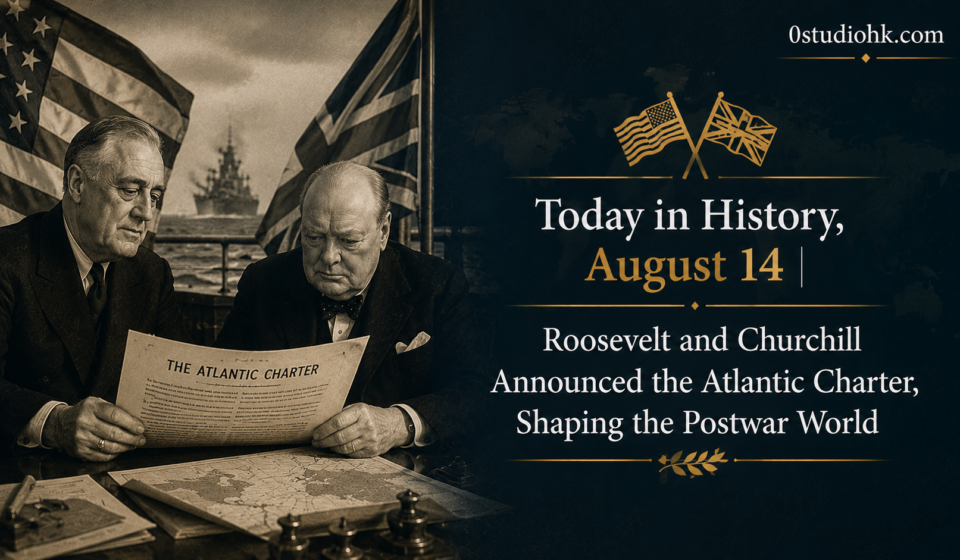
🎵 8月14日今日歷史|羅斯福與邱吉爾發表《大西洋憲章》,描繪戰後世界新秩序 Today in History, August 14 | Roosevelt and Churchill Announced the Atlantic Charter, Shaping the Postwar World
1941年8月14日,美國總統羅斯福與英國首相邱吉爾公布《大西洋憲章》,提出自決、自由貿易、海洋自由及集體安全等戰後世界原則。雖然它並非正式條約,卻成為二戰後國際秩序的重要思想基礎。
On August 14, 1941, U.S. President Franklin D. Roosevelt and British Prime Minister Winston Churchill announced the Atlantic Charter, outlining principles for a different postwar world. Its ideas about self-determination, economic cooperation, freedom of the seas, and collective security later influenced the development of the United Nations and the modern international system.
中文版本
1941年8月14日,第二次世界大戰仍然進行得如火如荼,歐洲大片土地已經落入納粹德國及其盟友控制之下,而美國雖然仍未正式參戰,卻已經逐漸成為英國重要的物資及經濟支援來源。就在這樣緊張的背景下,美國總統富蘭克林・羅斯福與英國首相溫斯頓・邱吉爾,在加拿大紐芬蘭附近的普拉森舍灣舉行秘密會議,並於8月14日公布一份共同聲明,後來被稱為《大西洋憲章》。這份文件並不是正式的國際條約,也不是兩國簽署的一份具有法律約束力的協議,而是一份共同宣示戰爭目標及未來世界秩序原則的政治文件,但它對後來的世界歷史產生了非常深遠的影響。1941年夏季,歐洲戰局仍然極為危險。英國在1940年的不列顛戰役後避免了德軍入侵,但英國本土仍然受到戰爭威脅,德國在歐洲大陸持續擴張,而1941年6月德國又入侵蘇聯,使戰爭進一步擴大。與此同時,日本在亞洲及太平洋地區的擴張亦令英國及美國非常關注。羅斯福與邱吉爾於1941年8月9日至12日在紐芬蘭附近會面,討論戰爭目標以及戰後應該建立一個怎樣的世界。當時美國尚未正式加入第二次世界大戰,因此這次會面本身已具有重要的外交意義。羅斯福希望維持美國的戰略空間,同時逐步增加對英國的支援;邱吉爾則希望美國更加接近英國,甚至最終加入對德戰爭。兩位領袖雖然有各自的政治考慮,但都認為有必要提出一套共同原則,向世界說明他們希望戰爭結束後建立一個怎樣的國際環境。《大西洋憲章》最重要的地方,在於它沒有單純討論如何擊敗納粹德國,而是開始思考戰爭結束之後的世界。文件提出,兩國不應以戰爭為手段追求領土擴張,也不應支持未經當地人民意願而改變國界;它同時支持各民族選擇自己的政府及政治制度。這一點後來成為《大西洋憲章》最具歷史影響力的理念之一。簡單來說,一個國家的未來,不應該只由強大的國家替它決定,而應該讓人民擁有選擇自己政治命運的權利。這個概念在1941年仍然充滿矛盾,因為英國本身擁有龐大的殖民帝國,邱吉爾對「人民自決」可能被殖民地人民用來要求獨立一直抱有疑慮。羅斯福則更加重視戰後建立一個開放的國際經濟環境,他希望降低貿易壁壘,促進國際貿易及經濟合作。兩國亦提出海洋自由的概念,希望未來世界能夠減少受到戰爭及封鎖影響的國際航行。這些原則與第一次世界大戰後的國際政治形成某種對比。第一次世界大戰雖然結束,但世界仍然沒有建立一套足夠穩定的安全體系,經濟危機、民族主義、軍事擴張及政治極端主義最終再次把世界推向戰爭。《大西洋憲章》因此試圖從另一個方向思考:如果戰爭結束後要避免再次出現如此大規模的衝突,世界是否需要更加合作、更加開放,而且建立一個能夠共同維持和平的國際制度?文件還提出,在戰後應該建立更加廣泛的經濟及社會合作,並希望所有國家及人民能夠生活在免於恐懼及匱乏的環境之中。這些概念在今天看起來可能十分熟悉,但在第二次世界大戰最黑暗的時期提出,卻具有相當重要的政治象徵意義。值得注意的是,《大西洋憲章》公布時,美國仍然沒有正式參戰。羅斯福面對的國內政治環境仍然限制了他的外交行動,當時不少美國民眾仍然反對直接加入歐洲戰爭。因此,《大西洋憲章》不能被理解為美國正式加入戰爭的宣言。真正令美國直接參戰的是幾個月後的1941年12月7日日本偷襲珍珠港。美國參戰之後,《大西洋憲章》的重要性進一步增加。它所提出的共同原則開始成為盟國合作的一部分。1942年1月,26個反軸心國家簽署《聯合國宣言》,並明確表示支持《大西洋憲章》所提出的共同目標。這一步非常重要,因為《大西洋憲章》原本只是羅斯福與邱吉爾的共同聲明,後來卻逐漸成為更廣泛盟國合作的思想基礎。它也與戰後建立國際組織的構想逐漸連結起來。1945年第二次世界大戰結束後,聯合國正式成立,雖然聯合國並不是簡單地由《大西洋憲章》直接創造出來,但兩者在集體安全、國際合作及避免未來戰爭等理念上有明顯的歷史關係。美國羅斯福總統圖書館亦指出,《大西洋憲章》經常被歷史學家視為通向聯合國成立的重要早期一步。 《大西洋憲章》還產生了另一個深遠而複雜的影響,就是它對殖民地人民爭取獨立的啟發。當文件談到人民應該有權選擇自己的政府時,亞洲、非洲及其他地區的民族主義者自然會提出一個問題:如果這項原則適用於歐洲被佔領的國家,那麼是否也應該適用於長期受到殖民統治的人民?這個問題後來成為戰後去殖民化的重要思想背景之一。美國國務院歷史資料指出,《大西洋憲章》的自決理念最終啟發了包括阿爾及利亞及越南等地的民族獨立運動。 當然,歷史並不是完全按照《大西洋憲章》的理想發展。戰後世界仍然出現冷戰、軍事對抗、殖民戰爭及新的國際衝突,而「人民自決」在不同國家及地區的實際運用亦一直存在爭議。英國自身的殖民帝國也沒有在1941年後立即結束。然而,《大西洋憲章》的重要性並不在於它一次過解決了所有問題,而在於它提出了一套可以被後來世代繼續引用的政治語言:人民應該有選擇未來的權利,國家不應以武力任意擴張,國際貿易應該更加開放,海洋應該更加自由,而國際社會應該尋找共同維持和平的方法。1941年8月14日,這些理念由兩個仍處於戰爭陰影中的大國領袖公開提出,之後逐漸擴展到盟國合作、聯合國以及戰後國際秩序。今天回望這一天,我們看到的並不只是一份歷史文件,而是一個世界在戰爭尚未結束之前,已經開始思考戰後應該如何重新開始。《大西洋憲章》沒有立即結束戰爭,也沒有保證世界從此和平,但它把「戰後世界應該是甚麼樣子」這個問題帶到了國際政治的核心位置。從這個角度看,1941年8月14日不只是第二次世界大戰中的一個外交日期,更是現代國際秩序逐步形成的重要一天。
[audiobook title=”8月14日今日歷史” src=”https://pub-0d950852c1b24118b76198710040037c.r2.dev/wp-content/uploads/2026/08/August-14.mp3″]
English Version
On August 14, 1941, while the Second World War was still raging across Europe and Asia, U.S. President Franklin D. Roosevelt and British Prime Minister Winston Churchill released a joint statement that became known as the Atlantic Charter. The document was not a formal treaty, and it did not legally bind the two governments in the way a conventional international agreement would. Instead, it expressed a shared vision of the war aims of the United States and Britain and, more importantly, their hopes for the kind of international order that might emerge after the conflict. Its significance became much greater in the years that followed. In the summer of 1941, the military situation was extremely dangerous. Nazi Germany controlled much of continental Europe, Britain remained under enormous military and economic pressure, and Germany had invaded the Soviet Union in June. Japan was also expanding its influence across East and Southeast Asia, creating serious concerns for both Britain and the United States. Britain was already at war with Germany, while the United States remained formally outside the conflict. Washington was nevertheless providing increasing material assistance to Britain through the Lend-Lease program. Against this background, Roosevelt and Churchill met secretly aboard naval vessels in Placentia Bay, Newfoundland, between August 9 and 12. Their discussions covered military matters, economic assistance, the strategic situation, and the future of international relations. Churchill wanted stronger American support and hoped that the United States would eventually enter the war. Roosevelt had to consider American public opinion, which was still strongly resistant to direct intervention in the European conflict. Despite their different political objectives, both leaders saw value in presenting a common set of principles. The resulting statement became one of the most famous political documents of the Second World War. The Atlantic Charter contained eight broad principles. Among them was a rejection of territorial expansion for its own sake. The two governments stated that they did not seek territorial changes that did not accord with the freely expressed wishes of the peoples concerned. They also expressed support for the right of peoples to choose their own form of government. This principle of self-determination became one of the Charter’s most influential and controversial ideas. In simple terms, it suggested that the future of a nation should not simply be decided by powerful governments from outside, but that people should have a role in determining their own political destiny. Yet the principle immediately contained a contradiction. Britain still governed a vast colonial empire, and Churchill was aware that the language of self-determination could be used by colonial peoples to demand independence. Roosevelt and Churchill therefore did not necessarily interpret every part of the Charter in exactly the same way. The American president also placed considerable importance on the future international economy. The Charter called for greater access to trade and raw materials and envisioned a world in which economic cooperation could help reduce the tensions that had contributed to earlier international conflicts. The two leaders also supported freedom of the seas and hoped to establish conditions under which countries could rebuild without being subjected to arbitrary economic restrictions or military aggression. These ideas reflected lessons drawn from the experience of the First World War. The end of that conflict had not produced a permanently stable international system. Economic crises, political extremism, nationalism, territorial disputes, and military expansion eventually contributed to another global war. The Atlantic Charter therefore looked beyond the immediate military struggle. It asked a much larger question: if the Allies won the war, what kind of world should follow? The answer emphasized cooperation, self-government, economic openness, freedom of navigation, and collective security. Another important element was the desire for a peace in which people could live free from fear and want. At the time, such language carried particular weight because the world was experiencing enormous destruction and uncertainty. The Charter offered an image of a postwar international system based not simply on military power, but on broader principles of political and economic cooperation. It is important, however, not to mistake the Atlantic Charter for an American declaration of war. The United States was still neutral in August 1941. Roosevelt faced a domestic political environment in which many Americans remained opposed to direct involvement in the European war. The United States would not enter the conflict until after Japan attacked Pearl Harbor on December 7, 1941. Nevertheless, the Atlantic Charter brought Washington and London closer together and publicly demonstrated their shared opposition to Axis aggression. After the United States entered the war, the Charter’s influence expanded. In January 1942, twenty-six nations fighting the Axis powers signed the Declaration by United Nations and subscribed to principles connected with the Atlantic Charter. The document had therefore moved beyond being a statement between Roosevelt and Churchill and had become part of a wider Allied political program. This development helped connect wartime cooperation with the emerging idea of a postwar international organization. When the United Nations was established in 1945, the Charter was not transformed directly into the United Nations Charter, but the historical relationship between the two is important. Ideas concerning collective security, international cooperation, self-determination, and the prevention of future aggression were central to the international system that emerged after the war. The Franklin D. Roosevelt Presidential Library describes the Atlantic Charter as one of the significant early steps toward the eventual creation of the United Nations. The Charter also had an influence that neither Roosevelt nor Churchill could fully control: its language about self-determination could be applied to colonial societies. If people had the right to choose their own government, many people living under colonial rule naturally asked why that principle should apply only to countries occupied by enemy forces. This question became increasingly important after 1945, as nationalist movements across Asia, Africa, and other regions demanded independence. The U.S. Office of the Historian notes that the Charter’s principle of self-determination eventually inspired independence movements in parts of the developing world, including Algeria and Vietnam. The political consequences were therefore complicated. The Charter expressed ideals that were not immediately or consistently applied by the governments that promoted them. Britain did not suddenly dismantle its empire, and the United States itself would continue to face debates over how self-determination should operate in different parts of the world. The postwar international system also did not eliminate conflict. The Cold War produced a new confrontation between the United States and the Soviet Union, while wars, political divisions, and struggles for independence continued across the globe. Yet the importance of the Atlantic Charter does not depend on whether every promise was fulfilled. Its significance lies partly in the political vocabulary it introduced and popularized. It provided a way to discuss international relations in terms of principles rather than simply the balance of military power. It suggested that nations should not be allowed to expand their territory through conquest, that people should have a voice in determining their governments, that international trade should be more open, that the seas should remain accessible, and that nations should work together to maintain peace. These principles became part of a broader international conversation after the war. The Charter also demonstrated how diplomacy could operate before a war had even been won. Roosevelt and Churchill were not simply planning military operations. They were attempting to imagine the political landscape that would follow victory. Their declaration gave Allied cooperation a larger purpose and helped create a sense that the war was being fought not only to defeat Germany and its allies, but also to establish a different kind of international future. The document was especially significant because the United States was not yet formally at war. Roosevelt’s participation showed that Washington was already thinking seriously about the shape of the postwar world, even while American troops had not yet entered the European conflict. Churchill, meanwhile, understood that Britain could not determine the future of the international system alone. The meeting therefore represented a major step in the developing partnership between the United States and Britain. The Atlantic Charter also illustrates the complicated relationship between ideals and political reality. A statement promising self-government could inspire people seeking freedom, while governments issuing the statement could simultaneously be reluctant to apply the same principle everywhere. That contradiction would become one of the defining tensions of the postwar era. Across Asia and Africa, nationalist leaders would increasingly use the language of self-determination to challenge European colonial rule. In this sense, the Charter acquired a life of its own. Its ideas were taken up by people and movements far beyond the original intentions of the two leaders who created it. The Atlantic Charter therefore occupies a special place in modern history. It was written in the middle of a catastrophic war, yet it was fundamentally concerned with what would happen after the war. It did not end the Second World War, did not immediately create the United Nations, and did not guarantee a peaceful world. Instead, it helped establish a framework of ideas that influenced the Allied cause and later discussions about international cooperation, economic reconstruction, self-government, and collective security. When we look back at August 14, 1941, the importance of the date lies not simply in the announcement of a document. It marks a moment when two major leaders publicly began to describe a possible future beyond the war. At a time when much of the world was experiencing occupation, bombing, political repression, and uncertainty, the Atlantic Charter offered a vision in which international relations might be based on cooperation rather than conquest. Its legacy remains complicated, but its influence is undeniable. The Charter helped connect the struggle of the Second World War with the construction of the postwar international system, and its language about freedom, self-determination, economic cooperation, and collective security continued to influence international politics long after the original document had been published.
總結
1941年8月14日,《大西洋憲章》提出自決、自由及國際合作等理念,成為戰後國際秩序及聯合國發展的重要思想來源。
On August 14, 1941, the Atlantic Charter presented a vision of self-determination, freedom, and international cooperation that helped shape the postwar world and influenced the path toward the United Nations.