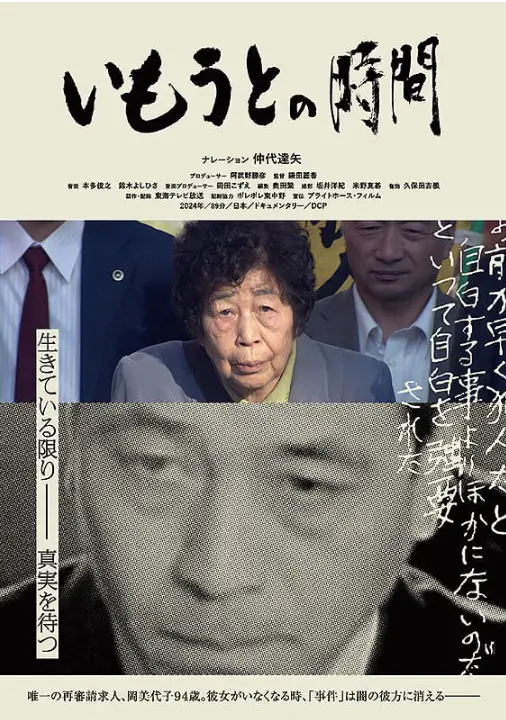
《妹妹的時間》是一部紀錄片,聚焦於「名張毒葡萄酒事件」死刑囚奧西勝的妹妹岡美代子。哥哥始終聲稱自己無罪,最終卻在獄中離世;多年來,美代子一直相信哥哥的清白,並為案件重審奔走。
My Sister’s Time is a documentary centred on Miyoko Oka, the younger sister of former death-row prisoner Masaru Okunishi, who was convicted in the Nabari Poisoned Wine Incident. Okunishi maintained his innocence until his death in prison, while Miyoko continued to believe in her brother’s innocence and fight for a retrial.
電影內容|中文版本
《妹妹的時間》由鎌田麗香執導,是一部記錄岡美代子人生與信念的紀錄片。岡美代子是1961年發生的「名張毒葡萄酒事件」被告奧西勝的妹妹。奧西勝當年被捕後一直聲稱自己無罪,但最終在獄中度過漫長歲月,並於2015年去世。這起案件發生於1961年。三重縣與奈良縣交界的葛尾村落舉行村民聯誼會期間,5名飲用葡萄酒的女性死亡。當時35歲的奧西勝被認定為案件的犯人並遭到逮捕。然而,案件並沒有客觀證據支持他的罪行,主要依據只有他的自白調書。一審時,奧西勝獲判無罪,但案件進入二審後,判決出現重大轉變,最終被改判死刑。即使面臨死刑判決,奧西勝仍然持續主張自己是無辜的。他在長期羈押與司法程序中不斷申訴,希望透過再審重新證明自己的清白。然而,他始終未能等到案件獲得最終的平反。2015年,89歲的奧西勝在獄中去世。哥哥去世後,妹妹岡美代子仍沒有放棄。她與辯護團隊持續尋找新的證據,並一次又一次提出再審請求,希望案件能夠重新被審理。可是,再審請求持續被駁回,這場司法上的抗爭竟然延續了半個世紀。對美代子而言,這不只是哥哥留下的案件,也是她自己人生的一部分。她長年相信哥哥沒有犯罪,因此即使面對一次又一次的挫折,仍然沒有停止為哥哥尋找清白的可能。紀錄片特別聚焦於美代子晚年的時間感。再審請求並不是任何人都可以提出,根據本片所介紹的制度,只有配偶、直系親屬以及兄弟姊妹可以提出再審請求。到了2023年,美代子已經94歲。這意味著她的存在本身,已經成為案件能否繼續被追問的重要因素。如果美代子不在了,這宗延續數十年的案件是否也會逐漸消失在歷史之中,成為無人再追問的過去?這也是《妹妹的時間》最令人沉重的問題之一。片中的美代子並沒有因為年老而放棄。她仍然相信哥哥是無辜的,並且為了繼續等待可能到來的轉機,甚至下定決心要好好活下去。對她而言,「長壽」不只是個人的願望,而是一種繼續守護哥哥清白的方式。電影的時間跨度也因此顯得格外沉重。從1961年案件發生,到奧西勝被捕、判決、長期服刑,再到他2015年在獄中去世,最後到妹妹在94歲高齡仍然為案件奔走,已經跨越六十多年。這段漫長時間裡,案件始終沒有真正從美代子的生命中離開。《妹妹的時間》由東海電視台製作團隊長期採訪這起案件的資料重新整理而成。東海電視台自事件發生後長達46年持續採訪相關人物,並於2024年2月播出相關電視節目。其後製作團隊再進行追加採訪及重新剪輯,將電視節目重新整理成電影版本。這使電影不只是一次性的案件回顧,也帶有長期新聞採訪累積下來的歷史重量。作品真正關注的,不只是「名張毒葡萄酒事件」本身,更是案件如何長期影響一個家庭,以及一名妹妹如何在哥哥去世後仍然繼續相信他的清白。當司法程序一次又一次關閉大門,美代子仍然選擇等待。她的等待不是被動地停留在過去,而是一種持續行動:尋找新證據、支持辯護團隊、提出再審請求,並努力讓這起案件不被遺忘。片名《妹妹的時間》因此具有特殊意義。時間對一般人而言會不斷向前,但對美代子而言,時間同時也是等待哥哥獲得清白的漫長過程。哥哥已經離世,而她仍然活著;案件已經過去數十年,但她仍然沒有放下。她相信,只要自己還在,這個案件就還有人可以繼續追問。這份信念也是電影最核心的情感所在。《妹妹的時間》沒有把焦點單純放在一宗歷史案件的犯罪經過,而是透過一名高齡女性的生活與回憶,呈現一個人如何在漫長歲月裡守護親人的清白。當時間不斷帶走案件中的人物,能夠留下來的人越來越少,美代子卻仍然選擇長久地等待。她的身影也讓這起延續半個多世紀的案件,重新回到觀眾面前。
English Version
My Sister’s Time is a documentary directed by Reika Kamata that follows Miyoko Oka, the younger sister of Masaru Okunishi, who was arrested and sentenced to death in connection with the 1961 Nabari Poisoned Wine Incident. Okunishi maintained his innocence throughout his imprisonment and eventually died behind bars, while Miyoko continued to believe that her brother had been wrongly convicted. The incident took place in 1961 in Kuzuo, a settlement located between Mie and Nara prefectures. During a village social gathering, five women died after drinking wine. Masaru Okunishi, who was 35 years old at the time, was arrested as the alleged perpetrator. However, according to the account presented in the film, there was no objective evidence directly supporting his guilt. The principal evidence was a written confession. Okunishi was initially acquitted at his first trial, but the decision was overturned on appeal, and he was subsequently sentenced to death. Despite the severe verdict, Okunishi continued to insist that he was innocent. He spent decades imprisoned while seeking to overturn the conviction and obtain a retrial. Yet he never received the final vindication he had hoped for. In 2015, at the age of 89, Okunishi died in prison. His death did not end Miyoko’s struggle. She continued working with his defence team and searching for new evidence that might support another retrial. Again and again, applications for a retrial were rejected, extending the legal struggle across more than half a century. For Miyoko, the case is not simply a historical criminal investigation. It is inseparable from her own life and from her determination to protect her brother’s name. She has continued to believe that he was innocent, even after decades of disappointment. The documentary places particular emphasis on Miyoko’s advanced age and the limited time remaining to continue the fight. As described in the film, applications for a retrial can only be made by a spouse, direct relatives or siblings. By 2023, Miyoko had reached the age of 94. Her continued existence therefore carried a significance beyond her personal story. If she were no longer able to pursue the case, the decades-long effort to revisit the conviction could potentially disappear with her. This question gives the film its particular sense of urgency. Yet Miyoko refuses to give up. She continues to believe in her brother’s innocence and even resolves to live as long as possible so that she can remain involved in the struggle. For her, longevity is not merely a personal wish. It becomes a way of continuing to protect her brother’s memory and the possibility of proving his innocence. The passage of time is therefore central to the documentary. From the original incident in 1961, through Okunishi’s arrest, trials and decades of imprisonment, to his death in 2015 and Miyoko’s continued efforts at the age of 94, more than six decades have passed. Yet the case has never truly left her life. My Sister’s Time grew out of the long-term reporting of Tokai Television, which had followed the case for 46 years. The broadcaster originally produced a television programme that was broadcast in February 2024. Additional interviews and reporting were subsequently conducted, and the material was re-edited into a feature-length documentary. This long history of reporting gives the film a perspective that extends beyond a simple retrospective account of an old criminal case. It is also a record of how a legal dispute can continue to shape the lives of family members long after the original event. At its heart, the film is concerned not only with the Nabari Poisoned Wine Incident but with the human cost of a case that has remained unresolved in the eyes of those who continue to question the conviction. Miyoko’s persistence becomes an important part of that story. Each rejected retrial request could have marked the end of her efforts, yet she continues searching for evidence, supporting the defence team and keeping the case in public memory. The title My Sister’s Time carries a deeper meaning in this context. Time normally moves forward, but for Miyoko it has also become the long period of waiting for her brother’s innocence to be recognised. Her brother is gone, yet she remains. More than half a century has passed, yet she has not abandoned the belief that the case deserves to be reconsidered. As long as she remains able to speak and act, the story has someone willing to keep asking questions. The documentary therefore presents a deeply personal portrait of persistence. Rather than focusing solely on the details of a historical criminal case, it follows an elderly woman who has spent much of her life defending the memory and innocence of her brother. As time takes away more and more of the people connected to the case, Miyoko continues to stand as one of the remaining witnesses to its long history. Through her, a case that began more than six decades ago returns to the present.
紀錄片簡介|Short Description
哥哥在1961年「名張毒葡萄酒事件」中被捕並被判死刑,始終聲稱自己無罪。哥哥獄中離世後,妹妹岡美代子仍然相信他的清白,並持續為再審而努力。
After her brother was convicted and sentenced to death for the 1961 Nabari Poisoned Wine Incident, Miyoko Oka continued to believe in his innocence even after his death in prison, dedicating her later years to the pursuit of a retrial.
作品資料
作品:いもうとの時間
英文:My Sister’s Time
導演:鎌田麗香
類型:紀錄片、社會、司法
事件:名張毒葡萄酒事件
製作背景:東海電視台長期採訪及2024年電視節目重新製作
核心人物
岡美代子
奧西勝
總結
《妹妹的時間》透過岡美代子的晚年生活,記錄一場延續超過半世紀的司法抗爭。哥哥已經在獄中離世,但妹妹仍然相信他的清白,並以自己的時間守護哥哥的記憶與再審的可能。
My Sister’s Time follows Miyoko Oka as she continues a decades-long struggle after her brother’s death in prison. Her unwavering belief in his innocence turns her remaining years into a commitment to preserve his memory and keep the possibility of a retrial alive.