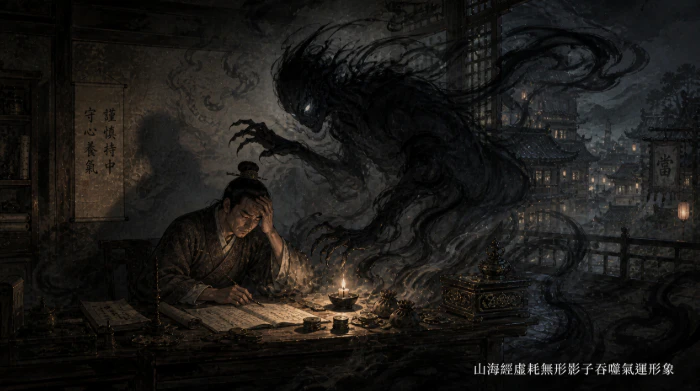
在《山海經》的記載中,虛耗是一種無形無常的存在,專門吞噬人的氣運與福祉。牠象徵無法察覺的損耗與潛伏於日常之中的隱性災厄。
In the Shan Hai Jing, Xu Hao is described as an unseen entity that consumes fortune and vitality. It represents invisible loss and the subtle erosion hidden within everyday life.
中文
城市未眠之時,燈火如星,人聲喧雜,繁華掩蓋了細微的異樣。人們忙碌於各自的生活,卻未曾察覺,有些東西正悄然流失。銀錢減少、機會錯失、心神疲憊,似乎一切都在不知不覺中變得不順。老人們低聲提起一個名字——虛耗。傳說虛耗並無固定形體,或似人影,或如煙霧,能依附於人群之中,悄無聲息地吞噬氣運。牠不製造災難,卻讓一切逐漸走向衰敗。某個年輕商人原本生意興隆,財源廣進,然而短短數月之間,交易頻頻失誤,投資接連失利,身邊人亦漸漸疏遠。他開始懷疑命運,卻找不到原因。夜深之時,他獨坐帳房,燭光搖曳,忽然感到一陣寒意掠過。窗外並無風,卻有影子在牆上輕輕晃動。那影子並非固定形狀,時而拉長,時而扭曲,彷彿在呼吸。他凝視著那影子,心中升起難以言說的不安。影子忽然停住,隨後緩緩向他靠近。那一刻,他彷彿看見一雙空洞的眼睛,沒有情緒,只有無盡的空虛。燭火微微一暗,房間的氣息變得沉重。第二日,他醒來時一切如常,但內心卻多了一層難以擺脫的疲憊。此後的日子,他越發覺得自身運氣流失,無論如何努力,都無法扭轉局面。村中長者得知此事後,前來查看,沉默良久,最終說出結論——虛耗已附其身。要驅逐虛耗,並非單靠力量,而需重整自身心志與氣運。長者告誡他,虛耗最喜依附於心神不定之人,一旦人心失衡,便容易被其侵蝕。商人開始改變生活,減少貪念,穩定心神,並在每日清晨靜坐。隨著時間推移,那種沉重與不順逐漸減弱。某夜,他再次在燭光下看見牆上的影子,卻已不再扭曲,而是慢慢消散。虛耗離去之後,他的運勢逐漸回升,雖不再如昔日輝煌,卻恢復了平穩。這個故事在城中流傳,人們開始相信,真正的災厄並不總是外在的破壞,而是來自內在的流失。虛耗或許無形,卻無處不在,當人們忽視自身的平衡與節制,它便悄然出現。於是,人們學會警惕那些看不見的消耗,也學會在喧囂之中守住內心。或許虛耗從未真正消失,它只是潛伏在光影之間,等待下一個失去平衡的瞬間,再次出現。
English Version
In a city that never truly sleeps, lights shimmer across endless streets, and voices blend into a constant hum of activity. Amid this movement, subtle changes often go unnoticed. Opportunities slip away, resources diminish, and a quiet fatigue settles into the lives of those who once thrived. Few recognize these shifts for what they might be. Fewer still dare to name the force behind them—Xu Hao. Unlike creatures of flesh and form, Xu Hao exists in absence. It has no fixed shape, appearing at times as a faint shadow, at others as a distortion barely visible at the edge of perception. It does not strike with violence. Instead, it drains—slowly, steadily, until what once felt certain begins to unravel. A merchant who had once prospered began to experience this decline. His ventures faltered without clear cause, alliances weakened, and his confidence eroded. He searched for explanations in numbers, in decisions, in fate itself, but found none. One evening, alone under the dim glow of a candle, he noticed something unusual. The shadow cast upon the wall did not behave as it should. It shifted independently, stretching and contracting as if alive. As he watched, a sense of unease took hold. The shadow stilled, then moved toward him. For a brief moment, it seemed to take on form—not solid, but suggestive of presence. There was no face, yet there was an emptiness that felt like being observed. The candle flickered, and the air grew heavy. The next morning, nothing appeared different, yet everything felt altered. A subtle exhaustion lingered, and with it, a sense that something essential was being lost. Days turned into weeks, and the pattern continued. When an elder heard of his situation, they spoke of Xu Hao—a force drawn to imbalance, feeding on uncertainty and inner unrest. The solution was not confrontation, but restoration. The merchant began to change. He simplified his life, reduced excess, and sought clarity within himself. Each morning, he sat in stillness, focusing not on gain, but on balance. Gradually, the weight began to lift. The failures ceased, and a quiet stability returned. One night, he saw the shadow again, but this time it did not move. It faded, dissolving into nothingness. The story spread, becoming less a warning of an external threat and more a lesson in awareness. Xu Hao, people came to believe, was not merely an entity but a reflection of imbalance. It thrived where excess and unrest created openings, where attention faltered and control weakened. Even now, it is said to linger in unseen spaces, not as a monster to be feared, but as a reminder. Loss does not always arrive loudly. Sometimes, it begins as something barely noticeable—a shadow at the edge of perception, waiting for the moment it can take form.