隆中對後,局勢迅速轉動。曹操南望荊州,劉備夾縫求存,一場未開戰的較量悄然展開。拒絕,有時比迎戰更需要智慧。
After Longzhong, pressure builds fast. Cao Cao turns south, and Liu Bei stands in a fragile position. Before any battle begins, a quieter conflict unfolds—one where refusal becomes strategy.
中文
自隆中一談後,天下似乎開始有了輪廓。
然而,真正的考驗,從未因計策而停止。
荊州之地,地處南北要衝,向來為兵家必爭。如今更因曹操北方勢力穩固,目光轉向南方,使這片土地再度成為風暴中心。
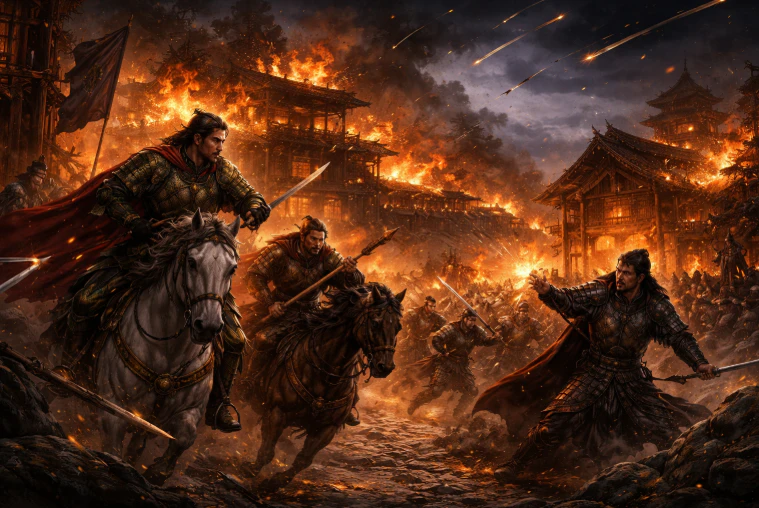
消息傳來,曹操已整軍備戰,意圖南下。
這並非單純的軍事行動,而是一種試探。
曹操深知,荊州之主劉表年老體衰,內部矛盾漸生。而在此局中,最不穩定的因素,正是寄居其下的劉備。
劉備的存在,如同一枚隱伏的棋子。
他既未掌權,卻擁有人心;既無地盤,卻具潛力。
這樣的人,不能放任。
於是,曹操遣使而來。
表面上,是邀請;實際上,是試探與壓迫。
使者言辭恭敬,卻暗藏鋒芒:「丞相久聞將軍之名,願共圖大業。」
這句話,看似禮遇,實則是一道選擇題。
答應,則成為附庸;拒絕,則成為敵人。
劉備聽後,神情平靜。
他明白,這不只關乎個人去留,而是整個未來方向。
此時的他,尚未真正立足,若貿然投靠曹操,將失去自主;若直接拒絕,又可能引來殺機。
進退之間,唯有一線。
他召集眾人商議,其中最為冷靜的聲音,來自諸葛亮。
諸葛亮分析局勢,不急不躁。
「曹操此舉,意在觀我之志。」
「若應之太急,則示弱;若拒之太明,則示敵。」
關鍵,不在答與不答,而在如何答。
於是,一個看似簡單卻極為巧妙的決策誕生。
劉備選擇「不拒而拒」。
他以劉表之名為托辭,表示身為客將,不敢擅自決定去留,需聽從主公安排。
這一回應,既保全了禮數,也巧妙地避開了直接對抗。
曹操得知後,未再強逼。
但他已得到想要的答案——
劉備,不會歸附。
荊州之內,暗流依舊。
蔡氏一族對劉備愈發忌憚,而劉備亦清楚,自己正站在風口浪尖。
他雖暫避鋒芒,卻無法長久隱身。
這片土地,終究容不下兩種未來。
夜深之時,劉備獨坐,回想隆中之言。
諸葛亮曾說:「先取荊州,以觀天下。」
如今看來,荊州不只是機會,更是一場試煉。
他沒有退路。
而遠在北方,曹操亦已做出判斷。
下一步,將不再只是試探。
風,開始轉向。
這一回,沒有兵刃交鋒,卻已決定了未來的走向。
因為有些戰爭,從選擇的那一刻,就已開始。
English Version
The Longzhong plan had given Liu Bei something he had long lacked—a vision.
But vision alone does not create safety.
In fact, it often attracts danger.
Jing Province, once a place of relative calm, was becoming increasingly unstable. Its strategic importance made it impossible to ignore, especially for someone like Cao Cao, whose power in the north had reached a level where expansion was no longer optional—it was inevitable.
Turning south was not a question of “if,” but “when.”
Before armies moved, however, came something subtler.
A message.
Cao Cao did not immediately send troops. Instead, he sent an invitation.
On the surface, it was courteous—a gesture of recognition toward Liu Bei, acknowledging his reputation and suggesting cooperation. But beneath the politeness lay a calculated test.
Would Liu Bei submit?
Or would he resist?
At this point, Liu Bei’s position was uniquely fragile.
He was respected, but not secure. Influential, but not in control. He lived under Liu Biao’s protection, which meant his autonomy was limited. Any decision he made would carry consequences far beyond himself.
Accepting Cao Cao’s offer might bring short-term safety, but at the cost of independence. Refusing it outright could provoke immediate retaliation.
There was no safe answer.
So Liu Bei did something more difficult than choosing.
He reframed the question.
Consulting with Zhuge Liang, he understood that the situation was less about what to decide, and more about how to present that decision. A direct response would define him too clearly—either as subordinate or opponent.
Ambiguity, in this case, was power.
His reply was carefully crafted.
He did not say yes.
He did not say no.
Instead, he deferred.
As a guest under Liu Biao, he claimed he lacked the authority to make such a decision independently. It was respectful, logical, and—most importantly—noncommittal.
To an untrained eye, it might have seemed like hesitation.
To Cao Cao, it revealed everything.
Liu Bei would not submit willingly.
That was enough.
The message had served its purpose.
No alliance would form.
From that moment on, the relationship between the two men shifted. What had once been uncertain now became inevitable.
Conflict was no longer a possibility.
It was a trajectory.
Back in Jing Province, the tension deepened. Liu Bei’s position grew increasingly precarious, caught between external pressure and internal suspicion. Lady Cai’s faction saw him as a threat. Liu Biao’s weakening authority made protection unreliable.
He remained where he was—but only physically.
Strategically, he had already begun to move.
The events of this chapter are quiet. There are no battles, no dramatic confrontations. Yet they carry immense weight.
Because this is where lines are drawn.
Not with swords, but with intent.
And once drawn, they rarely disappear.