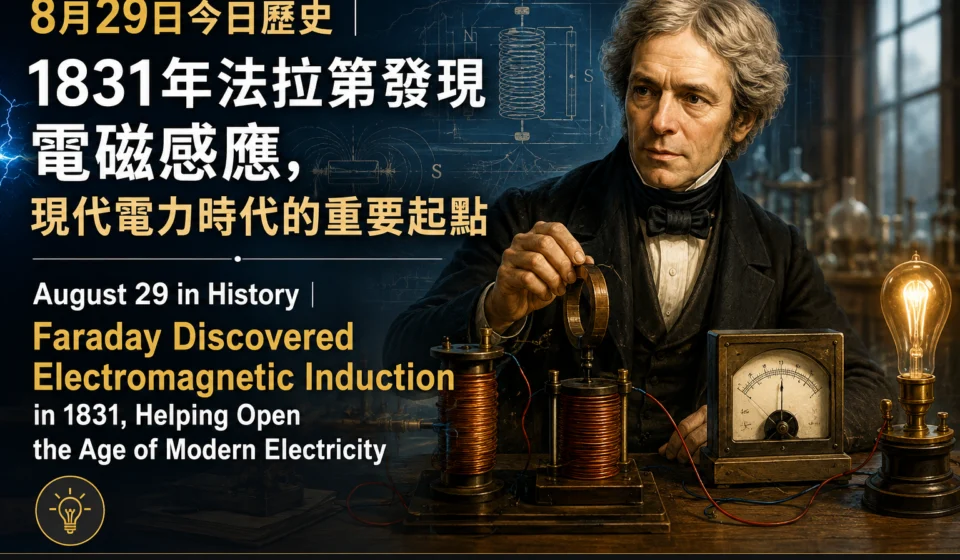
8月29日今日歷史|1831年法拉第發現電磁感應,現代電力時代的重要起點 | August 29 in History|Faraday Discovered Electromagnetic Induction in 1831, Helping Open the Age of Modern Electricity
1831年8月29日,法拉第首次觀察到電磁感應現象,證明磁場變化可以產生電流,為現代發電技術奠下重要基礎。
On August 29, 1831, Michael Faraday observed electromagnetic induction, showing how changing magnetism could generate electricity and helping lay the foundations of modern power generation.
中文版本
1831年8月29日,英國科學家邁克爾・法拉第(Michael Faraday)進行了一項後來深刻改變人類生活的實驗。他當時研究的是電與磁之間的關係,而他的發現最終成為現代電力工業的重要科學基礎。19世紀初,科學家已經知道電流可以產生磁場,也逐漸發現電與磁並不是兩種完全獨立的自然現象,但一個關鍵問題仍然存在:磁是否也可以反過來產生電?法拉第長期研究這個問題,並設計了一系列實驗尋找答案。1831年8月29日,他在倫敦皇家學會相關研究中觀察到,當一個線圈附近的磁場發生變化時,另一個線圈中可以產生瞬間的電流。這種由磁通量變化而產生電動勢的現象,後來被稱為「電磁感應」(electromagnetic induction)。法拉第的實驗並不是簡單地把一塊磁鐵放在電線旁便產生持續電流,而是關鍵在於磁場必須發生變化。當磁鐵移近線圈、遠離線圈,或者磁場本身發生改變時,導體內便會出現感應電流。這個看似簡單的原理,卻揭開了人類大規模生產電力的道路。在法拉第之前,人們已經可以利用電池產生電流,但電池所能提供的電力有限,而且不適合成為後來城市及工業社會所需要的大規模電力來源。電磁感應則提供了另一種完全不同的思路:不是把電力儲存在電池之中,而是利用機械運動與磁場變化持續產生電能。這個原理後來成為發電機運作的核心。簡單來說,發電機可以利用機械能帶動線圈或磁場旋轉,使磁通量不斷改變,從而產生電能。這意味著水力、蒸汽、燃料甚至後來的風力等不同形式的能量,都可以透過發電機轉化成電力。從這個角度看,法拉第1831年的發現並不只是一項實驗室中的科學成果,而是為日後整個現代電力系統提供了重要的物理基礎。電磁感應也同時成為變壓器工作的基本原理。透過變化的磁場,電能可以在不同電路之間傳遞,使電壓能夠升高或降低。這對現代電力輸送極其重要,因為發電站產生的電力需要經過長距離輸送,適當提高電壓可以降低輸電過程中的能量損耗,再於接近用戶的位置降低電壓供日常使用。今天我們按下電燈開關、使用電腦、雪櫃、洗衣機或其他電器時,背後的電力供應網絡仍然建立在這些基本電磁原理之上。法拉第本人並不是以複雜的數學理論聞名,他更擅長透過實驗觀察自然現象,建立新的物理概念。他對電磁學的研究,包括電磁旋轉、電磁感應以及電解等方面的工作,對19世紀科學發展產生深遠影響。他後來的研究亦啟發了其他科學家進一步建立電磁理論,其中詹姆斯・克拉克・馬克士威(James Clerk Maxwell)便將法拉第的實驗與「力線」概念轉化為更加完整的數學理論。法拉第的貢獻因此不只是「發明了一部發電機」這麼簡單,而是發現了一項自然界的重要規律,讓後來的科學家與工程師可以利用這項規律發展新的技術。19世紀後半葉,電力開始逐漸走出實驗室,進入工廠、街道、交通系統以及家庭。發電機、變壓器、電動機和輸電網絡相互配合,最終形成現代電力社會的基本架構。今天全球各地的城市能夠在晚上保持燈火通明,工廠能夠運作大量機械,醫院可以維持醫療設備,互聯網資料中心可以持續運行,全部都與電力的大規模生產和輸送有密切關係。而在這條漫長的技術發展道路上,1831年的電磁感應發現是一個非常重要的起點。更值得注意的是,法拉第當年的實驗所揭示的原理,到今天仍然沒有過時。大型發電站的發電機、風力發電機、水力發電機,以及許多不同形式的電力設備,都仍然依靠電磁感應將機械運動轉化為電能。即使能源來源不斷改變,從煤炭、石油和天然氣,到水力、核能、風能及其他可再生能源,最終將能量轉換成電力的過程,仍然離不開電磁學。1831年8月29日,因此值得被記住的不只是法拉第完成了一次重要實驗,而是人類開始更清楚地掌握「磁可以產生電」這個關鍵自然規律。這項發現把科學上的好奇心轉化成後來可以支撐整個工業社會的技術基礎。從一個簡單的線圈與磁場實驗,到今天覆蓋全球的電力網絡,兩者之間相隔近兩個世紀,但背後仍然連繫著同一項基本原理。法拉第的工作提醒我們,改變世界的科學發現未必一開始便看起來驚天動地;有時候,一個實驗中短暫出現的電流,便足以成為人類能源文明的一個新起點。
English Version
On August 29, 1831, British scientist Michael Faraday carried out an experiment that would eventually become one of the foundations of the modern electrical age. Faraday was fascinated by the relationship between electricity and magnetism, two phenomena that scientists were gradually discovering were closely connected. By the early nineteenth century, researchers already knew that an electric current could produce a magnetic effect. The unanswered question was whether the relationship could work in the opposite direction: could magnetism somehow produce electricity? Faraday spent years investigating this problem through carefully designed experiments. In 1831, he demonstrated that a changing magnetic field could induce an electric current in a nearby circuit. This phenomenon became known as electromagnetic induction. The crucial word is “changing.” A stationary magnet placed beside a coil does not simply produce a continuous current. Instead, when the magnetic conditions around the conductor change—for example, when a magnet moves toward or away from a coil—an induced electrical effect appears. The principle may sound simple, but its consequences were enormous. Before Faraday’s work, electrical current could be produced using batteries, but batteries were not a practical solution for supplying the vast quantities of electricity that an industrialising society would eventually require. Electromagnetic induction offered a different possibility. Mechanical movement could be converted into electrical energy through the interaction between magnetic fields and conductors. This became the fundamental principle behind the electric generator. A generator can rotate coils or magnetic fields so that the magnetic flux through the circuit continually changes, producing electrical power. This opened the possibility of converting many different forms of energy into electricity. Water moving through turbines, steam produced by heat, wind turning turbine blades and other mechanical energy sources can all ultimately drive generators based on electromagnetic induction. Faraday’s discovery therefore went far beyond a single laboratory experiment. It provided one of the key physical principles needed to produce electricity on a large scale. Electromagnetic induction also lies at the heart of the transformer. By using changing magnetic fields, transformers can transfer electrical energy between circuits and change voltage levels. This became essential to the development of practical electricity networks. Electricity generated at a power station may need to travel long distances before reaching homes and businesses. Raising the voltage for transmission helps reduce energy losses, after which the voltage can be reduced again for safer distribution and everyday use. Much of the electrical infrastructure surrounding modern life therefore depends on principles that can be traced back to Faraday’s nineteenth-century experiments. When people switch on a light, charge a computer, operate a refrigerator or run industrial machinery, the electricity reaching those devices has passed through a system built upon generations of work in electromagnetism. Faraday was especially remarkable because his approach relied heavily on experimental observation rather than advanced mathematical analysis. He developed powerful physical intuitions about electric and magnetic fields and used experiments to reveal relationships that were not previously understood. His work on electromagnetic induction, electromagnetic rotation and electrochemistry helped transform nineteenth-century science. Later scientists, including James Clerk Maxwell, built on Faraday’s ideas and developed a mathematical framework for electromagnetic theory. Faraday’s contribution should therefore not be reduced to the claim that he simply “invented the generator.” His deeper achievement was discovering a fundamental relationship in nature that engineers could later turn into practical technology. During the second half of the nineteenth century, electricity gradually moved from laboratories into factories, streets, transport systems and homes. Generators produced electricity, transformers helped manage voltage, electric motors converted electricity back into mechanical motion, and transmission networks connected these technologies into increasingly large systems. Together, they helped create the infrastructure of the modern electrical world. The consequences are visible everywhere today. Cities can remain illuminated after sunset, hospitals can operate complex equipment, factories can run automated machinery, communication networks can remain active and data centres can process enormous quantities of information. All of this depends on the ability to generate, transmit and use electricity reliably. The path toward that world was shaped by many scientists and engineers, but Faraday’s discovery of electromagnetic induction stands among its most important scientific foundations. The remarkable thing is that the principle itself remains relevant nearly two centuries later. Generators used in hydroelectric power stations, wind turbines and many other energy systems still rely on electromagnetic induction to convert mechanical motion into electrical energy. The energy source may change—from coal and gas to water, wind or other forms of energy—but the electromagnetic principle involved in converting mechanical energy into electricity remains fundamentally the same. August 29, 1831, therefore represents more than a date in the history of science. It marks a moment when an experimental observation helped reveal a practical route toward producing electricity on a scale that future societies would eventually depend upon. From a coil and a changing magnetic field to enormous interconnected power grids, almost two centuries separate Faraday’s experiment from today’s electrical civilisation. Yet the underlying physical principle remains recognisable. Faraday’s achievement is a reminder that scientific revolutions do not always begin with something that immediately appears spectacular. Sometimes a brief electrical response in a carefully designed experiment can become the starting point for technologies that reshape everyday life across the world.
總評
中文版本
法拉第發現電磁感應,讓機械能轉化電能成為可能,奠定發電機及現代電力系統的重要基礎。從照明到科技社會,這項1831年的發現影響至今。
English
Faraday’s discovery of electromagnetic induction provided a foundation for practical power generation. Nearly two centuries later, the same principle remains central to generators and the electrical systems that support modern civilisation.