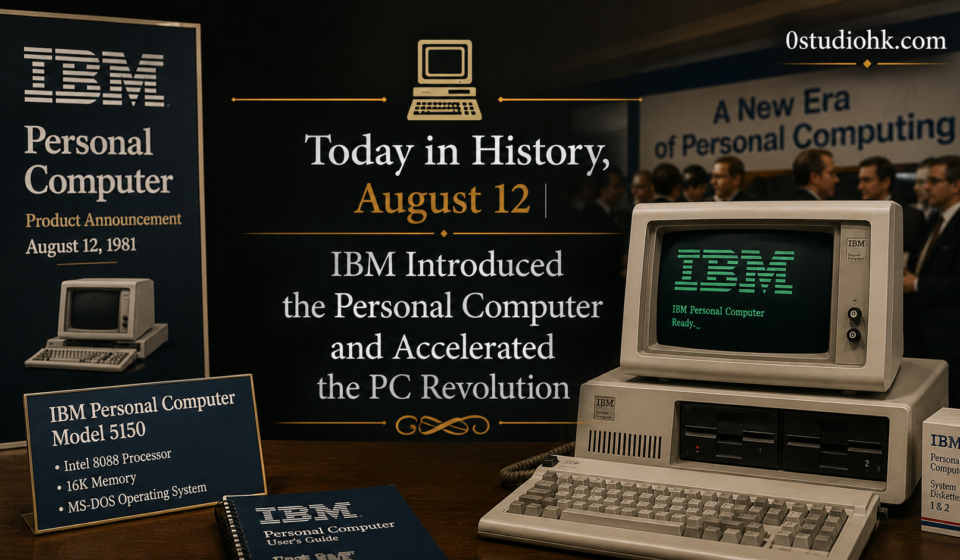
🎵8月12日今日歷史|IBM推出個人電腦,PC時代正式加速 Today in History, August 12 | IBM Introduced the Personal Computer and Accelerated the PC Revolution
1981年8月12日,IBM正式推出 IBM Personal Computer(Model 5150)。這部電腦並不是世界上第一部個人電腦,但憑藉IBM的品牌影響力、開放式架構及龐大的商業市場,它大幅推動個人電腦進入企業及大眾市場,成為現代PC歷史上的重要轉折點。
On August 12, 1981, IBM introduced the IBM Personal Computer, or Model 5150. It was not the first personal computer, but IBM’s reputation and its open architecture helped transform the PC from a niche technology into a major business and consumer platform.
中文版本
1981年8月12日,IBM在紐約華爾道夫酒店正式推出IBM Personal Computer,型號為5150。今天我們習慣把「PC」視為日常生活的一部分,但在1981年,個人電腦仍然是一個正在快速發展的新興市場。IBM的加入,令這個市場出現了一個非常重要的轉折點。
IBM其實並不是第一間製造個人電腦的公司。在IBM PC出現之前,市場上已經有Apple II、TRS-80、Commodore等個人電腦產品。因此,8月12日的重要性並不是「第一部個人電腦誕生」,而是全球最具影響力的電腦公司之一正式進入個人電腦市場,令PC得到企業界及一般消費者更大的信任。Computer History Museum指出,IBM的品牌知名度及大型市場推廣,幫助個人電腦市場快速成長。
IBM Model 5150採用Intel 8088處理器,運作速度為4.77 MHz,並使用Microsoft提供的MS-DOS/PC DOS作業系統。以今天的標準來看,這些規格幾乎令人難以想像:電腦的記憶體只有16 KB,而且基本配置甚至沒有磁碟機。當年它的售價為1,565美元,而如果加入顯示器、兩部磁碟機及打印機,整套系統的價格可以再增加接近3,000美元。
但真正改變歷史的,不只是這部電腦本身,而是IBM採取了一個與公司過去傳統不同的策略。
IBM過去習慣自行設計及製造自己的電腦系統,但為了快速進入新興PC市場,IBM PC大量採用現成的商業零件,包括Intel處理器。軟件方面,IBM亦沒有完全自行開發作業系統,而是與Microsoft合作,最後使用PC DOS,而Microsoft則把相應產品以MS-DOS形式授權給其他電腦製造商。
這種「開放式架構」後來成為IBM PC最深遠的影響之一。
IBM公開了PC的部分設計規格,讓其他公司可以開發相容硬件及軟件。結果很快形成一個龐大的PC生態系統。其他公司開始製造記憶體、擴充卡、周邊設備及相容電腦,而軟件公司則開始大量為IBM PC開發應用程式。
這也帶來一個非常有趣的歷史結果:IBM雖然成功令PC成為商業標準之一,但後來市場上的「IBM compatible」相容機越來越多,IBM自己的市場份額反而受到競爭者影響。Computer History Museum指出,1983年Compaq推出IBM PC的相容機,開始形成後來更加龐大的PC兼容機市場。
IBM PC對商業世界的影響尤其巨大。
過去大型電腦通常集中在企業、政府、大學及研究機構,由專門人員操作。個人電腦則可以直接放在辦公室的桌面上,由普通職員使用。文字處理、試算表、資料管理及其他辦公室工作逐漸可以在桌面電腦上完成。
IBM的PC亦令Microsoft的DOS系統接觸到大量新用戶,進一步建立IBM與Microsoft之間的重要合作關係。後來Windows逐步取代DOS成為Microsoft的主要桌面作業系統之一,而IBM PC架構亦逐漸成為全球個人電腦產業的重要基礎。
IBM PC推出後的市場反應也相當驚人。IBM資料指出,到1982年底,IBM PC的銷售速度一度達到每個工作日每分鐘一部;推出後一年內,已經有超過750款軟件可以在IBM PC上使用。
這說明了一個非常重要的事情:一部電腦真正有影響力,不只是因為它本身的硬件性能,更重要的是它能否建立一個完整的生態系統。
電腦需要軟件,軟件需要開發者,開發者需要使用者,而使用者越多,企業便越願意為這個平台開發更多產品。更多軟件又吸引更多使用者,最終形成一個正向循環。
IBM PC的開放式架構正好促成了這種發展。
到了1980年代後期及1990年代,PC已經逐漸進入辦公室、學校及家庭。人們開始使用電腦處理文件、製作報表、玩遊戲、學習、編程及進行各種工作。電腦不再只是大型企業或工程師的專用設備,而成為普通人可以每天接觸的工具。
今天我們使用Windows PC、桌上型電腦、筆記型電腦甚至一些企業系統時,仍然可以看到當年IBM PC留下的技術及產業影響。
更有意思的是,IBM PC的歷史也告訴我們,一個產品即使不是市場上的第一名,也可以成為標準的重要建立者。
IBM進入PC市場時,其他公司已經在製造個人電腦。但IBM的品牌、企業客戶、銷售網絡及市場推廣能力,讓PC從「電腦愛好者的產品」進一步成為企業可以認真考慮的商業工具。Computer History Museum形容IBM PC改變了人們對個人電腦的看法,讓PC逐漸由玩具轉變成商業工具。
而這個轉變,最終又影響到我們今天的生活。
如果沒有個人電腦的普及,後來的辦公室軟件、互聯網、網頁設計、數碼出版、電子商務及今天的人工智能產業,都可能走上不同的道路。
所以,1981年8月12日值得記住的並不只是「IBM推出了一部電腦」。
真正重要的是:個人電腦開始從少數人的科技產品,逐步走進普通人的工作與生活。
從16 KB記憶體的IBM 5150,到今天可以處理影片、人工智能及大型資料的電腦,短短數十年間,個人電腦的能力已經發生巨大變化。
而這條道路,其中一個重要的歷史起點,就是1981年8月12日。
English Version
On August 12, 1981, IBM officially introduced the IBM Personal Computer, known as the Model 5150. Personal computers already existed before IBM entered the market. Apple, Commodore, Tandy/RadioShack and other companies had already produced machines for consumers and hobbyists. IBM’s importance was different: one of the world’s most powerful and respected computer companies was entering the personal computer market and giving the technology enormous credibility.
The IBM PC was built around an Intel 8088 processor running at 4.77 MHz. Its basic configuration contained only 16 kilobytes of memory, and the original system did not even include a disk drive. IBM’s introductory price was $1,565, while adding a display, diskette drives, and a printer could add thousands of dollars to the cost. By modern standards, the machine was extremely limited, but in 1981 it represented an important new direction for business computing.
One of IBM’s most important decisions was to build the PC using an open architecture. Unlike many of IBM’s earlier computer systems, the company relied heavily on commercially available components rather than designing every part itself. The processor came from Intel, while the operating system was supplied through Microsoft’s relationship with IBM. The system was released with PC DOS, while Microsoft also licensed the operating system as MS-DOS to other manufacturers.
The decision to use an open architecture had enormous consequences. IBM published technical information that allowed other companies to create compatible hardware and software. Soon, an ecosystem developed around the IBM PC. Companies produced memory expansions, peripheral devices, software, and eventually entire compatible computers.
This created one of the great ironies of IBM’s PC history. IBM helped establish the architecture as an industry standard, but the same openness allowed competitors to build compatible systems. In 1983, Compaq introduced an IBM-compatible computer, and the clone market began to grow. Over time, IBM’s own share of the PC market declined even though its architecture remained enormously influential.
The IBM PC’s biggest impact was probably in the workplace. Before the personal computer became common, computing was often associated with large centralized machines operated by specialists. The PC brought computing directly onto the office desk.
Workers could use computers for word processing, spreadsheets, databases, accounting, communication, and many other tasks. The personal computer became a practical business tool rather than simply an expensive technical curiosity.
The software ecosystem was equally important. IBM’s PC helped introduce MS-DOS to a huge new user base and contributed to the development of a large software industry. Within a year of the launch, more than 750 software packages were available for the IBM PC.
This demonstrates an important principle of technology history: hardware alone rarely creates a technological revolution. A successful platform needs software developers, applications, accessories, users, and businesses willing to invest in it.
The IBM PC created exactly this kind of ecosystem.
IBM’s strong reputation also helped change the perception of personal computers. The company had been associated with large business computers, so its entry into the PC market reassured many businesses that personal computers were serious tools. The Computer History Museum describes the IBM PC as helping change the perception of the personal computer from something resembling a hobbyist’s machine into a legitimate business tool.
The impact continued far beyond IBM itself. The PC architecture became a foundation for an enormous computer industry. Microsoft grew alongside the PC ecosystem, eventually developing Windows into the dominant desktop operating environment. Hardware manufacturers built compatible computers, while software companies created increasingly sophisticated applications.
By the late twentieth century, personal computers were becoming common in offices, schools, and homes. People were using them to write documents, calculate budgets, create graphics, play games, learn programming, communicate, and eventually access the internet.
The transformation from the original IBM 5150 to today’s computers is extraordinary. The first IBM PC had only 16 KB of memory and a processor running at 4.77 MHz. Modern computers are millions of times more capable in many respects and can process high-resolution video, large databases, advanced graphics, and artificial intelligence workloads.
Yet the basic idea remains recognizable: a computer placed directly in the hands of an individual user.
The history of August 12, 1981 is therefore not simply the story of IBM releasing another computer. It represents a major step in the movement of computing from specialized institutions into everyday life.
The IBM PC was not the first personal computer, but IBM helped make the personal computer a mainstream business platform. Its open architecture encouraged a huge ecosystem of hardware and software, while its brand gave the emerging PC industry a level of legitimacy that helped accelerate adoption.
From a machine with 16 kilobytes of memory to the powerful computers used today, the personal computer has transformed work, education, entertainment, communication, and creativity.
And one of the important dates in that transformation is August 12, 1981.
總結
1981年8月12日,IBM推出Model 5150個人電腦。它不是世界第一部PC,卻憑藉IBM的品牌、開放式架構及軟件生態系統,推動個人電腦由小眾產品走向企業及大眾市場。
The IBM PC was not the first personal computer, but its open architecture, strong brand, and growing software ecosystem helped turn personal computing into a mainstream business and consumer technology.