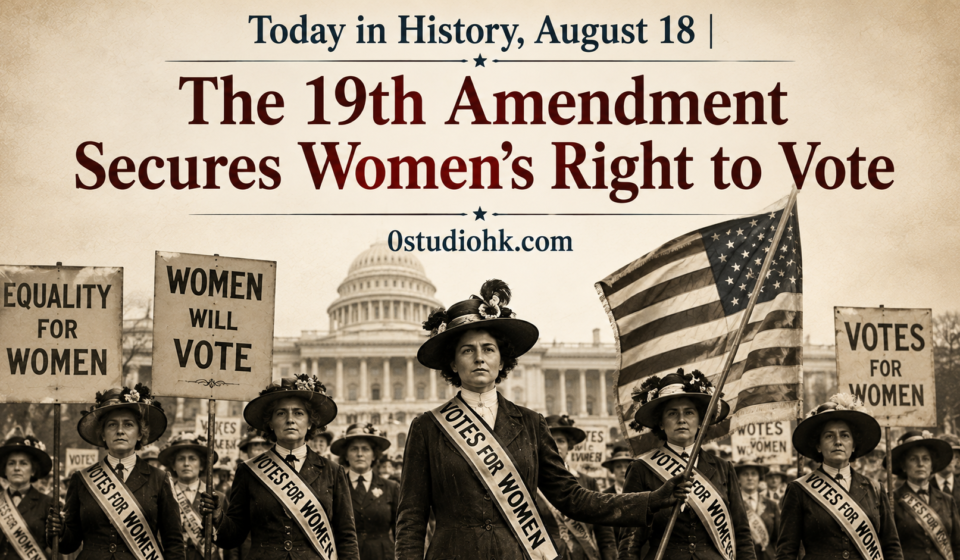
🎵 8月18日今日歷史|美國第十九修正案通過,女性投票權寫入憲法 | Today in History, August 18 | The 19th Amendment Secures Women’s Right to Vote
1920年8月18日,美國田納西州成為通過第十九修正案的關鍵第36個州,使女性投票權修憲案跨過四分之三州批准的門檻。這場歷經數十年的爭取,改變了美國選舉制度,也成為女性爭取政治權利的重要歷史里程碑。
On August 18, 1920, Tennessee became the 36th state to ratify the Nineteenth Amendment, providing the final approval needed for its adoption. The achievement followed decades of campaigning, protest and political organising, creating a landmark change in American democracy while also revealing how much work remained to make voting rights truly inclusive.
中文版本
1920年8月18日,美國歷史迎來一個重要轉折。田納西州議會以極為接近的票數通過美國憲法第十九修正案,成為批准修正案的第36個州,達到憲法要求的四分之三州門檻,令這項保障女性投票權的憲法修正案正式獲得批准。第十九修正案規定,美國公民的投票權不得因性別而被聯邦政府或任何州拒絕或限制。這一天並不是女性突然獲得政治權利的開始,而是經過數十年組織、遊行、請願、遊說、抗議以及社會運動後所取得的重大成果。 美國女性爭取投票權的歷史可以追溯到19世紀。1848年,紐約州Seneca Falls舉行女性權利大會,女性平等與公民權利開始成為更公開的政治議題。此後,多代女性參與者持續推動選舉權改革,有人透過州級法律爭取投票資格,有人向國會請願,有人組織遊行,也有人採取更激烈的抗議方式。這場運動並不是由單一人物完成,而是由不同年代、不同背景的女性共同推動。 到了19世紀後期,女性投票權修憲案開始正式進入美國國會的政治程序。國會於1878年首次提出相關憲法修正案,但此後多年一直沒有取得足夠支持。部分州則選擇自行改革,讓女性在州級選舉中逐步取得投票資格。到1912年,已有九個西部州通過女性投票相關法律。這些州級改革證明女性投票權並非完全無法實現,但全國性的憲法修正仍然需要更長時間的政治協調。 進入20世紀後,女性參政運動逐漸形成更有組織的全國性力量。不同團體開始合作,把目標集中到聯邦憲法修正案。她們採取的方式很多,包括公開演講、遊行、請願、遊說國會,以及在白宮前進行靜默示威。有些抗議者因示威而被捕,部分被拘留的女性甚至以絕食抗議待遇。這些行動使女性投票權問題從少數改革者的訴求,逐漸變成全國政治無法忽視的議題。 第一次世界大戰期間,女性參政運動的政治環境亦開始改變。1917年,紐約州採納女性投票權;1918年,美國總統Woodrow Wilson轉而支持聯邦女性投票權修正案。政治力量逐漸向支持修憲的一方移動。1919年,眾議院通過女性投票權修正案,參議院亦在同年通過,之後修正案送交各州批准。對支持者而言,國會通過只是漫長道路的一個階段,真正的最後關卡是取得足夠數目的州批准。 到1920年夏季,已有35個州批准第十九修正案,只差一個州便能達到當時所需的36州門檻。於是,所有目光集中到田納西州。支持者與反對者都聚集在州首府Nashville,媒體密切報道議會辯論,女性投票權運動的重要人物Carrie Chapman Catt亦親自參與推動。這場表決不只是地方政治問題,而是決定整個美國憲法是否正式承認女性投票權的關鍵一票。 田納西州的表決過程充滿戲劇性。州參議院已經批准修正案,但州眾議院的支持與反對力量十分接近。經過多輪討論後,議員Harry Burn成為關鍵人物。當時他原本被視為反對修正案的一方,但在最終投票前,他收到母親的信件,母親希望他支持女性投票權。Burn最終改變立場,投票支持修正案,使田納西州以僅一票之差通過批准。田納西州因此成為第36個批准第十九修正案的州,令修正案正式跨過憲法要求的門檻。 這場一票之差的表決,後來成為美國女性投票權歷史中最著名的政治時刻之一。1920年8月18日,田納西州的批准使第十九修正案正式成為美國憲法的一部分。國家檔案館記錄指出,修正案是在1919年6月4日由國會通過,並於1920年8月18日完成批准。8月26日,美國國務卿Bainbridge Colby正式認證批准結果,令修正案完成法律程序。 第十九修正案的歷史意義非常深遠。它改變了美國選民的組成,也使女性在全國性的政治選舉中取得憲法層面的投票權保障。1920年秋季的總統選舉,女性首次可以在全國性的憲法保障下參與投票。這不只是增加選民人數,更代表女性由政治制度長期排除在外的地位開始出現根本變化。女性可以透過選票影響總統、國會以及其他公共政策,政治代表性因此進入新的階段。 然而,今天回顧第十九修正案時,也不能簡化成「1920年所有美國女性從此完全享有平等投票權」。實際情況更加複雜。國家檔案館指出,非裔美國女性以及其他少數族裔女性在此後仍然面對不同形式的政治排斥與投票障礙。一項憲法修正案可以改變法律文字,但法律權利能否真正落實,仍然受到州級制度、種族歧視、地方政策及社會環境影響。因此,1920年既是一個重要勝利,也只是更長期投票權平等歷史中的一個階段。 四十多年後,美國國會通過1965年的《投票權法》,進一步建立保護投票權的法律機制,處理包括種族歧視在內的選舉障礙。從這個角度看,1920年的第十九修正案與1965年的投票權立法,其實可以放在同一條漫長的民主發展道路上理解:第一步是把原則寫進憲法,之後則需要持續建立制度,確保這些權利能夠真正落實。 8月18日因此不只是女性歷史的一天,也是美國民主制度發展的重要日期。它提醒我們,政治權利從來不是憑空出現,而是經過長期社會運動與政治博弈才逐步建立。從19世紀的女性權利大會,到20世紀初的遊行和抗議,再到1919年的國會表決,以及1920年田納西州那一票關鍵投票,每一個階段都構成了最後成功的一部分。今天回望這段歷史,我們看到的並不只是一次憲法修正,而是一代又一代人對「誰有權參與民主」這個問題持續提出挑戰的過程。1920年8月18日的真正意義,在於美國憲法正式承認女性不能因性別而被剝奪投票權,並為女性參與國家政治提供新的法律基礎。這項改變影響了美國選舉制度,也成為全球女性政治權利歷史中的重要參考。它同時提醒後人,民主制度的擴展通常不是一次完成,而是在每一代人的努力下逐步向前。
[audiobook title=”8月18日今日歷史” src=”https://pub-0d950852c1b24118b76198710040037c.r2.dev/wp-content/uploads/2026/08/August_18_out.mp3″]
English Version
August 18, 1920, became a landmark date in the history of American democracy. On that day, Tennessee became the 36th state to ratify the Nineteenth Amendment to the United States Constitution, providing the final state approval needed for the amendment to be adopted. The amendment stated that the right of citizens to vote could not be denied or restricted by the United States or by any state on account of sex. Its ratification represented the culmination of decades of campaigning by women’s suffrage activists and fundamentally changed the political landscape of the United States. The struggle had begun long before 1920. During the nineteenth century, women increasingly challenged the legal and political systems that excluded them from voting and other forms of public participation. The 1848 women’s rights convention at Seneca Falls, New York, became one of the most important early milestones in the organised American women’s rights movement. Activists argued that women should have the same basic rights as male citizens, including the ability to participate in elections and influence the government that governed their lives. The movement continued for generations, with different activists adopting different strategies. Some campaigners concentrated on state-level reform. Others sought a federal constitutional amendment. Activists wrote petitions, delivered speeches, organised public meetings, lobbied lawmakers, marched through cities, challenged discriminatory laws in court, and used demonstrations to draw attention to their cause. By the early twentieth century, the campaign had become a national political movement. Nine western states had adopted woman suffrage legislation by 1912, showing that voting rights for women were already becoming a reality in parts of the country even though a nationwide constitutional guarantee remained out of reach. The campaign was often met with determined resistance. Opponents argued that women should not participate in politics or that traditional gender roles would be undermined by female voters. Suffragists responded with increasingly visible public campaigns. Some activists held silent demonstrations outside the White House, while others were arrested for civil disobedience. Some imprisoned women went on hunger strikes and endured forced feeding. These confrontational tactics generated controversy, but they also increased public attention and helped keep the issue of voting rights in the national political debate. Political circumstances began to shift during the 1910s. New York adopted woman suffrage in 1917, while President Woodrow Wilson moved toward support for a federal constitutional amendment in 1918. The major national suffrage organisations increasingly united behind the constitutional strategy. In 1919, Congress finally approved the proposed amendment. The House of Representatives passed it in May, followed by the Senate in June. The amendment was then sent to the states, where approval by three-fourths of the states was required before it could become part of the Constitution. By the summer of 1920, thirty-five states had ratified the amendment. Only one more state was needed. Attention turned to Tennessee, where supporters and opponents gathered in Nashville for an intense political struggle. Newspapers followed the proceedings closely, while national suffrage leaders and large groups of supporters travelled to Tennessee to influence the outcome. The state legislature was now at the centre of a national constitutional battle. The final debate became particularly dramatic because the vote in Tennessee was extremely close. The state Senate had already approved the amendment, but the House remained divided. Representative Harry Burn was regarded as an opponent, but before the decisive vote he received a letter from his mother encouraging him to support ratification. Burn changed his vote and supported the amendment. His decision helped Tennessee approve the measure by a margin of just one vote. Tennessee became the 36th state to ratify the amendment, providing the crucial approval needed to reach the constitutional threshold. The significance of that vote extended far beyond Tennessee. On August 18, 1920, the Nineteenth Amendment was ratified and became part of the Constitution. The National Archives records that Congress had passed the amendment on June 4, 1919, while Tennessee’s ratification on August 18, 1920, completed the required three-fourths approval. The ratification was formally certified by Secretary of State Bainbridge Colby on August 26. The amendment transformed the American electorate. Women could now vote in national elections under a constitutional guarantee that prohibited discrimination in voting rights on the basis of sex. In the presidential election later that year, women across the country participated in a national election with this new constitutional protection. The change represented a major expansion of political participation and demonstrated that a movement once considered radical had succeeded in changing the Constitution itself. Yet the history of August 18 also requires an important qualification. The ratification of the Nineteenth Amendment did not immediately create equal access to voting for every American woman. African American women and other minority women continued to face serious barriers in many parts of the country. Local laws, discriminatory practices and political systems could still prevent people from exercising rights that formally existed under the Constitution. The National Archives therefore emphasises that the struggle to make voting rights meaningful and inclusive continued long after 1920. This distinction is important because constitutional change and social reality do not always move at the same speed. The Nineteenth Amendment established a powerful legal principle, but enforcing that principle required additional political and legal battles. Decades later, the Voting Rights Act of 1965 strengthened federal protections against discriminatory barriers to voting. The history of American voting rights can therefore be understood as a continuing process rather than a single victory. The amendment of 1920 was a major breakthrough, but it was part of a much longer effort to make democratic participation available in practice as well as in law. The story of August 18 also illustrates how political change can depend on persistence over many generations. The women who celebrated the ratification in 1920 inherited a movement built by activists who had begun campaigning decades earlier. Some of the earliest supporters did not live long enough to see the final amendment become law. Others spent years organising campaigns that initially appeared unlikely to succeed. Their efforts created pressure that gradually changed public opinion, state laws and the political calculations of national leaders. The Tennessee vote provides another lesson in the unpredictable nature of political history. After decades of national debate, the constitutional amendment ultimately depended on a single state and, at a critical moment, a single vote. Harry Burn’s decision became famous because it demonstrated how individual choices can influence major historical outcomes. Yet his vote was only the final link in a chain that had been built over generations. Without the decades of organising that came before it, the decisive Tennessee vote would never have been enough. Today, August 18 is remembered as one of the major milestones in the history of women’s political rights in the United States. It represents the moment when the Constitution formally recognised that voting rights could not be denied on the basis of sex. It also demonstrates how democracy can expand through persistent civic action, political negotiation and constitutional change. The achievement did not solve every problem surrounding voting rights, but it permanently altered the meaning of political participation in the United States. Looking back more than a century later, the importance of August 18 lies not only in what happened in Tennessee, but in the generations of people whose efforts made that moment possible. From the early women’s rights conventions of the nineteenth century to the demonstrations and lobbying campaigns of the twentieth, the movement repeatedly challenged the assumption that political participation should be restricted by gender. The ratification of the Nineteenth Amendment transformed that challenge into constitutional law. It stands today as a reminder that democratic rights are often expanded through long, difficult and unfinished struggles. The story of August 18, 1920, is therefore both a story of victory and a reminder that the work of making democracy genuinely inclusive does not end when a law is passed.
總結
1920年8月18日,田納西州成為第36個批准第十九修正案的州,讓女性投票權正式寫入美國憲法。這場歷經數十年的抗爭,成為美國民主發展的重要里程碑。
English
On August 18, 1920, Tennessee supplied the decisive 36th ratification of the Nineteenth Amendment, securing constitutional protection for women’s voting rights. The victory capped decades of activism and marked a major expansion of American democracy.