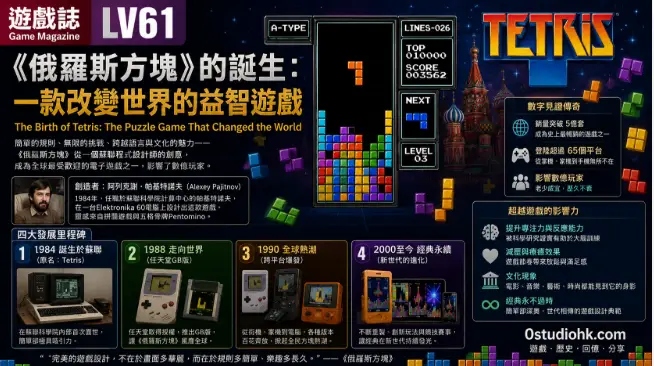
遊戲誌 LV61|《俄羅斯方塊》的誕生:一款改變世界的益智遊戲|Game Magazine LV61 | The Birth of Tetris: The Puzzle Game That Changed the World
1984年6月6日,《俄羅斯方塊》在前蘇聯一間研究所悄然誕生。沒有華麗畫面、沒有音樂、甚至沒有真正的圖形介面,卻憑藉簡單而近乎完美的設計,成為全球最具影響力的益智遊戲之一。
Few games have influenced popular culture like Tetris. Created in the Soviet Union in 1984, the puzzle masterpiece began as a modest programming experiment before becoming one of the best-selling and most recognizable video games of all time.
中文
1984年6月6日,29歲的程式設計師阿列克謝·帕基特諾夫(Alexey Pajitnov)於前蘇聯科學院工作期間,在Elektronika 60電腦上完成了《俄羅斯方塊》的第一個版本。這部電腦沒有圖形晶片,只能顯示文字字元,因此他利用方括號等文字符號組成方塊,創造出玩家今天熟悉的七種四連方塊(Tetromino)。初代《俄羅斯方塊》沒有彩色畫面、沒有背景音樂,也沒有動畫效果,但憑藉簡單而耐玩的玩法,很快就在研究所內廣為流傳。遊戲的創作靈感來自阿列克謝童年喜愛的木製拼圖「Pentomino(五連方塊)」。然而,他並沒有直接把五格拼圖搬進電腦,而是為了讓遊戲規則更簡潔、節奏更流暢,改採由四個小方塊組成的Tetromino,並結合希臘文「Tetra(四)」與自己喜愛的運動「Tennis」,創造出「Tetris」這個名字。1985年,年僅16歲的程式高手Vadim Gerasimov把遊戲移植到IBM PC平台,加入彩色畫面,使《俄羅斯方塊》開始透過磁碟片迅速傳遍莫斯科各大學、研究所及辦公室,成為當時最受歡迎的電腦遊戲之一。然而,由於阿列克謝是在蘇聯科學院工作期間利用公家設備完成遊戲,按照當時蘇聯法律,遊戲版權並不屬於他本人,而是由國營電子進出口公司ELORG統一管理。隨著《俄羅斯方塊》流傳至歐美市場,多家遊戲公司爭奪發行權,引發遊戲史上最著名的版權糾紛之一。直到1991年蘇聯解體後,阿列克謝移居美國,並於1996年與合作夥伴共同成立The Tetris Company,才正式取得遊戲品牌管理權,開始獲得應有的版權收益。雖然1984年的Elektronika 60版才是真正的起點,但真正讓《俄羅斯方塊》征服全世界的,是1989年任天堂將其與Game Boy同捆推出的版本。搭配俄羅斯民謠《Korobeiniki》改編而成的經典背景音樂,以及隨時隨地都能遊玩的掌上體驗,《俄羅斯方塊》迅速風靡全球,Game Boy版本累積銷量超過三千五百萬套,也讓《俄羅斯方塊》成為史上最成功的益智遊戲之一。四十多年過去,《俄羅斯方塊》幾乎登陸所有遊戲平台,其簡潔卻近乎完美的設計,至今仍被視為遊戲設計史上的經典範例,也證明真正偉大的遊戲,不需要複雜畫面,只需要令人停不下來的玩法。
English Version
On June 6, 1984, software engineer Alexey Pajitnov completed the first version of Tetris while working at the Soviet Academy of Sciences. Developed on an Elektronika 60 computer with no graphical display capabilities, the game relied entirely on text characters to represent its falling blocks. Despite lacking colors, sound effects, or animation, the game’s elegant mechanics immediately captured the attention of colleagues and quickly spread throughout research institutes. The inspiration came from Pentomino, a traditional puzzle consisting of five connected squares. Rather than recreating that puzzle directly, Pajitnov simplified the concept by using four-square Tetromino shapes, creating a faster and more accessible game. He combined the Greek prefix “tetra” with his favorite sport, tennis, to create the now-famous name “Tetris.” In 1985, teenage programmer Vadim Gerasimov successfully ported the game to IBM PC, adding color graphics and helping it spread rapidly through universities, laboratories, and offices across Moscow via floppy disks. Because the software had been created using government equipment during Pajitnov’s employment, Soviet law assigned the commercial rights to the state-owned organization ELORG rather than the game’s creator. As Tetris attracted publishers throughout Europe, Japan, and North America, an extraordinary international licensing dispute unfolded, becoming one of the most famous copyright battles in gaming history. Following the collapse of the Soviet Union, Pajitnov moved to the United States and co-founded The Tetris Company in 1996, finally gaining long-awaited control over the brand he had created. Although the original 1984 version marked the birth of Tetris, it was Nintendo’s 1989 Game Boy edition that transformed the puzzle into a worldwide phenomenon. Combined with the unforgettable Korobeiniki melody and the portability of the Game Boy, Tetris reached millions of players and helped define handheld gaming. More than forty years later, Tetris continues to appear on virtually every gaming platform, proving that elegant design and timeless gameplay can outlast generations of technological change.