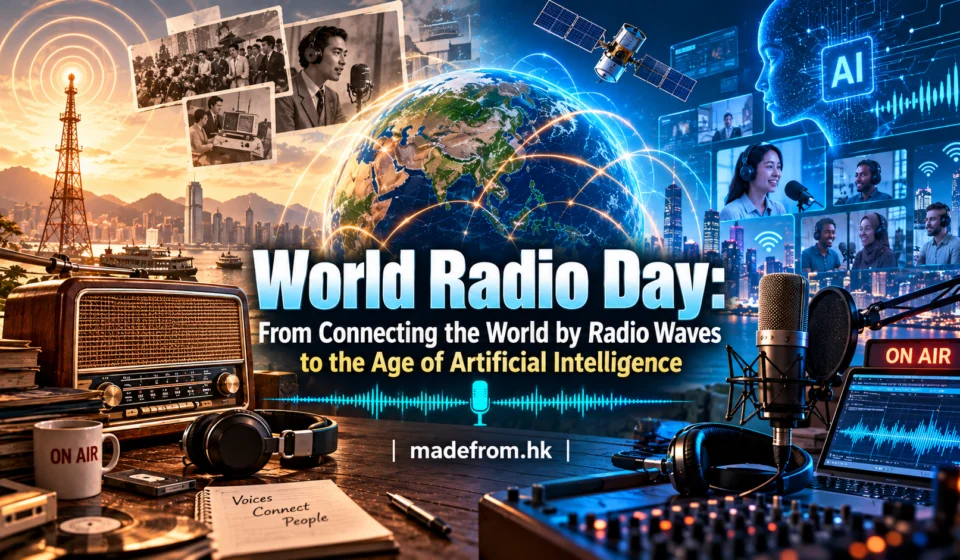
World Radio Day: From Connecting the World by Radio Waves to the Age of Artificial Intelligence
Every February 13, World Radio Day celebrates radio’s enduring ability to connect communities, deliver information and give people a voice across borders.
World Radio Day is observed every February 13, a date established by UNESCO in 2011 and endorsed by the United Nations General Assembly in 2012. The choice of February 13 commemorates the establishment of United Nations Radio in 1946, giving the day a direct connection with the history of international broadcasting and the development of radio as a medium for information, public communication and cultural exchange. Radio may seem like a technology from another era, yet its importance has not disappeared with the arrival of television, the internet, smartphones and streaming platforms. Instead, radio has repeatedly adapted to changing technologies and audiences. From long-distance broadcasts and news programmes to music, education, community broadcasting, internet radio and podcasts, audio continues to offer something distinctive: it can reach people without requiring them to remain focused on a screen. A radio signal can travel across large distances, while relatively simple equipment can provide access to information in places where more advanced communication infrastructure may not always be available. The United Nations highlights radio’s ability to reach diverse communities, including people in remote or vulnerable areas, and recognizes its role in emergency communication, disaster response and public information. This ability to reach people directly is one of the reasons radio has remained relevant for so long. During natural disasters, conflicts, emergencies or disruptions to other communication networks, radio can continue to provide practical information and updates. A broadcast may tell people what has happened, where to seek assistance, what precautions to take or how a community is responding. In such circumstances, radio is not simply entertainment or journalism; it can become part of a community’s communication infrastructure. Radio also has an important social function. It can provide space for different communities, cultures and perspectives to tell their own stories. Local stations can discuss issues that may receive little attention elsewhere, while public-service broadcasters can provide information intended to serve society as a whole. The United Nations describes radio as a platform for democratic dialogue and emphasizes its ability to represent diverse voices. One of the objectives of World Radio Day is therefore to promote awareness of the value of public-service audio and encourage free, independent and pluralistic radio. There is also a deeply personal side to radio. A familiar presenter, a particular programme, a piece of music or a late-night voice can become part of someone’s daily routine. Listeners may forget individual broadcasts, but they may remember how a certain voice accompanied them while driving home, studying, working late or going through an important period of life. Unlike visual media, radio leaves much of the imagery to the listener’s imagination. A voice can create a personal mental picture, making listening an unusually intimate form of communication. The digital revolution has not eliminated this experience. Instead, it has expanded the definition of radio. Live internet streams, mobile applications, podcasts, smart speakers and on-demand audio now allow programmes to reach audiences beyond traditional broadcast frequencies. A radio show can exist simultaneously on air, on a website, through social media and as a podcast, while an online audio programme can adopt many of the production techniques traditionally associated with broadcasting. The boundaries between radio and digital audio have therefore become increasingly fluid. In 2026, World Radio Day places particular attention on another major transformation: artificial intelligence. UNESCO’s 2026 theme is “Radio and Artificial Intelligence”, exploring how AI can influence broadcasting, audio production, accessibility, journalism and the relationship between broadcasters and their audiences. Artificial intelligence can assist with transcription, translation, noise reduction, audio processing, subtitles and other production tasks. It may also help broadcasters reach people who previously faced barriers to accessing audio content. Automatic transcription can make programmes more accessible to people with hearing difficulties, while speech synthesis and translation technologies may allow content to be delivered in more languages and formats. For radio professionals, AI can function as a production assistant, helping organize information, process recordings, analyse material or support editorial workflows. But the arrival of synthetic voices creates an important new question: when machines can reproduce human speech with remarkable realism, how can listeners know whether the voice they hear belongs to a real person or has been artificially generated? This question involves transparency, consent, privacy, copyright, identity and public trust. UNESCO’s 2026 guidance uses the idea “AI is a tool, not a voice”, emphasizing that artificial intelligence should support human creativity and professional judgement rather than silently replacing human identity or misleading audiences. This distinction becomes particularly important in journalism. Broadcasting is not simply about transmitting sound; it is also about whether information is accurate, whether sources have been checked and whether audiences understand where information comes from. In an environment where AI can produce content extremely quickly, speed should not be confused with reliability. Editorial judgement, fact-checking, journalistic ethics and accountability remain essential. UNESCO makes this point clearly: technology itself does not create trust; broadcasters do. World Radio Day therefore remains relevant not only because of the technology of broadcasting, but because of the human relationship behind it. When a community has a local station, when a minority language has access to programming, when young people can tell their stories through audio, or when people in remote areas can receive educational and public information, radio becomes more than a communication system. It becomes part of the social fabric. This is why World Radio Day continues to emphasize diversity, inclusion, access to information and freedom of expression. From United Nations Radio in 1946 to today’s livestreams, podcasts and AI-assisted production, audio media has travelled through a remarkable technological transformation. Production equipment has become smaller and more affordable, distribution has become faster and audiences have become more active. Listeners are no longer simply people waiting for a scheduled programme. They can comment, share, create their own shows and build communities around specific interests. The radio of the future may therefore be less about a single frequency and more about an ecosystem connecting live broadcasting, on-demand audio, podcasts, social platforms and artificial intelligence. Technology will continue to reshape broadcasting, but the fundamental value of radio may remain remarkably familiar: someone speaks, someone listens, information moves, and people connect through stories. World Radio Day is consequently more than a celebration of an old communication technology. It is an opportunity to reconsider what we expect from sound in a rapidly changing media environment. As artificial intelligence becomes capable of generating voices, imitating speech patterns and assisting with production, society must also consider what kind of voices it wants to hear. Should the future simply deliver more content at greater speed, or should technology help create audio that is more trustworthy, accessible, inclusive and genuinely connected to human experience? From the earliest radio transmissions to today’s AI-enabled media, technology has repeatedly changed how information travels, but the human need for knowledge, storytelling, companionship and communication has remained. That may be the enduring lesson of World Radio Day. The medium can change, the devices can change and the production process can change, but as long as people need to speak, people need to listen, and communities need ways to remain connected, radio and audio will continue to have a place in the world.
World Radio Day shows how radio has evolved from traditional broadcasting into a digital and AI-enabled medium. Technology changes how audio is created and delivered, but its human purpose—informing, connecting and giving people a voice—remains.