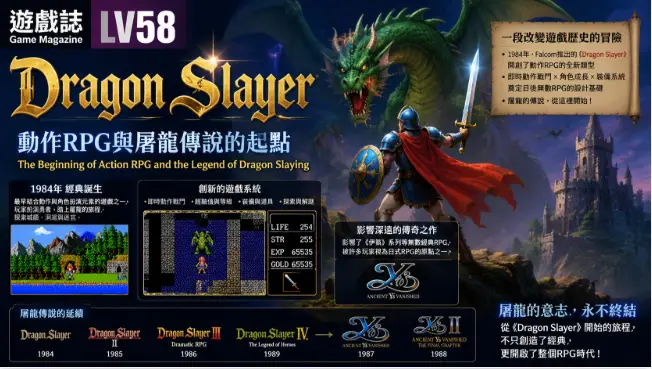
遊戲誌 LV58|Dragon Slayer:動作RPG與屠龍傳說的起點|Game Magazine LV58 | Dragon Slayer: The Beginning of Action RPG and the Dragon-Slaying Legend
在奇幻遊戲世界中,「屠龍」一直象徵著英雄冒險的最高榮耀。然而,真正將屠龍作為遊戲核心目標,並奠定日式動作角色扮演遊戲基礎的,正是1984年Falcom推出的《Dragon Slayer》。這部作品不僅改變了RPG的發展方向,更孕育出《英雄傳說》與《伊蘇》等經典系列。
Long before dragons became a familiar sight in fantasy adventures, one pioneering title built an entire game around defeating a dragon. Released by Falcom in 1984, Dragon Slayer became one of the earliest Action RPGs and laid the foundations for many of Japan’s most influential role-playing franchises.
中文
1984年,日本遊戲公司Falcom推出《Dragon Slayer》,這款作品被公認為日式動作角色扮演遊戲(Action RPG)的重要開山之作,也是最早以屠龍為最終目標的代表性作品之一。當時大部分角色扮演遊戲仍採用回合制或文字指令操作,而《Dragon Slayer》首次把即時戰鬥、角色成長、迷宮探索及解謎元素融合在同一套系統之中,開創了全新的遊戲體驗。這部作品由Falcom傳奇製作人木屋善夫幾乎獨力完成,於1984年9月在NEC PC-8801平台推出,很快便成為日本電腦遊戲史上的經典之作。玩家必須深入地下迷宮,一邊擊敗怪物、一邊搬運魔法十字架(Cross)等道具提升能力,收集散落各地的重要寶物,最終進入龍巢擊敗守護王冠的巨龍,完成整個冒險。雖然今日看來畫面與系統相當簡單,但在四十多年前,它已經成功結合即時操作與角色養成概念,對日後RPG發展產生深遠影響。《Dragon Slayer》另一項重要創新,是採用了後來被稱為「Bump Combat(碰撞戰鬥)」的戰鬥方式。玩家無須按下攻擊鍵,而是利用角色與敵人接觸進行攻擊,站位與方向將直接影響戰鬥結果。這套機制後來成為《伊蘇》系列的重要特色,也深深影響早期日式動作RPG設計。《Dragon Slayer》的成功,讓Falcom並沒有單純推出內容相近的續作,而是把它發展成一個大型系列。每一代《Dragon Slayer》幾乎都採用全新玩法與系統,因此系列作品之間風格差異極大,卻始終保留探索、冒險與角色成長等核心精神。1985年的《Xanadu》創下日本電腦遊戲史空前銷量,成為PC平台最成功的RPG之一;1987年的《Dragon Slayer IV》則登陸任天堂紅白機,以《Legacy of the Wizard》之名在海外廣受歡迎,其龐大的迷宮設計至今仍備受玩家推崇。而系列第六作《Dragon Slayer 英雄傳說》更直接發展成後來的《英雄傳說》系列,最終孕育出今日享譽全球的《軌跡》系列,可說Falcom最重要的RPG王國,皆源自《Dragon Slayer》的成功。談到早期屠龍遊戲,還有另外兩部經典作品同樣不可忽略。1983年的《Dragon’s Lair》利用LaserDisc技術呈現近乎動畫電影般的畫面,玩家扮演騎士Dirk闖入城堡擊敗惡龍Singe拯救公主,被視為互動動畫與快速反應事件(QTE)的先驅之一。1985年NAMCO推出《Dragon Buster》,則融合橫向動作、平台跳躍與角色成長元素,並加入二段跳等創新設計,對後來主機動作遊戲影響深遠。不過,若論真正建立日式Action RPG核心架構,並以完整角色成長、地下城探索與即時戰鬥為設計基礎,《Dragon Slayer》依然具有不可取代的歷史地位。它不只是Falcom最重要的代表作之一,更是《伊蘇》、《英雄傳說》與《軌跡》系列共同的源頭。四十多年過去,《Dragon Slayer》或許已不再為新世代玩家熟悉,但它留下的設計理念仍持續影響現代動作角色扮演遊戲,證明真正的經典,不一定擁有最華麗的畫面,卻能改變整個遊戲產業的發展方向。
English Version
Dragon Slayer occupies a unique place in video game history. Released by Falcom in September 1984 for the NEC PC-8801 computer, it is widely regarded as one of the earliest Japanese action role-playing games and one of the first major titles to build an adventure around defeating a dragon. At a time when most role-playing games relied on turn-based commands or text input, Dragon Slayer introduced real-time combat, character progression, dungeon exploration, and puzzle solving within a single continuous experience. Designed almost entirely by Yoshio Kiya, the game quickly became one of the defining achievements of Japan’s early computer gaming era. Players explored dangerous underground labyrinths, collected magical treasures, strengthened their abilities, and eventually confronted the dragon guarding the kingdom’s legendary crowns. While technically modest by modern standards, the game’s design established principles that would influence countless Japanese RPGs for decades. One of Dragon Slayer’s most important innovations was its real-time collision system, later known as Bump Combat. Instead of pressing an attack button, players defeated enemies simply by making contact, with positioning and movement determining success in battle. This elegant mechanic later became the signature gameplay style of the Ys series and inspired many early Japanese action RPGs. Rather than repeating the same formula, Falcom transformed Dragon Slayer into an experimental franchise where every sequel introduced entirely new mechanics and gameplay concepts. Dragon Slayer II: Xanadu became one of Japan’s best-selling computer RPGs, while Dragon Slayer IV reached Nintendo audiences worldwide under the title Legacy of the Wizard, earning lasting recognition for its interconnected labyrinth design. The sixth installment, Dragon Slayer: The Legend of Heroes, eventually evolved into Falcom’s long-running Legend of Heroes franchise, which later gave birth to the globally acclaimed Trails series. The early era of dragon-themed adventures also included several landmark releases. Dragon’s Lair astonished arcade audiences in 1983 with LaserDisc animation that resembled an interactive cartoon, while Dragon Buster introduced side-scrolling exploration, platforming, and advanced movement mechanics such as double jumping. Nevertheless, Dragon Slayer remains historically significant because it successfully combined exploration, real-time action, character growth, and dungeon progression into one cohesive design. More than four decades after its release, its influence can still be seen throughout the action RPG genre, reminding players that many of today’s greatest adventures trace their origins back to one pioneering dragon-slaying quest released in 1984.