
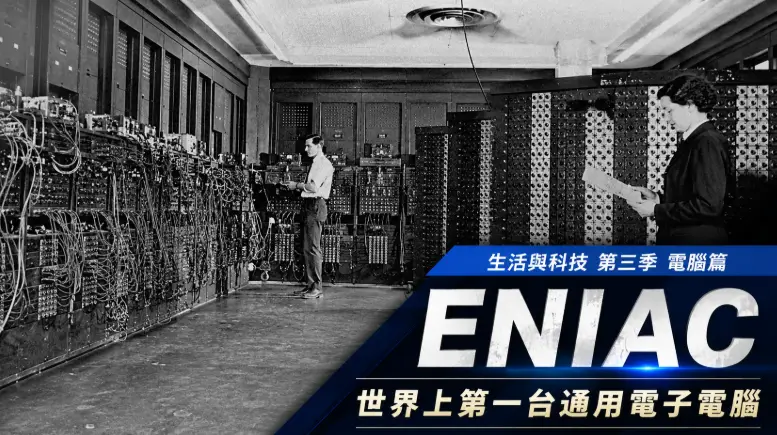
生活與科技 第三季 電腦篇 001|ENIAC:世界上第一台通用電子電腦 | Life and Technology Season 3 Computer Series | ENIAC: The World’s First General-Purpose Electronic Computer
在人類科技發展史上,ENIAC 被視為現代電腦的重要起點。它不但改變了計算方式,也讓電子計算正式進入實用時代。從軍事運算到科學研究,ENIAC 的誕生象徵人類開始進入真正的數位世界。
Long before laptops, smartphones, and cloud computing became part of everyday life, ENIAC marked the beginning of the electronic computing age. Built during World War II, it demonstrated that machines could process complex calculations at unprecedented speed, opening the door to the modern digital era
中文
ENIAC,全名為「Electronic Numerical Integrator and Computer」,中文一般譯作「電子數值積分計算機」。它於1945年完成,1946年正式公開,被普遍認為是世界上第一台通用電子電腦。雖然在ENIAC之前已有一些計算機器存在,但多數屬於機械式或功能有限的專用設備,而ENIAC最大的突破,在於它能夠透過重新設定來執行不同工作,因此被視為「通用電子電腦」的重要起點。ENIAC由美國賓夕法尼亞大學的約翰·莫奇利與約翰·埃克特主導開發,最初用途是協助美軍進行炮彈彈道計算。在第二次世界大戰期間,傳統人工計算速度太慢,而戰場需求卻越來越高,因此軍方希望建立一種更快速的大型電子計算系統。ENIAC就在這種背景下誕生。ENIAC體積極為龐大,佔地超過一百六十平方米,重量超過三十公噸,內部使用超過一萬七千支真空管。當機器運作時,會產生大量熱力,因此需要大型冷卻設備。它的耗電量亦非常驚人,甚至有傳聞指每次啟動時都會令附近地區燈光變暗。雖然這些說法帶有誇張成分,但也反映出早期電子電腦的巨大規模。與現代電腦相比,ENIAC的性能其實相當有限。今天一部普通手機的運算能力,已遠遠超越ENIAC。然而在當時,它的速度已經震撼世界。過去需要數小時甚至數天完成的數學運算,ENIAC可以在短時間內完成。這種高速電子計算能力,首次讓人類真正看到電子電腦的潛力。ENIAC的操作方式亦與現代電腦截然不同。今天的電腦只需輸入程式即可執行工作,但ENIAC需要工程師手動插拔電線、調整開關與重新配置系統。每次改變工作內容,都可能需要數小時甚至數天才能重新設定完成。即使如此,它仍然比人工計算快得多,因此在當時被視為革命性技術。ENIAC除了軍事用途之外,也曾被應用於天氣研究、核能計算與科學實驗。它證明電子計算不只適合軍事,更能推動整個科學與工程世界發展。後來許多電腦技術,包括儲存程式概念、電子邏輯設計以及大型計算系統,都受到ENIAC影響。值得一提的是,ENIAC背後亦有一群女性程式設計員參與操作與編程工作。她們負責研究如何利用這部巨大機器完成不同計算,但在很長時間裡,她們的貢獻並未受到重視。直到後來,歷史學界才逐漸重新認識這批早期女性程式員的重要地位。ENIAC最終於1955年正式退役,但它留下的影響卻深遠無比。今天我們所使用的電腦、手機、網絡與人工智能,其實都能追溯到這部龐大的電子計算機。它不只是科技產品,更象徵人類開始以電子方式處理資訊的歷史轉折點。從真空管到晶片,從大型機房到掌上裝置,ENIAC開啟了整個資訊時代的大門。
English Version
ENIAC, short for Electronic Numerical Integrator and Computer, is widely recognized as the world’s first general-purpose electronic computer. Completed in 1945 and officially unveiled in 1946, it represented a major leap beyond earlier mechanical calculating devices. Previous machines could perform limited tasks, but ENIAC introduced the idea that a machine could be reconfigured to solve different kinds of problems, making it a true milestone in computing history. The machine was developed at the University of Pennsylvania by John Mauchly and J. Presper Eckert during World War II. Its original purpose was to help the United States Army calculate artillery firing tables more efficiently. At the time, complex calculations were performed manually, often requiring enormous amounts of time and manpower. Military planners needed faster mathematical processing, and ENIAC became the answer to that challenge. Physically, ENIAC was enormous. It occupied a massive room, weighed over thirty tons, and contained more than seventeen thousand vacuum tubes. The system generated extreme heat while operating, requiring extensive cooling equipment to keep it functioning properly. Its electrical consumption was so high that stories circulated about nearby lights dimming whenever the machine powered on. Whether exaggerated or not, such stories reflected the incredible scale of early electronic computing technology. By modern standards, ENIAC’s computing power appears tiny. A modern smartphone can perform calculations millions of times faster. Yet during the 1940s, ENIAC’s speed was astonishing. Problems that previously required days of human calculation could suddenly be completed within minutes. This dramatic improvement proved that electronic computation could transform science, engineering, and military operations. Programming ENIAC was also very different from using a modern computer. Instead of writing software on a screen, engineers physically rewired the machine using cables, switches, and plugboards. Reconfiguring ENIAC for a new task could take hours or even days. Despite this complexity, the machine still saved enormous amounts of time compared to traditional manual calculations. Beyond military applications, ENIAC later contributed to weather forecasting, nuclear research, and scientific studies. It demonstrated that electronic computers could support many different fields, not just warfare. The ideas developed during the ENIAC project influenced future computer architecture, including stored-program systems and large-scale digital processing. An often-overlooked part of ENIAC’s history involves the women who programmed the machine. These early programmers developed methods for configuring and operating the system, yet their contributions remained largely unrecognized for decades. Modern historians now view them as pioneers of computer programming and an essential part of computing history. ENIAC officially retired in 1955, but its legacy continues to shape the modern world. Every computer, smartphone, cloud network, and artificial intelligence system can trace part of its history back to this groundbreaking machine. ENIAC was more than a wartime invention—it marked the beginning of humanity’s transition into the digital age and laid the foundation for the technological world we know today.
總結
中文
ENIAC不只是世界上第一台通用電子電腦,更是現代資訊科技的重要起點。它讓電子計算由理論變成現實,也開啟了人類進入數位時代的大門,對後世電腦科技影響深遠。
English Version
ENIAC was not simply an early machine; it was the foundation of modern computing. By proving the power of electronic calculation, it transformed technology forever and paved the way for the digital systems that now shape everyday life around the world.