在古希臘的雅典,柏拉圖建立了影響兩千年的哲學體系,從理念論到理想國,他不僅塑造了哲學,也深刻影響政治、教育與文化。
In ancient Athens, Plato built a philosophical system that shaped two millennia, from the Theory of Forms to the ideal state, influencing politics, education, and culture.
中文
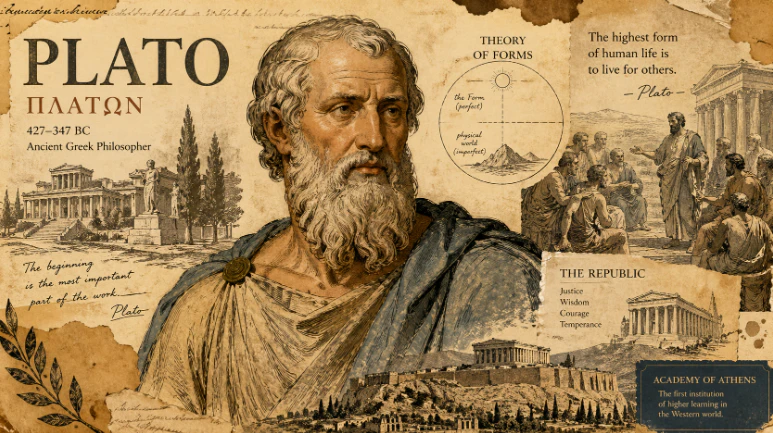
在古希臘文明的黃金時代,雅典不僅是政治與藝術的中心,更是思想激盪的搖籃,而柏拉圖正是在這樣的環境中成長並發展出影響深遠的哲學體系。柏拉圖出生於貴族家庭,年輕時曾受教於蘇格拉底,其思想深受老師啟發,尤其是對真理與道德的追求。然而,當蘇格拉底被雅典民主制度判處死刑後,柏拉圖對政治產生深刻懷疑,這一事件成為他哲學轉向的重要契機。他認為,多數人的意見並不等於真理,真正的知識來自理性與智慧,因此他提出「理念論」,主張現實世界只是理想世界的影子,真正的本質存在於不可見的理念之中。柏拉圖在其著作《理想國》中進一步描繪一個理性統治的社會,他認為國家應由哲學家統治,因為只有哲學家具備追求真理與理解善的能力,這種「哲人王」的概念成為後世政治哲學的重要基礎。在教育方面,柏拉圖創立了西方最早的高等學府之一——學院(Academy),強調數學、哲學與邏輯的訓練,培養理性思考能力,這種教育模式影響了整個西方教育體系的發展。雅典的公共辯論文化與開放思想環境,使柏拉圖得以發展對話體寫作風格,透過人物對話探討真理,使哲學更具生命力與思辨性。他的學生中最著名的是亞里斯多德,後者雖然在某些觀點上反對老師,但仍延續並發展了柏拉圖的思想,使古希臘哲學達到高峰。柏拉圖的思想不僅停留在哲學領域,更滲透至政治理論、倫理學、形而上學與美學之中,成為西方思想的基石。即使在今日,我們對正義、真理與理想社會的思考,仍然可以看到柏拉圖的影子,而雅典這座城市,也因此被視為哲學誕生的象徵之地。
English Version
During the golden age of ancient Greece, Athens stood not only as a political and artistic center but also as a cradle of intellectual exploration, and it was within this dynamic environment that Plato developed one of the most influential philosophical systems in history. Born into an aristocratic family, Plato was initially drawn to politics, but his life took a decisive turn when he became a student of Socrates, whose method of questioning and pursuit of moral truth profoundly shaped his thinking. The execution of Socrates by the Athenian democracy deeply disillusioned Plato, leading him to question the reliability of popular opinion and the justice of political systems driven by the masses. This pivotal moment pushed him toward philosophy as a means of seeking absolute truth beyond the instability of human governance. Plato introduced the Theory of Forms, proposing that the physical world is merely a shadow of a higher, unchanging reality composed of perfect forms or ideas. According to this view, true knowledge is not derived from sensory experience but from intellectual understanding of these eternal forms. In his seminal work “The Republic,” Plato envisioned an ideal society governed by philosopher-kings, individuals uniquely equipped with wisdom and rational insight to rule justly. This concept challenged existing political norms and laid the foundation for centuries of political philosophy. Plato also established the Academy in Athens, widely regarded as the first institution of higher learning in the Western world, where subjects such as mathematics, philosophy, and logic were taught in a structured and rigorous manner. This educational model emphasized critical thinking and intellectual discipline, influencing Western education for generations. The vibrant culture of debate and dialogue in Athens enabled Plato to adopt a dialogical writing style, presenting philosophical ideas through conversations that explored complex questions about justice, knowledge, and existence. Among his students, Aristotle would become one of the most significant figures in philosophy, expanding and sometimes challenging Plato’s ideas while preserving their intellectual legacy. Plato’s influence extends far beyond philosophy, shaping fields such as political theory, ethics, metaphysics, and aesthetics. Even in modern times, discussions about justice, truth, and the ideal society continue to reflect Platonic thought, and Athens remains a powerful symbol of the birth of philosophical inquiry and intellectual tradition.