《山海經 051(哲學與象徵)》古代中國的宇宙觀:天地如何運作 Ancient Chinese Cosmology: How the Universe Works
古代中國對宇宙的理解融合神話與哲學,從陰陽五行到天人合一,描繪出一個運行有序、彼此相連的天地系統,展現人與宇宙之間的深刻關係。
Ancient Chinese cosmology blends myth and philosophy, presenting a universe governed by balance, cycles, and connection, where humanity and nature exist as parts of a unified and meaningful whole.
中文
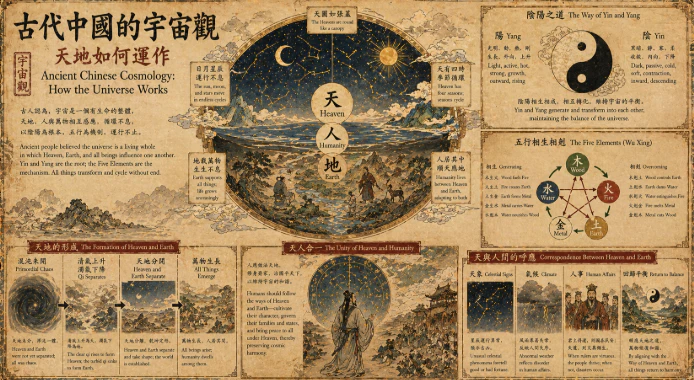
在遠古的想像之中,天地並非冰冷無聲的空間,而是一個充滿生命與秩序的整體。最初,世界處於混沌狀態,陰與陽尚未分化,一切如同未開的畫卷。隨著氣的流動,清氣上升為天,濁氣下沉為地,天地於是分離而成。這不是一次劇烈的爆發,而是一種緩慢而自然的展開,如同呼吸般延續。天在上,運行不息,日月星辰循環往復;地在下,承載萬物,山川河流各得其所。人則居於天地之間,既受其影響,也參與其運作。陰陽之理成為理解宇宙的核心,光與暗、動與靜、剛與柔,彼此對立卻又互補,構成萬物變化的基礎。當陽氣盛時,萬物生長;當陰氣增強,萬物收斂。四季更替,晝夜循環,皆源於這種平衡的轉換。進一步,五行的觀念將宇宙分為木、火、土、金、水五種基本力量,它們並非靜止,而是在相生相剋中推動世界運行。木生火,火生土,土生金,金生水,水生木,形成循環;同時,木剋土,土剋水,水剋火,火剋金,金剋木,維持制衡。這種動態關係使宇宙既穩定又充滿變化。古人觀察自然,將天象與人事相連,認為天的變化會影響人間的命運。當星辰異動,可能預示吉凶;當氣候失常,則反映人間秩序的紊亂。因此,統治者被視為天命的承載者,其行為需符合天地之道,才能維持世界的和諧。這種思想延伸為「天人合一」,強調人與自然不可分割。人不應征服天地,而應順應其規律,與之共存。山川被視為有靈之地,風雨被理解為氣的流動,萬物皆有其位置與意義。在這樣的宇宙觀中,世界不是由單一力量主導,而是由多重關係構成的網絡。每一個變化都影響整體,每一個存在都與他者相連。這種理解方式讓古人以敬畏之心面對自然,也在混亂中尋找秩序。即使面對災難,他們也相信只要回歸平衡,世界便能重新運作。這不僅是一種對宇宙的解釋,更是一種生活的指引。人如何行事,如何與他人相處,如何面對環境,都在這套宇宙觀中找到答案。天地不只是背景,而是持續運行的生命系統,而人,正是其中的一部分。
English Version
In ancient Chinese thought, the universe was never imagined as an empty expanse governed solely by physical laws. Instead, it was perceived as a living system shaped by rhythm, balance, and interconnected forces. In the beginning, all things existed in a unified state of chaos, where distinctions had yet to emerge. Gradually, through the movement of vital energy, clarity rose upward to form the heavens while density settled below to become the earth. This separation was not abrupt, but a natural unfolding, like a slow and continuous breath. The sky above became a realm of motion, where celestial bodies traced predictable paths, while the earth below offered structure and support to all living things. Humanity occupied a unique position between these realms, both influenced by and participating in their dynamics. At the heart of this worldview lies the concept of yin and yang—complementary forces that define change. Light and darkness, activity and stillness, strength and softness exist not in opposition alone, but in mutual dependence. Their interaction drives the cycles of nature: the growth of spring, the heat of summer, the decline of autumn, and the stillness of winter. Building upon this duality is the system of the Five Elements—wood, fire, earth, metal, and water—which represent dynamic processes rather than static substances. These elements generate and restrain one another in continuous cycles, ensuring that no single force dominates indefinitely. Through these interactions, the universe maintains both stability and transformation. Ancient observers extended these patterns to human affairs, believing that cosmic changes were reflected in earthly events. Unusual celestial phenomena might signal shifts in fortune, while environmental imbalance could mirror disorder within society. Rulers, therefore, were seen as intermediaries between heaven and earth, responsible for maintaining harmony through moral and just governance. This idea evolved into the principle of unity between humanity and the cosmos—a belief that humans should align themselves with natural rhythms rather than attempt to control them. Mountains, rivers, winds, and rain were all expressions of the same vital force, each playing a role in the greater system. In this worldview, existence is relational. Nothing stands alone; every action resonates across the whole. This perspective encouraged a sense of humility and respect toward the natural world, as well as a search for balance in times of disruption. Even in the face of chaos, there remained a belief that harmony could be restored by realigning with the underlying order of the universe. Thus, ancient Chinese cosmology was not only an explanation of how the universe works, but also a guide for how to live within it—with awareness, balance, and a deep sense of connection.