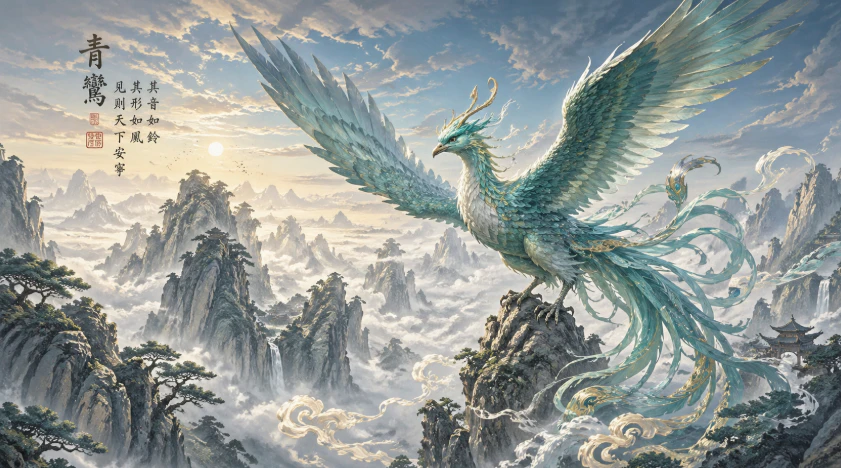
青鸞是《山海經》中極具象徵意義的神鳥,常被視為吉祥與純淨的化身。其形象與鳳凰相近,卻更帶神秘與靈性,象徵天地和諧與理想境界的存在。
The Qingluan, a mythical bird from the Shan Hai Jing, embodies purity, harmony, and auspicious meaning. Often compared to the phoenix, it carries a quieter, more mystical presence, symbolizing a refined balance between heaven and earth.
中文
在遠古未名的山海之間,天地尚未完全分明,風與雲仍在交錯流動,一種被稱為青鸞的神鳥棲息於高不可及的靈山之巔。它的羽翼如晨曦初開時的青光,帶著一種柔和而不刺眼的光澤,彷彿將天地間最純粹的色彩凝聚其中。當它展翅之時,空氣會泛起微微的波紋,如水面被輕輕觸動,萬物也隨之安靜下來。傳說中,青鸞並不輕易現身,它只在天地氣息調和、萬物各得其所之時才會出現,因此人們視其為祥瑞的象徵。古人相信,若有人能見到青鸞,必然意味著時運清明、天下太平。與其他神獸不同,青鸞並不象徵力量或威嚴,而是一種更深層的秩序與和諧,它的存在如同一段無聲的樂章,在天地之間緩緩流轉。有說青鸞與鳳凰同源,但鳳凰偏於盛世的榮耀與顯赫,而青鸞則更接近隱世的純淨與靜謐,它不爭、不顯,只在最恰當的時刻輕輕掠過人間。有一位旅人曾在群山深處迷失方向,饑渴與恐懼逐漸侵蝕他的意志,正當他以為生命將在荒野中終結之時,一抹青色的光影從林間飛過,那並非耀眼的光,而是一種溫柔的指引。旅人隨著那道光前行,竟意外走出了迷途。回望之時,青鸞已消失無蹤,只留下風中淡淡的羽影。自此之後,他再未向他人證明那段經歷,因為他明白,那並非凡人可以輕易觸及的存在。青鸞的傳說因此流傳於世,但它從未真正屬於人間,它更像是一種理想,一種對世界平衡與內心純淨的追尋。當人們仰望天空,或許看見的不是青鸞本身,而是對那份安寧與和諧的渴望。
English Version
In a time before the world settled into clear boundaries, when mountains and seas still breathed together in shifting forms, there lived a celestial bird known as the Qingluan. It dwelled atop unreachable peaks, where mist wrapped the cliffs and silence carried a subtle presence. Its feathers shimmered in shades of soft blue-green, like the first light of dawn spreading gently across the sky. Unlike blazing creatures of legend, its glow was calm and restrained, as if it carried the quiet essence of the natural order itself. Whenever it spread its wings, the air seemed to ripple, not violently but with a delicate resonance that soothed the surroundings. Creatures would grow still, and even the wind would soften, as though acknowledging its presence. The Qingluan did not appear often. It revealed itself only when the world was in balance—when seasons flowed correctly, when hearts were untroubled, and when chaos had momentarily withdrawn. Because of this, it became a symbol of harmony and auspicious fortune. People believed that witnessing the Qingluan was not merely luck, but a sign that one had entered a moment where heaven and earth aligned. Though often associated with the phoenix, the Qingluan carries a different meaning. The phoenix represents grandeur, renewal, and imperial glory, while the Qingluan embodies subtlety, spiritual clarity, and quiet perfection. It does not seek attention, nor does it dominate the skies. Instead, it exists like a hidden melody—present, yet elusive. There is a tale of a wanderer who lost his way deep within ancient mountains. Exhaustion clouded his mind, and fear began to take hold as night approached. Just as despair seemed inevitable, a faint blue light passed through the forest. It did not dazzle, but guided. Drawn by instinct, the wanderer followed it, step by step, until he emerged from the wilderness. When he turned to look back, the light had vanished, leaving only a whisper in the wind. He never tried to convince others of what he had seen, for he understood that such encounters belong to a realm beyond proof. The Qingluan remains less a creature of the physical world and more a reflection of an ideal—a vision of harmony, purity, and quiet balance. When people gaze at the sky, perhaps they are not searching for the bird itself, but for the peace it represents.