Today in History: September 15 – Liverpool Railway, Agatha Christie, and World Events
September 15 connects railway innovation, literature, democracy and public participation in the making of modern life.
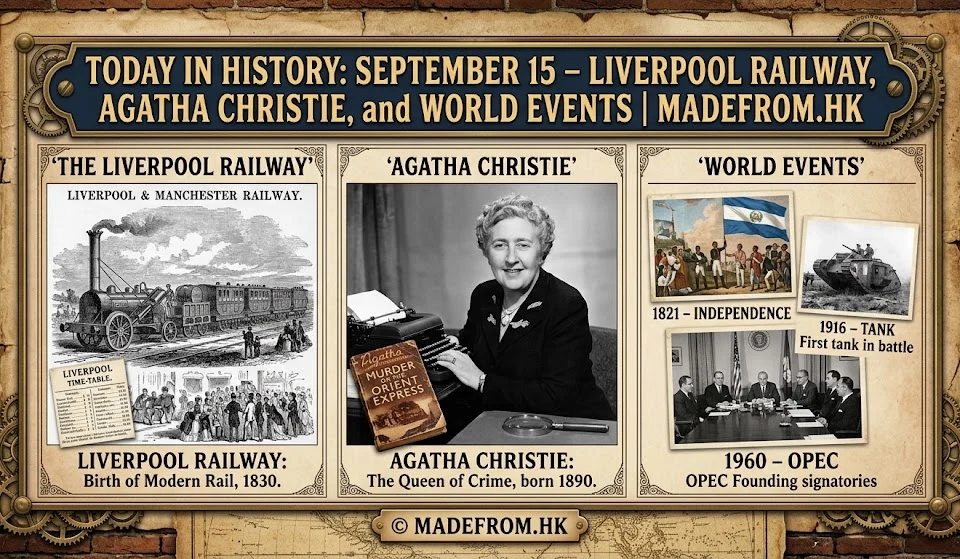
September 15 offers a fascinating view of modern life through transportation, literature, public institutions and civic participation. Rather than focusing only on dramatic political events, the date allows us to see how ordinary systems and ideas gradually changed the way people lived. One of the most important developments associated with September 15 occurred in Britain in 1830, when the Liverpool and Manchester Railway officially opened. The railway connected two major industrial centres and became an important milestone in the development of modern railway transport. Liverpool was a major port, while Manchester was one of Britain’s most important industrial cities. A reliable railway connection allowed people, goods and information to move between them much more efficiently. The opening attracted enormous public attention, and eight trains took part in the inaugural celebrations. The Duke of Wellington and other prominent figures were among the passengers and guests. The significance of the railway went far beyond the opening ceremony itself. Railways changed people’s understanding of distance and time. Trains had to operate according to timetables, encouraging businesses and communities to organise their activities around increasingly precise schedules. A journey that once depended on roads, horses and uncertain travel times could now be planned around a railway timetable. The Liverpool and Manchester line therefore represented an important step towards the connected, mobile society that we recognise today. Modern commuters may think nothing of travelling between cities for work, education or leisure, but such mobility was once a remarkable technological development. Railways helped create the idea that cities could be physically closer even when they remained many miles apart. September 15 is also the birthday of one of the world’s most famous writers of detective fiction, Agatha Christie. Born in 1890, Christie became one of the most successful and influential mystery writers of the twentieth century. She created two of the best-known fictional detectives, Hercule Poirot and Miss Marple, and wrote internationally famous novels including “Murder on the Orient Express,” “Death on the Nile” and “And Then There Were None.” Her books have continued to attract readers around the world for generations. One reason for Christie’s lasting popularity is the way her stories invite readers to become part of the investigation. The reader is given clues, suspicious characters, misleading information and carefully constructed details, and is encouraged to work out the solution before the detective reveals it. Her novels therefore turn reading into a form of participation. The reader is not simply watching the story unfold; the reader is trying to solve the mystery. This structure has allowed her books to remain popular across different cultures and generations. The date is also associated with William Howard Taft, who was born on September 15, 1857. Taft later became the 27th President of the United States and, after his presidency, served as Chief Justice of the United States. He remains a distinctive figure in American public life because he held both of these major positions. His career reflected the growing importance of law, government administration and public institutions in the United States during the late nineteenth and early twentieth centuries. Another major development associated with September 15 is much more recent: the International Day of Democracy. In 2007, the United Nations General Assembly adopted a resolution declaring September 15 the International Day of Democracy. The purpose was to promote and uphold the principles of democracy and encourage public awareness of democratic institutions and participation. The first International Day of Democracy was observed in 2008. The Inter-Parliamentary Union has also promoted the day as an opportunity to examine the state of democracy and the role of parliaments. Activities around the world have included exhibitions, workshops, public discussions, competitions, broadcasts and programmes designed to encourage citizens to engage with democratic ideas. Democracy is not simply about elections. It also involves participation in public life, the ability to express opinions, access to information and the opportunity for citizens to influence the systems that govern their communities. The United Nations resolution emphasised democracy as a universal value based on the freely expressed will of people and their participation in political, economic, social and cultural life. Seen from this perspective, September 15 has an interesting common theme: participation and connection. The railway connected cities and made movement easier. Agatha Christie connected writers and readers through the shared experience of solving a mystery. Democracy connects citizens with public institutions and decision-making. These events belong to completely different areas of history, yet all of them involve people becoming part of something larger than themselves. The railway created a new physical network. Literature created an imaginative network between author and reader. Democratic institutions created a civic network linking individuals with their communities and governments. September 15 therefore provides an opportunity to look at history through everyday experiences. A railway opening may appear to be an engineering event, but it can change the way people work, travel and conduct business. A novel may seem like entertainment, but it can create characters and ideas that remain part of global culture for generations. An international observance may seem symbolic, but it can encourage people to think about their rights, responsibilities and role in society. This is one reason history is more than a collection of famous dates. The systems that shape modern life are often built gradually. In 1830, the people watching the first trains between Liverpool and Manchester could not have known how completely railways would transform travel and commerce. When Agatha Christie began writing detective stories, she could not have known that her characters would become international cultural icons. When the United Nations established the International Day of Democracy, it was creating a recurring opportunity for societies around the world to reflect on participation and democratic values. Each event began at a particular moment, but its influence extended far beyond that day. Today, the legacy of September 15 can be seen in ordinary life. We travel through transport networks that developed from early railway systems. We continue to read detective stories built around the kind of clues and puzzles Christie popularised. We live in societies where questions about representation, participation and public responsibility remain part of everyday discussion. The date therefore connects technology, culture and civic life in a surprisingly natural way. It reminds us that modern society is not the result of one invention or one decision. It is the product of countless developments that accumulated over generations. Railways made physical connections stronger. Literature created connections across languages and time. Democratic institutions created systems through which citizens could participate in public affairs. September 15 is therefore a useful reminder that some of the most important changes in history begin as ordinary ideas. A new railway timetable, a new detective novel or a new international observance may seem small when it first appears. Yet if the idea meets a genuine need or captures the imagination of society, it can last for generations. That is the quiet power of history. The world we know today is filled with things that were once new, experimental and uncertain. September 15 gives us a chance to look back at some of those moments and understand how they helped shape modern life. From railway stations to bookshelves, and from public institutions to international observances, the stories of this date show that history is not only about the past. It is also about the foundations of the world in which we live today.
September 15 shows how transport, literature and democratic participation have connected people and gradually shaped modern society.