September 16 in History|From the Bank of England and Ford to the Formation of Malaysia
September 16 connects finance, industry, urban life and nation-building in the development of the modern world.
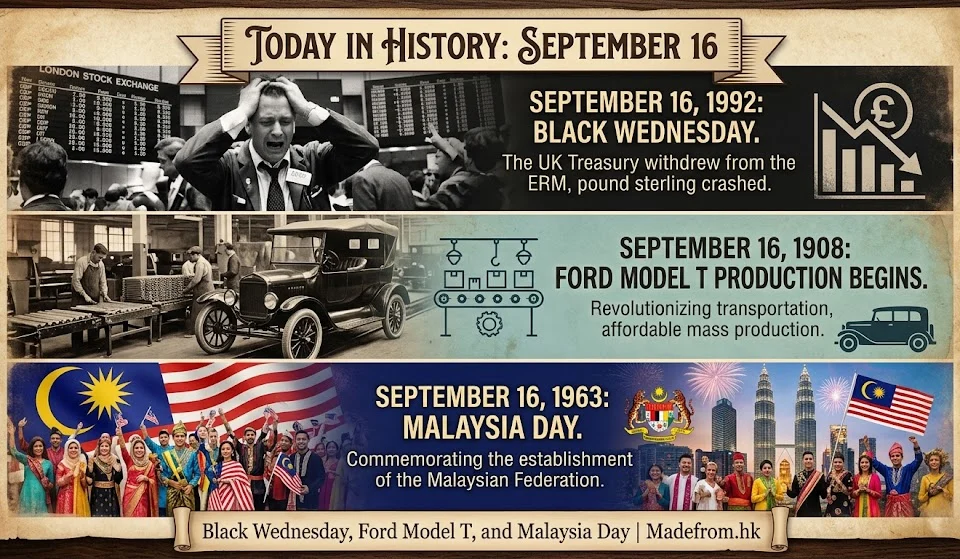
September 16 provides an interesting way to explore how modern life has been built through finance, industry, national development, culture and international cooperation. The date is not simply a collection of major political anniversaries. It also reminds us that many of the systems we take for granted today were once new ideas that gradually transformed society. One of the earliest examples is the foundation of the Bank of England in 1694. The institution was established at a time when the English government needed a more reliable way to raise finance. William Paterson and his supporters helped create the bank, which provided a substantial loan to the government. Over the following centuries, the Bank of England became one of the central institutions of the British financial system and eventually took on major responsibilities relating to monetary policy, banking stability and the wider economy. For most people, a central bank can seem distant from everyday life, but its influence can be felt through interest rates, currency, banking confidence and financial stability. The creation of the Bank of England therefore represents an important stage in the development of the modern financial world. Another transformation associated with September 16 can be found in the development of industrial manufacturing and transport. The early twentieth century was a period when automobiles were gradually changing from expensive products for wealthy customers into goods that could eventually reach a much wider market. Ford Motor Company, established in 1903, played a major role in this transformation. In 1908, the company introduced the Model T, and the development of standardised production and assembly-line manufacturing helped make mass-produced cars increasingly affordable. The consequences extended far beyond the factory. As car ownership expanded, societies needed new roads, petrol stations, parking facilities, traffic systems and forms of suburban development. The automobile changed where people lived, where they worked and how they travelled. The modern expectation that a person can drive to work, go shopping in another district or travel between cities is closely connected with this industrial transformation. September 16 also marks an important date in the development of a modern nation in Southeast Asia. On September 16, 1963, Malaysia was formally established, bringing together the Federation of Malaya, Sabah, Sarawak and Singapore in a new federation. Singapore later left the federation in 1965 and became an independent country, but September 16 remains a fundamental date in Malaysian history. Malaysia now observes September 16 as Malaysia Day, a national occasion that commemorates the formation of the federation.The creation of Malaysia is particularly interesting because it involved bringing together territories with different histories, communities, languages, religions and cultural traditions. Nation-building is rarely just a matter of drawing a border or announcing a new government. It involves institutions, identities, negotiations and the continuing process of creating a shared sense of belonging. September 16 therefore provides a useful window into the complexity of modern Southeast Asian history. The date is also associated with an important figure in twentieth-century music. B. B. King was born on September 16, 1925, and went on to become one of the most influential blues musicians of his generation. His distinctive guitar playing, expressive singing and long musical career helped bring the blues to audiences far beyond its traditional American roots. His famous guitar, “Lucille,” became closely associated with his identity as a performer. King’s career demonstrates how culture can cross borders through technology and mass media. Blues developed within specific communities and historical circumstances in the United States, but recordings, radio, concerts and the international music industry allowed its sound to reach audiences around the world. The influence of blues can subsequently be heard in rock, soul, jazz and many forms of popular music. A musical tradition that once belonged strongly to particular communities became part of a much wider global cultural language. September 16 also has an important environmental dimension. On September 16, 1987, countries adopted the Montreal Protocol on Substances that Deplete the Ozone Layer. The agreement established a framework for reducing and eventually eliminating many substances responsible for damaging the ozone layer. It later became widely regarded as one of the most successful examples of international environmental cooperation. The ozone layer is invisible, but it plays a crucial role by absorbing much of the Sun’s harmful ultraviolet radiation. Protecting it therefore has direct implications for human health, ecosystems and the wider environment. The United Nations observes September 16 as the International Day for the Preservation of the Ozone Layer, using the date to promote awareness of environmental protection and international cooperation. The Montreal Protocol is particularly significant because ozone depletion was not a problem that any single country could solve alone. The atmosphere crosses national boundaries, meaning that international scientific cooperation, industrial changes and government policy all needed to work together. The agreement demonstrates how global environmental problems can encourage countries to create shared solutions. There is an interesting connection between the two major observances associated with September 16: Malaysia Day concerns the creation of a national community, while the International Day for the Preservation of the Ozone Layer concerns cooperation across national borders. One focuses on building a shared identity within a country; the other reminds us that some problems are shared by the entire planet. Seen together, they reveal an important feature of modern history: people increasingly live within networks that extend far beyond their immediate surroundings. Finance connects businesses and consumers. Cars connect cities and regions. Nations create political communities. Music connects cultures. Environmental agreements connect governments in response to problems that ignore borders. September 16 is therefore a day about connection in many different forms. The Bank of England represents financial connections and institutions. The automobile represents physical mobility. Malaysia’s formation represents political and social integration. B. B. King’s music represents cultural exchange. The Montreal Protocol represents international cooperation. None of these developments appeared overnight. Each emerged from particular circumstances and gradually became part of the modern world. Today, people transfer money through banks without thinking about the centuries of financial development behind the system. We drive along roads designed for a world transformed by mass automobile ownership. We listen to music created in cultures far from our own. We live under national institutions whose origins may reach back decades or centuries. We also benefit from international environmental agreements whose success is easy to overlook precisely because the problem they addressed can become less visible when cooperation works. This is why September 16 is worth remembering. It shows that history is not only about famous leaders or dramatic moments. It is also about institutions, technologies, cultural movements and international agreements that quietly reshape everyday life. A bank can influence the economy. A factory can transform transport. A new federation can create a national identity. A musician can carry a regional tradition around the world. An environmental treaty can protect a part of the atmosphere shared by everyone. These are different stories, but together they reveal how the modern world has been constructed through networks of cooperation and connection. September 16 therefore offers a useful reminder that many of the things we consider normal today were once new, uncertain or experimental. Over time, successful ideas become invisible because they become ordinary. The calendar tells us what day it is, banks organise financial activity, cars make long-distance travel routine, music crosses cultural boundaries, and international agreements address environmental problems that no country can solve alone. History allows us to look behind these everyday realities and understand where they came from. September 16 is, in that sense, not simply a date filled with anniversaries. It is a snapshot of the continuing process through which human societies organise themselves, build connections and respond to a changing world.
September 16 shows how finance, mobility, nations, music and environmental cooperation have connected societies and shaped everyday life.